The Planning Board rules on “2 Washington Street“
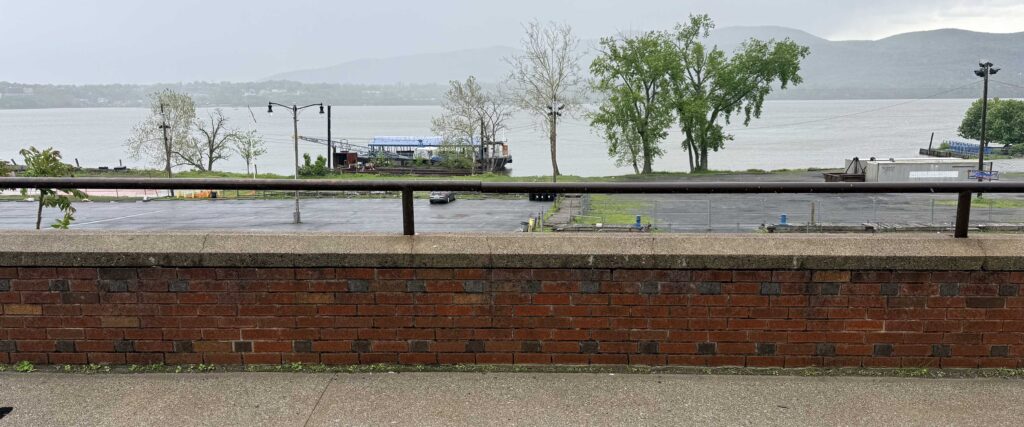
The “2 Washington Street” site, looking toward the Hudson. Photo, © NIA
It’s late Tuesday afternoon. I am at my home office, struggling with my latest essay with the working title “Architecture, Authoritarianism and Democracy”. It is the densest thing I have written since I started writing Newburgh Is America, and for a week, it has not been going very well. I thought that the more of these that I do, the easier and faster it would get, but it has been the opposite. It was starting to get me down.
The day’s international news wasn’t helping. Yes, the “war” with Iran is, allegedly, over. After a war Trump called “a small price to pay” at $200 billion, he agreed to at least $300 billion for Iran’s reconstruction, to lift sanctions on its oil, and to pull U.S. forces from the region — and got almost nothing in return. Five hundred billion dollars, divided by 349 million Americans. That’s roughly $1,400 for every man, woman, and child in the country. Think about that the next time you fill up your tank.
I take a break, go upstairs and listen to some music. I start with Milton Nascimento’s 1972 double LP “Clube Da Esquina”, considered a masterpiece of Brazilian music, on par with The Beatles’ “White Album”. Then I go to John Fahey’s “Fare Forward Voyagers”, a standout of the American Primitivism genre.
Still in somewhat of a funk, I decide to go for broke. Being the counterintuitive person that I am, I look for that master of fragile, melancholically moody solitude, Nick Drake. If you have heard of him, it might likely be because of the ad made by Volkswagen in the late 1990s that featured his song “Pink Moon”:
https://www.youtube.com/watch?v=_-kqUkZnDcM

Nick was a British folk singer in the late 1960s to early 1970s. He was highly respected by almost everyone in the British music scene, from Sandy Denny and Fairport Convention to Robert Plant of Led Zeppelin. But his albums sold poorly, barely 2,000 copies each, and he died in obscurity from an overdose of a prescription drug he was taking for severe depression.
That VW ad made Nick famous: it was single-handedly responsible for selling far more of Nick’s records than he had while he was living, and for his subsequent resurgence in popularity in the early 2000s.
I pull out his first LP, “Five Leaves Left”, place it on my turntable. The first track plays, “Time Has Told Me”.
I get an alert on my phone as the second track starts. It’s 7:15 PM: the Planning Board meeting is in 15 minutes.
Gonna see the river man
Gonna tell him all I can
About the plan…
About the way his river flows…*
From “River Man” to Planning Board: what a segue. A perfect segue.
Planning usually meets at The Activity Center, but tonight it’s at City Hall. Although the room is fairly full today, my usual spot in the front row next to the center aisle is still open. I slide into it and settle in for what I expected to be a long night. There is a long agenda, but most people are there for the public comment period for a proposed housing development on the waterfront at the eastern base of Broadway, currently identified as 2 Washington. I’ve been calling it 2WASH for short.
What does Planning do? According to the city’s website:
“The Planning Board is constituted under Chapter 76 of the City Code and consists of seven members appointed by the City Manager for seven-year terms, and two alternates appointed by the City Manager for two-year terms. The City Manager designates the Planning Board Chair from among its members.
The Planning Board oversees subdivision, site plan and special use permit approvals throughout the City of Newburgh in an effort to ensure compliance with the Zoning Code, to evaluate and mitigate environmental impacts of proposed development, and to provide for orderly growth pursuant to the City of Newburgh Master Plan.”
Keep that in mind.
Two index numbers come up first. They are disposed of quickly. Then we get to the main feature attraction.
Although the Planning Board has a Chair, the assistant corporation counsel tends to run the meetings and tonight is no exception. Joe Bonura and Jonathan Gatsik take their seats. Joan Kaplan, Jonathan’s mom, sits nearby. Together, the Kaplans and the Bonuras control or have controlled much of the economic activity – mostly restaurants – on the riverfront. Counsel asks them if they want to start first or do comments first. They say they will go first and that they will be brief. After they set up, they get going and true to their word, it was over rather quickly. Lisa asks if board members want to dive in before she opens the floor. Most of the engagement comes from Murray Cox and Daryl Kranec.
Projects of this nature and complexity, especially with regard to the environment, usually take a couple years to go through the pipeline. As there are over 4,000 pages of documents in folders on the city’s planning website for this project, clearly this must have been in the works for some time. Yet the applicant moved it in front of planning only in January. 4,000 pages is a lot of information to pore over for a board composed of volunteers with day jobs, none of whom have any expertise in environmental and land use matters. In spite of or because of this short runway, Daryl is particularly frustrated. There are a number of codes that the project violates and in those 5 months, he asserts that the applicants have done nothing to address them. As this is the third time I myself have seen the applicant present his project, I can vouch for 3 of those months: Daryl is essentially correct. At the last month’s meeting, the applicant stormed out rather than let the board vote on the submission. Tonight would be different.
Joe Bonura insisted that there had been changes, that he welcomed comments from the public and that he was looking forward to tonight’s. After some more back and forth, the public’s turn at the mike commenced.
I guessed that there were 40 or 50 people there. Although this is a city of 28,000, and although this is an important project that will inalterably affect and shape the long term future of the city, 40-50 is a good turnout for Newburgh. Joe Bonura is looking forward to the comments because there is little doubt he primed the room: at least 80% is there in favor of the project. About 15, maybe a few more get in line to speak. I stay in my seat for a while: the sound was poor, and I wanted to hear as much as possible before I got up to take my turn.
The supporters divided into mostly two arguments, and neither was about the technical specifics of the building. One was economic. The other was patience worn thin: we have waited long enough, it is time something happened here.
And besides, it’s private property.
First up were a few businessmen, who talked about the need for more residents so that the businesses could prosper from more foot traffic. Then Richard Fracasse took a turn. For those of you not in the know, he owns a commercial plumbing firm, a club and restaurant/café called The Silk Factory, and plays bass in a band that he leads called the Funk Junkies. He dresses assertively, and is hard to miss in a room. He began by talking about the four generations of his family that have been in Newburgh, starting with his great grandfather who arrived from Italy, moved through the tough times the city has suffered, and that it was about time that somebody did something on the waterfront. The Bonuras and the Kaplans were good families that have done good things: they will continue to be good for Newburgh.
Afterward, Michelle Basch and her husband Dan came up. Dan once owned a record store. When the record business dried up before “vinyl” (I still call them records) came back, Dan closed down the shop, took what was left of his inventory, moved into a new storefront on the corner of Liberty and Ann, stapled the inventory to the ceiling and opened a restaurant called The Wherehouse. They have been there for decades and wanted to see 2WASH move forward: it will bring new customers. And, “we have waited so long to see something like this”.
Nick Valentine took the mike. Nick was a little different. He was mayor during the Leyland proposal and planning with Andreas Duany in 2007-2008. He spoke of the excitement at the time, the not dozens, not hundreds, but over a thousand people who participated and produced the Leyland Plan (in another essay, I mentioned that two women who were there said that it was “better than sex”. Wow!). That plan called for a public park on this site, flanked by garages. No matter. Nick, too, had waited long enough. 2WASH is not perfect, let’s just move forward!
Remember where we are. This is a planning board — a body of code, environment, and fact, bound to measure a plan against the law, not plan against the mood of the room or the length of the wait. The supporters had brought a city-council argument to a courtroom.
The handful opposed began to speak. They brought something else: the act of looking. One of them, me, also brought 5 things that the board should grapple with as they deliberate a positive or negative SEQRA determination.
Noticeable about the opposition was the fact that no two of them said the same thing. Each had looked at the project from a different direction and found a different defect. One looked at the process, one at the street, one at the design, one at the code and the market. I brought seams in the record. And every one of them arrived at the same place: not necessarily “don’t build” (though there was that), but “this, as drawn, is beneath what this site and this city deserve.”
First was Gregory Nato. He made a practical case. It was the quiet demolition of “eighteen years is long enough.” The waterfronts and big developments people point to — Brooklyn Bridge Park, Domino, even Hudson Yards — were not approved as first drawn. They took years, decades, of negotiation, revision, lawsuits, and public pressure, and the public agencies that reviewed them required changes before they would proceed. That, Nato pointed out, is not an obstacle to development; it is the development process. Serious developers expect it. They carry contingency budgets — five to fifteen percent of project cost — precisely because they know reviewing boards and communities will require modifications. Asking a developer to do better is not anti-development. The danger, he said, is not asking too much of a developer. It is asking too little.
Zach Blaue, an architect living in the city, brought up Broadway. Broadway is the main thoroughfare by far, it is the city’s central axis. It points to the river. It flows downhill. It flows towards the river (the core idea behind the title of this essay). The applicant claims that there is a gap between two of the five towers that allows a river view from Broadway. Zach disagreed: if this project gets built, Broadway will never reach the river: it gets blocked by a wall. I made the exact same point, in greater detail, at a previous planning and zoning meeting, and here, in “The Holding”: https://newburghisamerica.com/2026/04/30/the-holding/
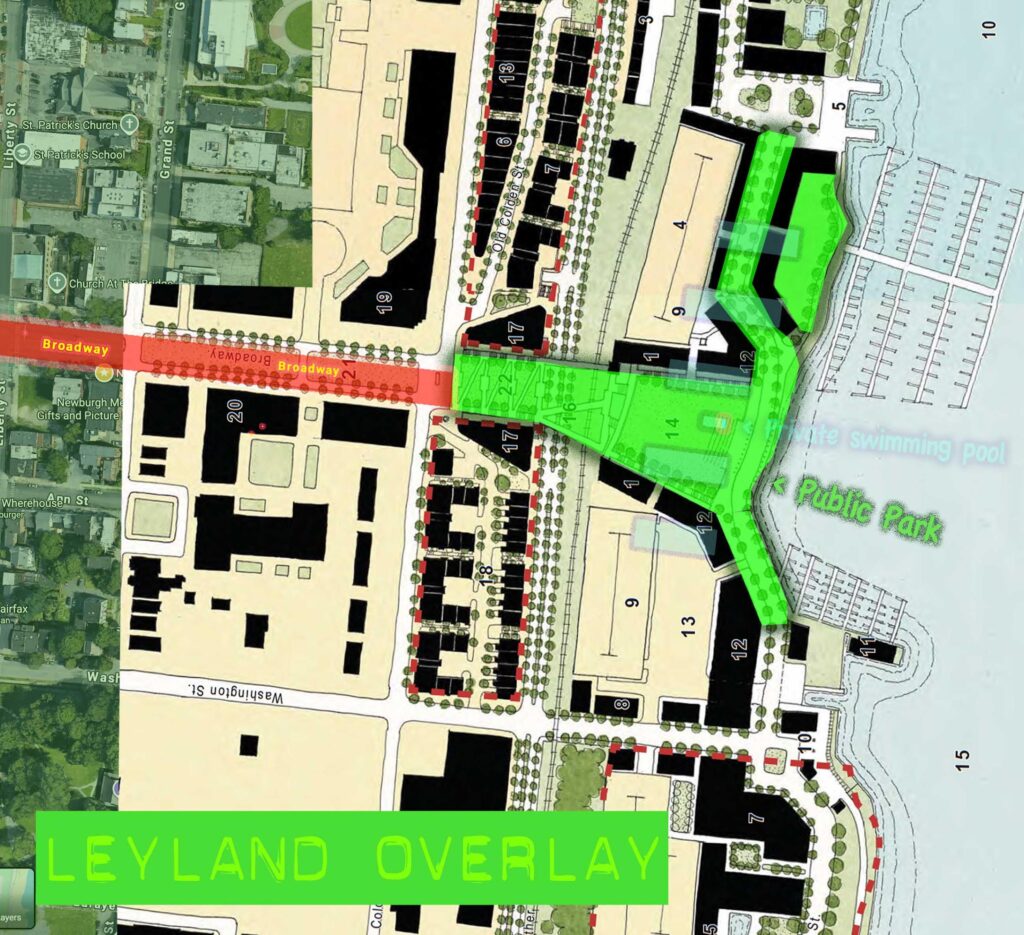
The Leyland Plan (2007–2008), overlaid on the site: Broadway opens to a public park at the river’s edge. Over a thousand residents helped shape this core idea. art © NIA
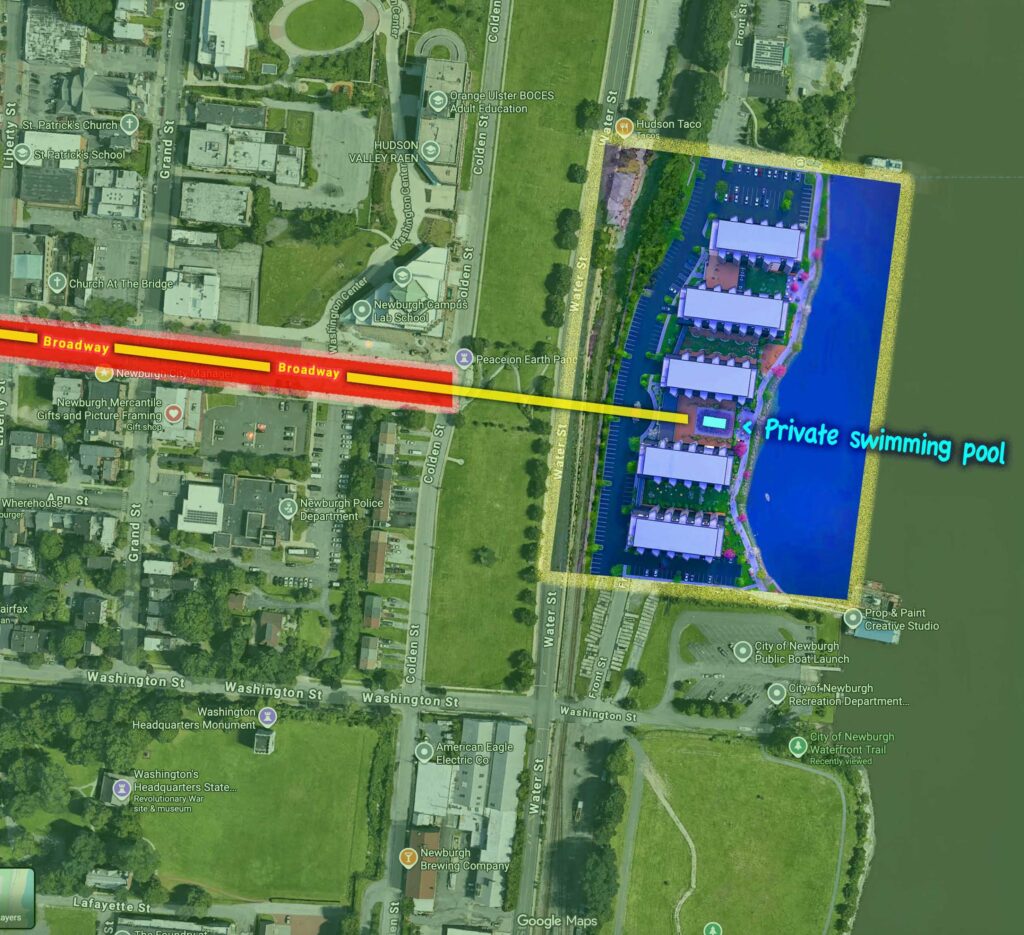
The 2 Washington proposal, overlaid on the same ground: Broadway dead-ends at the buildings, never reaching the river. The private pool sits exactly on the Broadway axis, where the public park would have been. art © NIA
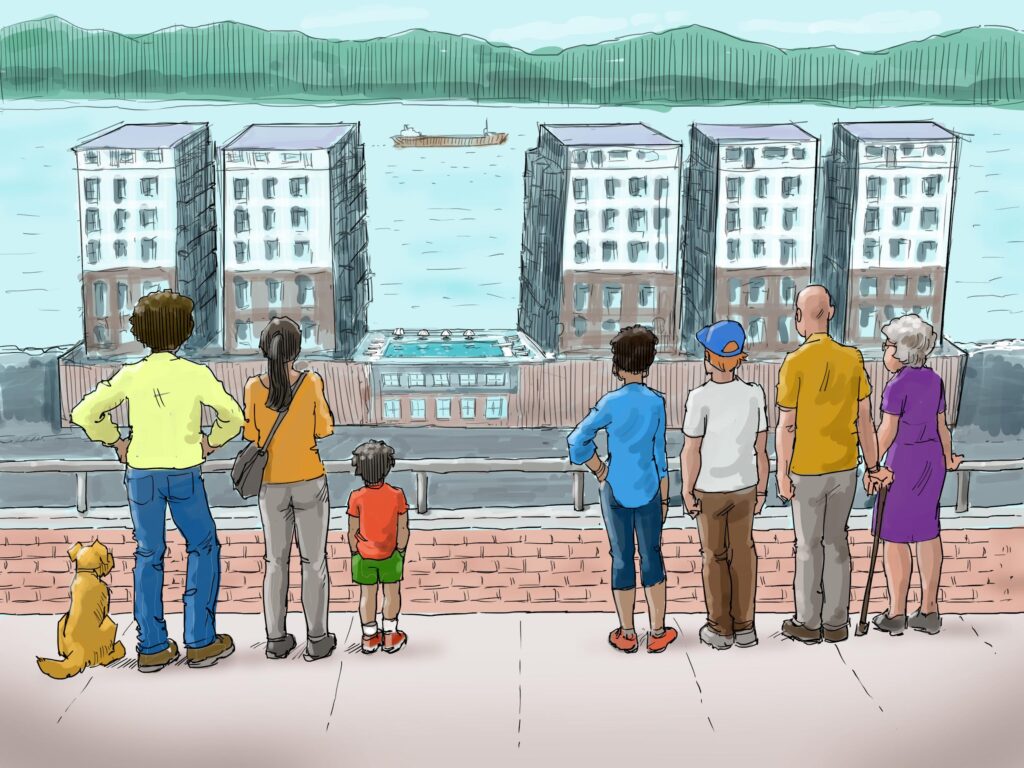
The author’s illustration of how the development would meet the public: walling them off from the river by a wall about 20 feet high and two football fields long, in the heart of the city. The podium edifice lifts most of the projects amenities above and beyond the reach of the public, the city’s citizens. Instead of regarding the city as THE amenity, it faces inwards, and walls the city out. The river view it holds for itself, while the public gazes at a pool it cannot use. The waterside promenade, the only publicly accessible feature, is so thin and hidden that its design suggests that the developers themselves are not planning on huge public foot traffic and instead conceive of it as yet another amenity, for 2WASH residents. (drawing © NIA, Interpretive, not the applicant’s official rendering).
Wendy Smith spoke not against housing on the waterfront but for better housing — supporting the families’ market-rate plan while pressing them to remember that what they build will stand for decades, and that design determines how a city lives. She drew the contrast with Brooklyn Bridge Park and Dumbo, where good design — trees, public access, mixed use, buildings that talk to the street and water — compounded value for owners and public alike. She warned that 2 Washington does the opposite: an inward-facing, parking-centric block that funnels residents from apartment to car and leaves dead zones at street level, the same failed model as the dead shopping malls. Her closing appeal was to build the Newburgh of tomorrow rather than the Newburgh of today.
Next up was Carson Carter. He supported housing on the site but argued the design falls short of what Newburgh is already proving it can do. He pointed out that excellent mixed-use projects are underway across the city at one of the highest rates in the Hudson Valley — the adaptive-reuse hotel visible from the room, a comparably sized housing project with ground-floor commercial just approved that same night on Liberty Street — and that to plan only for “today’s” retail reality ignores the economy and tax base the city is actively growing. He noted the waterfront’s proven desirability (Pizza Shop and Hudson Taco, packed year-round, expanding) and argued mixed-use needn’t mean only restaurants — a gym, a grocery, something that draws people to the water — whereas an office alone is too little for a site at the center of everything. Critically, he flagged that this project sits in the Planned Waterfront District, with far more permissive massing and code than the Gateway District nearby, and concluded that the building’s massing, the absence of real mixed use, and the riverfront parking lots flanking a single enormous mass are not minor details but essential issues for the board.
Then I took my turn.
We will skip me for the moment and move onto the last person who spoke that is worth noting. He was Dr Robert Gervasi, president of Mount Saint Mary College. Dr Gervasi has a rather impressive resume. He earned an Honors AB in Classics from Xavier University, an MA and PhD in Classics from The Ohio State University, and an MBA in Marketing from the Wharton School. A former Fulbright Scholar, he has served as Board Chair of the Fulbright Association. He reads or speaks Spanish, Italian, Greek (ancient and modern), Latin, French, and German. Poor little old me: I’m just an autodidact with a BFA from a cool art school. So, I was looking forward to his remarks. But in spite of his intellectual firepower, the best he could come up with was to attack critics of the plan (in particular, me), based on tone, not substance.
In Graham’s Hierarchy of Disagreement, an attack on tone is DH2:
https://bigthink.com/personal-growth/how-to-disagree-well-7-of-the-best-and-worst-ways-to-argue
DH2. Responding to tone.
This is a slightly more evolved form of disagreement when the debate moves away from personal attacks to addressing the content of the argument. One of the lowest forms of responding to writing is disagreeing with the author’s tone, according to Graham. For example, one could point out the “cavalier” or “flippant” attitude with which a writer formulated their opinion. But why does that really matter, especially when judging tone can be quite subjective? Stick to the material, Graham advises: “It matters much more whether the author is wrong or right than what [their] tone is.”
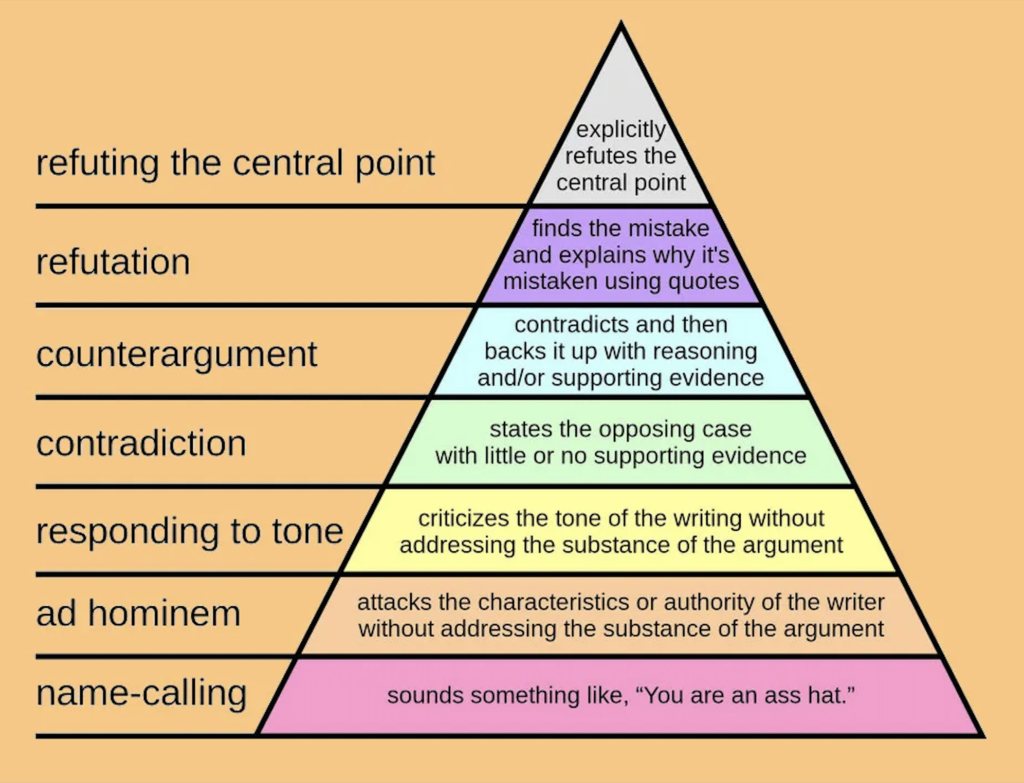
Paul Graham’s Hierarchy of Disagreement. Responding to tone (DH2) sits near the bottom — above only ad hominem and name-calling.
He complained that the critics were angry. He recalled his youth and how when he was 25, he was fired up with social justice. Now he is likely the 5th oldest person in the room (I think I give him a run for his money on the agism thing), and he knows better. This cliché of his reminded me of the old Phil Ochs lyric:
“Sure, once I was young and impulsive; I wore every conceivable pin
Even went to Socialist meetings, learned all the old Union hymns.
Ah, but I’ve grown older and wiser, and that’s why I’m turning you in.
So love me, love me, love me, I’m a liberal.“
He thinks that the critics are just fueled by anger-driven jealousy that they themselves are not rich. He accused them of daring to use religion in a divisive way. After that, he nevertheless concluded with an appeal for dialogue and friendship.
He did not address any of the substantive issues that I put onto the record. Not. A. Single. One. He left us, and me, unscathed.
The chair and the city’s counsel then tried to move things to a vote. SEQRA came up. Murray and Daryl seemed alarmed. Murray wanted to move to the code issues first, but counsel insisted that this was how it had to be done. Daryl said that the environmental issues were complex, they needed more scrutiny: shouldn’t we hire a lawyer who was expert in environmental and land use issues? As things are, the board is essentially relying on the applicant’s expertise. Counsel cautioned that it’s very difficult to find one lawyer that is expert in all the complex SEQRA issues. Murray was skeptical. Counsel backpedaled. He agreed that a firm might be found that could do it.
Not surprisingly, a SEQRA legal specialist was in fact in the room that very night. As anyone who does this work knows, the outcome counsel appeared to be steering toward was the kind that does not survive a challenge; a negative declaration on a record like this one is very often what gets undone in court. The expertise to see that wasn’t sitting on the board, but it was there, watching.
At the same time counsel advised that hiring an outside expert would be difficult to impossible, he waved off concerns about the stormwater designation — the very oversight the developer is trying to shift onto the City. So: no expertise to be found when it might slow the project down, but all the expertise the City needs when it comes to absorbing the developer’s liability. Funny how that works.
Daryl and Murray asked for clarification about the SEQRA determination. Until I see the minutes, all I will say right now is that counsel’s explanation was unsatisfactory, and appeared designed to skate the board to a negative declaration. I do remember Daryl asking for clarification of what the “hard look” under SEQRA was. Counsel seemed to me to struggle for an answer that would still get him where he wanted to go. He said something to the effect that the term “hard look” was hardly a precise legal term, smirked a little, and circled around it.
For the record:
Under New York’s State Environmental Quality Review Act (SEQRA), a “hard look” is a judicial standard of review. It requires a lead agency to thoroughly evaluate a project’s environmental consequences before acting on it. It is not spelled out in a single statute but comes from the courts: the phrase entered New York law in a 1979 case, Matter of H.O.M.E.S. v. New York State Urban Development Corp., which halted a project because the agency had not adequately studied its impacts. The standard was then settled in its now-familiar three-part form by the state’s highest court, the Court of Appeals, in Matter of Jackson v. New York State Urban Development Corp. (1986).
The three-part “hard look” test. To satisfy it, an agency must:
- Identify all the relevant areas of environmental concern.
- Take a hard look at them — thoroughly analyze whether the proposed action may have a significant adverse impact on the environment.
- Support its determination, whether a negative or a positive declaration, with a reasoned elaboration set out in the public record.
What the courts look for.
- Reasoned elaboration. The agency must give a transparent, written explanation of why it decided as it did — not generalized conclusions, and not mere lip service to its environmental obligations.
- Rule of reason. An agency is “not required to engage in an exhaustive analysis of every conceivable alternative” or impact; the depth of review is proportional to the scope of the project.
- Rational basis. If the agency did take the requisite hard look, courts will generally not second-guess its conclusions or substitute their own judgment.
In my comments, I had just handed the board 5 items that I could find no satisfactory answers for on the existing record and that should require this look. I do not claim the answers were not there: I simply am saying that I could not find answers for them, on the record. Could the board please look?
Given Murray’s and Daryl’s skepticism, I thought that they would point to at least one of them, and vote for a positive declaration, or at least try to buy time.
Before we move forward, one other thing working against the board — besides the city’s own counsel — is the Open Meetings Law itself. A public body like the Planning Board cannot deliberate outside a public meeting: get a quorum of members together to discuss the business, and the law requires it be done in the open. Which means the lawful way for the board to divide 4,000 pages among its members, go off and read, and reconvene privately to compare notes is constrained. The only place they can work through it together is the public meeting — one a month, starting at 7:30 at night. They could sit until the roosters crow at dawn, … the dawn, that is, after the next week is over, or the week after that, and still be scratching the surface.
Finally, counsel got to the vote, and he got the vote he wanted.
7-0 for a negative declaration.
I was stunned.
Sort of.
I had worked for 6 years in the effort to keep fracking out of NY. The first statewide meeting of 24 grassroots groups and environmental NGOs was held in my old farmhouse in Cochecton in 2008. A lawyer from Earth Justice talked about slowing the process down so the public could be educated — because once people learned what fracking was, they didn’t like it. Insisting on positive SEQRA declarations was a way to educate the public.
I remembered that back then, I at first found the labels confusing. They invite a kind of dyslexic response. A negative declaration means the environmental issues do not rise to the level of significant concern — it is the finding that lets a project proceed without a full review. A positive declaration means they do rise to that level: it triggers the environmental impact statement, or EIS. The words run backwards from the instinct: “negative” sounds like the tough vote, the one that stops things, when it is in fact the permissive one. I suspected that some on the board may have thought voting negative was the cautious, protective choice, when the protective choice was exactly the opposite.
The Board at least looked confused, and confused planning boards are a developer’s friend: that’s why they want authority pushed down from the state level. I could see the all-but-certain lawsuit coming.
Then, counsel moved for a vote on the project itself.
Again, Murray and Daryl balked. There were still many outstanding issues. But counsel responded that the applicant was expecting a vote.
I think that startled Murray. Say what?
The applicant is expecting a vote.
NOW.
So the board complied.
Someone motioned to vote. A second was obtained. Then the voting.
The chair, Lisa Daily, went first, which surprised me: I thought the chair goes last. Maybe she thought she was setting the example for others to follow? She made an argument similar to those of the supporters: something along the lines of we have waited long enough, I want to see something built before I die. She voted YES.
***********
Next came Alicia and Duane Ware.
Alicia’s family lost property during urban renewal. Apparently, the private property argument did not work out for them in those days.
She felt that you can’t always get what you want.
They both voted YES.
I felt a deep sadness for them.
Gonna see the river man…
If he tells me all he knows
About the way his river flows
I don’t suppose
It’s meant for me…*
I could not sit with this feeling: there were four votes left.
***********
Four. Just. One. More. And the motion carries.
David Lopez said something to the effect of “The buck stops here. Maybe we did things a certain way in the past. We have to look out for our future. It is not about perfection. We can do better.”
NO.
Three more.
Daryl brings up a letter that Chuck Thomas wrote. He is chair of the CAC. He said that Chuck wants to see development, but within the context of an overall plan, and wants people to look at Leyland.
NO.
Charles Robison
NO.
Murray Cox.
NO.
Counsel read the totals: 3 yes, 4 no.
I am stunned. Again. Not only did the board stand up to two of the most powerful families in Newburgh, the lawsuit just got mooted.
The applicants — “The River Men” — the men who want to build the wall, who want to block Broadway’s flow to the Hudson’s, got up, gathered their things, and left. To prepare their own lawsuit, perhaps? Is that why they forced a vote they seemed just as likely to lose as to win?
Parts of the room went berserk. Fracasse raced to the mike, and said something to the effect of “You losers! You destroyed Newburgh!” — I may have cleaned up the wording of his outburst a bit.
Memo to Richard: under Paul Graham’s Hierarchy of Disagreement, you just did a DH0.
Step back and look at what the two sides brought to that room.
The supporters brought standing and feeling.
The businessmen spoke of customers. Fracasse spoke of four generations and good families and how long he had waited. Basch and her husband spoke of foot traffic. Valentine spoke of a process he had presided over eighteen years ago. Every one of them was sincere, each was heartfelt. The longstanding grievances are real. Nothing wrong with that. I get it.
Not one of them was talking about the thing in front of the board. They argued from who they were, from what they felt, and from how long the waiting had been — none of which is a question a planning board is empowered to weigh. You do not get a variance because your family has been here four generations. You do not pass environmental review because you are tired of waiting. These were appeals for a city council — for legislators, who answer to mood and majority. They had been brought to the wrong room. Why? Are they used to a city council that ignores them? Do they think the council is incompetent? The city council is at the very least lacking in vision: if there was one, I don’t think we would be here. That said, city councilmembers have the same constraints as planning board members: they each have day jobs. Was it just that the supporters didn’t know better? Were they lazy and didn’t want to do the work? Or, was it because, this is how it has always been done, why shouldn’t it work this time? Maybe that is why Fracasse appeared to be directing his ire mostly at Lopez.
The opponents brought the opposite: things the board could actually act on. Nato brought the negotiation process. Blaue brought the street and the wall. Smith brought the design and the dead zones. Carter brought the zoning district, the massing, the missing mixed use. Every one of them pointed at something on the record — something the board had the authority, and the duty, to weigh. They had not come to say how they felt. They had come having looked.
That was the whole asymmetry of the night. One side felt; the other side looked. And a planning board is not built to measure feelings. It is built — bound — to look. Maybe felt was what they did in the past. That was then, this is now.
The day after the planning board meeting, I went to the Living In the City of Newburgh page. I posted the following: “Congratulations to the planning board for making a tough, controversial decision last night”.
I did so, assuming that the local press – I refer to them as stenographers, because they more often than not take the press release that the city hands out and prints it – had done stories already. Apparently they could not be bothered to even send out their stenographers that evening. So there was nothing out there. Nothing. On one of the most important votes by the planning board in recent memory: nothing. So people were complaining: what is this about; cryptic, tell us more. As if it is my job to snap to attention on a platform that I am trying to migrate away from. As I said at the outset: 40 people were there. Maybe 50. Out of a city of 28,000. Why weren’t more people there? On one of the most important decisions in recent years. As George Carlin said: “Some people see things that are and ask, Why? Some people dream of things that never were and ask, Why not? Some people have to go to work and don’t have time for all that shit.” And that’s how it is for most of us.
Back to Dr Gervasi. What exactly was it that I said that got him going? I was struck by the sense of privilege and entitlement of someone who could say, in THIS city, with THIS history, a history that gets erased by a project like this (hey, when the Fillmore East was replaced by an apartment building, they at least put a plaque on the wall) that the opponents were simply jealous that they were not rich and wealthy. In THIS city, where some 200 tenants lived without heat and hot water almost all winter, a situation that is still unresolved.
I was looking at board members’ faces when he said that. It did not go over well. Someone near me muttered that the good doctor seemed to be suffering from a bad case of affluenza.
James Baldwin described himself as being in a “rage almost all the time”.
Maxine Waters declared “I have a right to my anger, and I don’t want anybody telling me I shouldn’t be.”
From Martin Luther King himself: “Mass civil disobedience can use rage as a constructive and creative force. It is purposeless to tell Negroes they should not be enraged when they should be. Indeed, they will be mentally healthier if they do not suppress rage but vent it constructively and use its energy peacefully but forcefully to cripple the operations of an oppressive society.”
Was I angry? I feel fortunate that at the age of 72, after double bypass heart surgery that forced me to abandon a dream of building a business of acquiring and restoring distressed historic properties to near passive house standards at prices that middle class people could afford, that I can still get ticked off when I see justice squandered and ignored. And that I still have enough cognitive grip to write about it with some manner of granularity. I do art. Art is looking. Looking becomes seeing. Seeing is what I do.
As for the religion part, this agnostic is welcomed every Sunday to Rev. Lewis’s Calvary Church, “A Place of Renewal In A Renewing City” where “All Are Welcomed”. I am not worried. I simply used a familiar New Testament story as a trope to structure an argument, much as I am using Nick Drake’s song as a spine to hang a story on that might otherwise be as dull as vanilla pudding.
My statement, and my filings with counsel, are below this essay: judge for yourself.
That said, there is a way out of this controversy. Because there’s little leadership and almost no vision on the city council (again, not their fault: with full time jobs, who has the time?), things may seem hopeless, again. But there is a compromise position, one that everyone might actually be far happier with, developer incuded.
I will get to it on another day. For now, the developer seems not interested in compromise. Allegedly, they haven’t been for 5 months. They seem to be saying my way or the highway.
The board took the highway. The “highway” still has a good view, for now.
Gonna see the river man
Gonna tell him all I can…
About the ban
On feelin’ free…
Oh, how they come and go? *
Here is the link to the song, which was written, coincidentally, at the time of urban renewal. A stone-cold, drop-dead, fabulously gorgeous song, and one of my all time favorites. Of course I thought of this as a good segue and spine:
https://www.youtube.com/watch?v=idcaRTg4-fM&list=RDidcaRTg4-fM&start_radio=1
Nick Drake – River Man

*River Man lyrics © Samadhi Sound Publishing, Reservoir Reverb Music Ltd, Blue Raincoat Music Publishing Limited
© Newburgh Is America
I am a one-man band here — writer, editor, copy editor, fact-checker, legal consultant, publisher and moderator wrapped into one, publishing within a time line that is compressed from the weeks or even months of what is normally allowed for long-form investigative writing into sometimes as little as a few days. Errors and omissions are inevitable in work produced under these conditions. I rely on an informed public to identify them, and where they are identified, the record is corrected. This piece reflects my best understanding at the time of publication and is subject to revision as additional information becomes available.
Furthermore, there was no video and there are still no minutes of this meeting. As I was speaking myself, I was not taking my own notes, I was preparing for my turn. This is from memory.
Statement to the City of Newburgh Planning Board In the matter of PB2026-01 — 2 Washington Street — BCP Site C336101 – June 16, 2026
I live on Grand Street. I graduated from The Cooper Union for the Advancement of Science and Art, where I studied architecture, among other disciplines. My wife and I moved here 10 years ago, and started a business aquiring distressed historic buildings and restoring them to near passive house energy performance standards at a price point that working people can afford.
You believe you are reviewing a site plan tonight. You are not. You are being asked for relief the code does not allow as of right. I will use an archaic word. You are being asked for grace.
Grace is a gift — unearned, given before anything is returned. So three things are true of it. It cannot be demanded: demand it as a right and it is no longer grace. It cannot be bought: to put a price on the sacred is the oldest corruption there is. It cannot be granted for people who are not in the room: a debt is forgiven only by the one to whom it is owed. This board is a keeper of a place. It does not rule over the place.
Demanded. Bought. Granted for the absent. Now watch this application do all three.
It demands. A variance is relief from the rules everyone else lives under — grace claimed as a right — and they claim it on a Track 4 brownfield where the poison was capped, not removed, two acres of it sitting in the river.
It buys. The C.T. Male correspondence slides oversight off the developer and onto the City, while the developer keeps the Certificate of Completion and the liability shield. They keep the grace and hand us the risk.
It takes from the absent. The people this city already displaced have no chair in this room — and neither does the public, whose riverbed, two acres of it, lies beneath this project with its title unresolved.
The waterfront is the one inheritance a poor city still holds in common — a kind of temple, a house meant to be the public’s. A real waterfront would have been the one place in this city where the man who was moved out of the East End would stand at the rail with his grandchildren and own the river as much as anyone. Instead, these developers are carrying their table to the altar and asking you to grant them a grace: to take the unearned gift in the name of people that they are then locking outside the door. That is the moneychanger in the temple. This Board cannot serve both the public trust and the instrument that has come to privatize it.
Grace cannot be demanded. Grace cannot be bought. Grace cannot be granted in the name of the people you locked outside the door.
Choose. Turn the tables over.
————————————
Now, I recognize that counsel must and will hold you to the statutory issues before you. So let’s have a go at some of them.
First: I am submitting a written memorandum to the Board and to Corporation Counsel that sets out specific statutory and jurisdictional defects in this application, with citations. I ask that it be entered into the record in full. These are only some, and I reserve the right to bring more at a later date.
I will now state what the memorandum holds, in plain terms.
One. The contamination. This is a Track 4, Restricted Use brownfield. The contamination was not removed. It was left in place, under a cap. A 2016 investigation documented volatile organic compounds above ambient levels, still beneath that cap, on the parcel before you.
Two. The lands under water. Two acres of this site are not land. They are the bed of the Hudson River, held by the State in trust for the public. Title to that ground appears to be unresolved. The applicant, as best as I can tell from the submitted record, has not demonstrated that it owns, or holds a State grant for, the land its project would sit on. Until that is settled, this application is not ripe, and this Board cannot approve a plan built on ground the applicant cannot show it controls.
Three. The environmental review. Under the State Environmental Quality Review Act (SEQRA), this Board, as lead agency, must take a hard look — the standard the courts require — at the environmental impacts of this action. That includes the contamination left in place, the integrity of the cap, and whether construction and flooding will mobilize that contamination into the river. The Board must state a reasoned basis before it acts. That hard look has not been taken. A negative declaration issued on this record is unlikely to survive judicial review.
This Board is being asked to resolve genuinely complex environmental questions — brownfield remediation, flood inundation, contaminant mobilization, coastal consistency — on the strength of materials prepared by the applicant’s own experts. That is an enormous amount to ask of any volunteer board. A project encounters less resistance the less independent expertise stands between it and approval. You can see that logic elsewhere in this record: the applicant’s own consultant has asked the DEC, in writing, to confirm that the State will not review the project’s stormwater pollution plan — and that the City must take on that role instead.
The remedy is straightforward. I request that the Board retain its own independent environmental and land-use counsel — counsel who does not draw the majority of their income from developers — to advise it in these deliberations. The applicant has its experts. This Board, and the public, must have theirs.
Four. Coastal consistency. The City of Newburgh has an approved Local Waterfront Revitalization Program and a Waterfront Consistency Review Law. In the waterfront area, no action may be approved until there is a determination, on the record, that the action is consistent with those policies — including the policy protecting public access to the water. That determination has not been made. What the file appears to contain, as best I can determine, is a consistency finding by the Conservation Advisory Council — which, on my reading, is an advisory step, not a final determination, and not an approval.
The applicant’s response to City comments appears to carry that finding forward as though the consistency question were settled. It is not settled. A finding is not a determination, and an advisory step is not an approval. Before this Board relies on any account of the Council’s position, it should hear that position from the Council itself, on the record, in the Council’s own words — not as relayed in the applicant’s submission. The consistency determination is this Board’s to make, and it must be made directly, on a complete record, not inherited secondhand.
On the merits: the public-access policy is not satisfied by what is drawn here. Federal design standards found in the Federal Highway Administration Course on Bicycle and Pedestrian Transportation for Walkways, Sidewalks, and Public Spaces put desirable widths for high-traffic pedestrian walkways at twenty to forty feet — Pennsylvania Avenue in Washington runs thirty. What this plan offers is a narrow walkway, on the order of twelve feet, the very bottom of the desirable range for high-traffic walkways, pinned against a wall two full football fields long and so high that even Wembanyama could not dunk a basketball over it. That is not a promenade. It is a ribbon — built at the width of an ordinary shop sidewalk, not a waterfront meant to gather the public. The dimensions are in fact also a confession: this design shows that the developers are not expecting crowds: it is built as a private amenity, with the north and south entrances obscured, serving as camouflage. A design built for crowds does not look like this. Riverside Park this is not. This defeats access. A public-access determination cannot be affirmed on this record.
Five. The shifting of liability. The correspondence between the applicant’s engineers and the Department of Environmental Conservation appears to show stormwater and SWPPP oversight being moved from the DEC onto the City, while the developer retains the Certificate of Completion and its liability protection. The City should not, by approving this plan, take on a compliance duty and a long-term liability that belong to the applicant.
I want to flag a chronology for this Board to confirm against its own records, because the dates, if they hold, are troubling. This Board appears to have taken lead agency earlier this year. In what appear to be the March 5 Conservation Advisory Council minutes, the applicant states that he intends to consult the DEC on the brownfield cleanup. By early May, the applicant’s consultant appears to be asking the DEC to confirm that the State will not review the stormwater plan, and that the City will take it on instead. If that sequence is correct, it would mean the applicant was working to narrow the State’s role after this Board was already the lead agency responsible for the review. I ask the Board to either ratify or firmly establish these dates on the record, and to account for them.
Six. The variances. To the extent this project requires dimensional relief, that relief is the jurisdiction of the Zoning Board of Appeals, not this Board. This Board cannot grant site-plan approval for a plan that depends on variances the Zoning Board of Appeals has not granted.
For these reasons, the application is not ripe, and an approval on this record would be vulnerable to annulment. I ask this Board to:
- deny or defer the application until these questions are resolved;
- decline to issue a negative declaration under SEQRA, and issue a positive declaration requiring an EIS;
- require that the title to the lands under water be resolved by the State before this Board acts;
- make the coastal consistency determination, with a reasoned basis, on the record;
- refuse to assume the stormwater oversight and liability that belong to the applicant; and
- require that any variances be obtained from the Zoning Board of Appeals before any approval that depends on them.
One procedural matter. I have asked the Secretary to the Land Use Boards for the minutes of the recent Planning and Zoning Board meetings. I have not yet received them. With no video record of these meetings, the minutes are all the public has — which is exactly why what they contain, and how promptly they are produced, matters.
Finally:
At a recent Zoning meeting, this chair rose to speak after my comments. Before she could, the City’s counsel got out of his chair, crossed the room, immediately in front of me, before I could finish breaking down my presentation, and spoke to her privately. She returned to her seat without saying anything. Counsel returned to his seat, then stated that Planning Board members could not comment at Zoning.
This Board should establish, on the record, what passed between her and counsel — and it should conduct its deliberations in the open. A member who has prejudged this application cannot lawfully sit in judgment of it. Prejudgment warrants recusal. I therefore ask this Board to take up the question of whether or not recusal is warranted in the case of this chair, on the record.
I am completing a long form essay for my blog “Newburgh Is America”. It bears on the topic before us. It should be up by no later than end of day tomorrow. I ask that it be entered into the record when it is.
Thank you.
NEWBURGH IS AMERICA
Municipal Accountability Journalism · NIA LLC ·
MEMORANDUM
TO: Jeremy Kauffman Esq., Assistant Corporation Counsel, City of Newburgh
FROM: Michael Lebron, Newburgh Is America (NIA LLC)
DATE: June 16, 2026
RE: Statutory, Jurisdictional, and Procedural Obstacles to Site Plan Approval —
“2 Washington Street”; Planning Board Case PB2026-01;
NYSDEC Brownfield Cleanup Program Site No. C336101
I. Preliminary Statement
This memorandum is respectfully submitted to assist the Office of Corporation Counsel in its independent review of the above application. Its purpose is narrow: to identify the statutory, jurisdictional, and procedural defects that render any approval of the current application premature, that would expose any such approval to annulment in a proceeding under CPLR Article 78, and that would shift to the City environmental and fiscal liability properly borne by the applicant.
These conclusions are drawn from the application materials already on file with the Board — including the Full Environmental Assessment Form, the Stormwater Pollution Prevention Plan, the site plans, the Floodplain Development Letter and Permit Application, the survey, the landscape plan, the applicant’s response to City comments, and the Conservation Advisory Council’s comment letter. The issue in each instance below is not that the applicant failed to file. The record is voluminous. The issue is that the materials filed do not satisfy the governing legal standard, or that a determination the law requires remains unmade or unresolved. Volume is not sufficiency.
The legal authorities cited have been checked against current statutes and regulations and remain subject to Counsel’s independent verification. Several arguments turn on site-specific facts — in particular the allowable-use designation in the Certificate of Completion for Site C336101, the cleanup track, the 2016 sampling results, the acreage extending below the high-water line, and the contents of the C.T. Male correspondence with NYSDEC — which should be confirmed against the original documents. I can provide them.
II. The Application Is Not Ripe; Predicate Determinations Remain Unresolved
Notwithstanding the volume of the filing, several predicate determinations remain either deficient or unresolved: (a) title to the lands under water on which a substantial portion of the project sits; (b) the correct SEQRA classification and the adequacy of any determination of significance made on the filed Environmental Assessment Form; (c) written confirmation from NYSDEC that the site plan and the intended use are consistent with the environmental easement and Site Management Plan governing this Brownfield Cleanup Program site; (d) the mandatory coastal consistency determination under the City’s Waterfront Consistency Review Law; and (e) federal authorization for work in the navigable waters of the Hudson. A board may approve a site plan only on a record that supports the findings the law requires. Until these are resolved, the record cannot support approval, and an approval would be vulnerable to annulment as arbitrary and capricious.
III. SEQRA: Classification and the Adequacy of the Determination of Significance
One preliminary point should be met head-on. Certain brownfield sites that have received a Certificate of Completion are classified as Type II actions, exempt from review, under 6 NYCRR 617.5(c) — but only where the Certificate’s allowable use is commercial or industrial and the change-of-use requirements of 6 NYCRR 375-1.11(d) are satisfied. The exemption does not apply if the Certificate for this site was issued for residential or restricted-residential use, or if the proposed use exceeds the use for which the site was remediated. The allowable-use designation in the Certificate for Site C336101 is therefore the pivotal fact, and Counsel should confirm it before any party asserts a Type II exemption.
The applicant has filed a Full Environmental Assessment Form, so the question is not whether review has begun but whether the action is correctly classified and whether any determination of significance can survive on this record. Given the waterfront location, the scale, the in-water component, and the contaminated condition of the parcel, the action is at minimum Unlisted and a strong candidate for a Type I action under 6 NYCRR 617.4, which carries the presumption that the action may require an Environmental Impact Statement (6 NYCRR 617.4[a][1]). The threshold for requiring an EIS is relatively low (Matter of Spitzer v Farrell, 100 NY2d 185, 190 [2003]).
The Environmental Assessment Form, and any determination of significance resting on it, must reflect a “hard look” at the relevant areas of environmental concern, with a reasoned elaboration (Matter of Jackson v New York State Urban Dev. Corp., 67 NY2d 400, 417 [1986]; Matter of Akpan v Koch, 75 NY2d 561, 570 [1990]). Critically, the potential acceleration of the displacement of local residents is itself an environmental impact that must be analyzed (Matter of Chinese Staff & Workers Assn. v City of New York, 68 NY2d 359 [1986]). Counsel should confirm that the filed EAF actually analyzes (i) the contamination left in place under engineering and institutional controls, (ii) the lands under water, (iii) impacts to the tidal Hudson and the coastal zone, (iv) community-character and displacement impacts, and (v) cumulative and secondary impacts — and that the revised EAF entries are internally consistent. A negative declaration resting on an EAF that does not is annullable, because SEQRA’s mandates require strict compliance (Matter of King v Saratoga County Bd. of Supervisors, 89 NY2d 341, 347 [1996]).
Finally, Counsel should confirm that the review has not been improperly segmented (6 NYCRR 617.2[ah]; 617.3[g]) and that coordinated review among the involved agencies — NYSDEC, OGS, the U.S. Army Corps of Engineers, and the IDA — has occurred, as a Type I action requires (6 NYCRR 617.6).
IV. Lands Under Water: Title Is Not Established on the Record
The survey on file fixes the parcel boundary, and a substantial portion of the project — on the order of two acres — lies below the high-water line, on the bed of the Hudson. The Hudson at Newburgh is tidal and navigable, and title to the bed of the State’s navigable waters is presumptively held by the State, in trust for the people, under the jurisdiction of the Office of General Services (Public Lands Law art. 6, § 75). What the record does not establish is the applicant’s title to, or a State grant or easement for, that portion of the site.
The consequence is jurisdictional. A planning board cannot approve a site plan for improvements on lands the applicant has not shown it owns or controls. Where a substantial part of the footprint sits on lands under water with no established OGS grant, the applicant has not demonstrated the requisite interest in the property, and the application is not ripe. In making any grant of such lands, OGS is bound to preserve the public interest in navigation, recreation, environmental protection, and access to the navigable waters of the State (Public Lands Law § 75) — an interest the Planning Board cannot extinguish by site-plan approval. The title question must be resolved by the State before the Board acts.
V. Brownfield Cleanup Program: Consistency of the Plan, the Use, and the Cap Under Flood Conditions
This is a Track 4, Restricted Use site (ECL art. 27, tit. 14; 6 NYCRR Part 375). The contamination was not removed; it was left in place beneath a cap, governed by an environmental easement and a Site Management Plan, with volatile organic compounds documented above ambient in the 2016 Phase II investigation. The Certificate of Completion and its liability limitation (ECL §§ 27-1419, 27-1421) run with the land but are expressly conditioned on compliance with the Certificate, the easement, and the Plan.
Two consequences follow. First, the site plan’s physical works — excavation, regrading, the below-grade garage, stormwater infiltration — and the project’s intended use must be confirmed by NYSDEC to be consistent with the easement and the Site Management Plan, and any change from the use for which the site was remediated triggers the change-of-use requirements of 6 NYCRR 375-1.11(d), including a work plan and prior notice to NYSDEC. The record should contain that confirmation; if it does not, approval is premature.
Second, and not addressed by the floodplain filings: the entire site lies in FEMA Zone AE with a base flood elevation of 7.0 feet, as the applicant’s own survey and SWPPP reflect. The Floodplain Development filings address the building — raising habitable space above that elevation by means of the platform — but they do not, on their face, address the remedy. Whether the Site Management Plan and the EAF evaluate repeated flood inundation and recession across the cap, and across the at- and below-grade contaminated zone beneath the garage, as a contaminant-mobilization pathway to the Hudson, is a question the record must answer. A flood design that protects the dwellings while leaving the cap in the inundation zone has addressed the residents, not the remedy.
VI. Stormwater (SWPPP / SPDES / MS4): The Transfer of Oversight and Liability to the City
The applicant has filed a SWPPP. The defect is not its absence but what the C.T. Male correspondence with NYSDEC reveals about the allocation of responsibility under it: a proposed migration of stormwater and SWPPP oversight onto the City. Corporation Counsel should scrutinize this, because it converts a private compliance burden into a public liability.
On a capped brownfield governed by an environmental easement, stormwater management is entangled with the integrity of the remedy. The compliance obligations under the SPDES general permit for construction activity, and the long-term obligations that follow, are properly borne by the applicant and the remedial party — not assumed by the City through its MS4 program or by an approval condition. The asymmetry should be stated plainly on the record: the applicant retains the Certificate of Completion and its liability shield, while the City would absorb the oversight duty and the exposure. Counsel should not permit the City to be placed on that side of the ledger.
VII. Coastal Consistency: A Threshold CAC Finding Is Not the Required Determination
The City of Newburgh has an approved Local Waterfront Revitalization Program (approved by the Secretary of State in 2001) and a local Waterfront Consistency Review Law (Code of the City of Newburgh, ch. 159, art. III), adopted under Article 42 of the Executive Law. Before approving an action in the City’s waterfront area, the responsible body must determine, on the record, that the action is consistent with the LWRP’s policy standards. That determination is a mandatory predicate to approval.
The Conservation Advisory Council has issued a threshold consistency finding. But the applicant’s response to City comments characterizes that finding as project approval, omitting the unresolved concerns the CAC itself listed. That characterization should not be permitted to stand in the record. A threshold CAC finding is not the consistency determination the law requires, and it is certainly not an approval. The required determination remains to be made, with a reasoned basis, by the responsible body.
On the merits, the LWRP’s policies include the provision and protection of public access to the waterfront (Policies 19 and 20) and the protection of scenic and visual quality (Policies 24 and 25). The applicant’s provision of a [12]-foot-wide public walkway is itself an admission that the public-access policy applies; its dimensions and siting are evidence that it is not satisfied. A [12]-foot walkway pinned between the river and a continuous podium-and-garage wall approximately [20] feet high and [___] linear feet long — in shadow, with no public sightline to the water from the street grid behind it — is a corridor, not an access, and the same wall reduces the public’s existing view of the river, implicating the scenic policies independently. The Board cannot find consistency by pointing to the walkway’s existence; it must find, on the record, that the walkway delivers the access the policy requires. [Confirm the policy numbers against the City of Newburgh LWRP, Section III; insert the wall height, walkway width, and linear feet of blank façade from the approved plans.]
VIII. Variances: Zoning Board Jurisdiction and the Required Sequence
To the extent the project requires dimensional relief, that relief is the jurisdiction of the Zoning Board of Appeals, not the Planning Board. General City Law § 27-a expressly provides that where a site plan contains features that do not comply with the zoning regulations, application is to be made to the Zoning Board of Appeals for an area variance under General City Law § 81-b. The § 81-b balancing test expressly requires consideration of whether the variance will have an adverse impact on the physical or environmental conditions in the neighborhood, and whether the alleged difficulty was self-created — both of which cut against relief on a contaminated, partly submerged site. The sequence is jurisdictional: the Planning Board cannot grant site-plan approval for a plan that depends on variances the Zoning Board of Appeals has not granted.
Work placing fill or structures in the navigable waters of the Hudson requires federal authorization — Section 404 of the Clean Water Act (33 U.S.C. § 1344) and Section 10 of the Rivers and Harbors Act (33 U.S.C. § 403). This is distinct from the local Floodplain Development Permit. The Board should not grant an approval contingent on federal permits the applicant has not obtained; the status of any Army Corps authorization should be established on the record.
X. Conclusion and Requested Action
The application is not ripe, and an approval on the present record would be vulnerable to annulment under CPLR Article 78 while exposing the City to liability that belongs to the applicant. I respectfully request that Corporation Counsel advise the Planning Board as follows:
- That the application is not ripe and several predicate determinations remain unresolved, and that the Board defer any action until they are resolved.
- That the SEQRA classification be confirmed — including whether any Type II exemption under 6 NYCRR 617.5(c) is available given the Certificate’s allowable-use designation — and that no negative declaration issue unless the filed EAF reflects a hard look at the contamination, the lands under water, the coastal impacts, and the displacement of residents; the Board should consider a positive declaration.
- That title to, or a valid OGS grant or easement for, the lands under water be established before the Board acts.
- That NYSDEC confirm in writing that the site plan, the intended use, and the cap under flood conditions are consistent with the environmental easement and Site Management Plan, including any change-of-use work plan required under 6 NYCRR 375-1.11(d).
- That the City decline to assume, by approval condition or otherwise, stormwater or SWPPP oversight and liability properly borne by the applicant.
- That the coastal consistency determination be made on the record, with a reasoned basis, by the responsible body — and not by reference to the Conservation Advisory Council’s threshold finding, which the applicant has mischaracterized as an approval.
- That any required dimensional variances be obtained from the Zoning Board of Appeals under General City Law § 81-b before any site-plan approval that depends on them.
- That the status of federal authorizations under Section 404 and Section 10 be established on the record.
I reserve all rights, including the right to seek judicial review of any approval granted on the present record. I am available to provide the underlying documents at Counsel’s request.
Respectfully submitted,
Michael Lebron
Newburgh Is America · NIA LLC