Part 1: Whose Hero?
What the Hometown Heroes campaign asks a city to decide
Today I wade into a thorny thicket. There is a clearing on the other side. With any luck I’ll get there unscathed.
photograph © NIA
Photograph and image manipulation: Michael Lebron © NIA
A Newburgh council member has proposed that the City of Newburgh adopt the Hometown Heroes Banner Program — personalized banners honoring service members, displayed on utility poles throughout the city. He has stated his intent to move forward with it, and has described it as “not a statement about war or military conflict.”
The program began in grief. Ruth Stonesifer is a Gold Star mother whose son, Army Ranger Kristofor Stonesifer, was killed in a helicopter crash in Pakistan in October 2001, in one of the first operations of the war in Afghanistan. In 2007, she set out to hang a banner in Harrisburg for every Pennsylvanian lost in Iraq and Afghanistan. About 140 of the state’s 183 Gold Star families took part. The first banners rose at the state capitol in May 2007, one of them bearing her son’s face.1
A few months after his death, Stonesifer wrote of her son: “He wouldn’t understand all the fuss being made over him. He would be amused and bewildered that so much attention was being made about his life and death. He would not define his death as a sacrifice for his country.”2
The mother who founded the program, writing of the first man it honored, said he would not have called his own death what the banners were calling it. Some forty-three of those families did not take part. We are not told why.
What began as one mother’s grief did not stay one mother’s grief. It became a product.
The original banners were made by a commercial outdoor-decorations company, Holiday Outdoor Decor of Allentown, Pennsylvania, whose ordinary trade is seasonal and holiday displays.3 Ruth Stonesifer commissioned the firm to design and produce the signs; it operates several banner businesses under different names across the country. It has since claimed a trademark on the “Hometown Heroes Banner Program” and expanded the eligibility criteria to include all veterans and first responders. Its own sales materials promise to coach a town “through every step of the process,” from recruiting donors, to “creating excitement in your community” with flyers and social media, to “providing ad layouts for your local newspaper.” The design has since been widely copied. Other vendors sell the same template, and some towns run their own versions. The branded program, and the trademark, are the company’s.
That is the distance the thing has traveled: from a Gold Star mother securing a single utility pole for her fallen son, to a decorating company that has claimed a trademark on the tribute.* It is one reason why the program arrives the same in one town as the next — the same vinyl, the same brackets, the same application. The grief was authentic. The merchandising is not. The question is not whether the feeling is sincere, of course it is; it is whether a city should rely on a vendor’s template in order to decide how it speaks, on its own utility poles, in the name of all its residents, for whose benefit.
Sincerity is not incidental to the program: it is the program’s fuel. The wish to see a son, a father, a neighbor recognized is real. The program takes that wish and puts it to work: service, grief, pride, conscripted into a civic gesture that performs reverence.
*****
The program is not without a specific challenge to municipalities. When this government places expressive content on public property, it is bound by the First Amendment to remain neutral as between viewpoints. Contrary to the city councilmember’s assertion, this program does not meet that obligation.
The Councilmember puts it this way: “These banners are not symbols of war; they are symbols of service, sacrifice, duty, and community pride.” But symbols of whose service, chosen by whom? That question gets stepped over. When the subject is who deserves the public’s honor, the choice of subject is not neutral. It is an endorsement. “Honor” is not a topic like roads or parks. To decide whose service the State will publicly bless is to take a side.
Take the third of his words: duty. Duty to what? To the Constitution? In which case the citizen who refused an unjust war out of conscience has done his or her duty too. Yet the program excludes them? The refuser has a claim to the word hero that this program’s definition excludes. Consider one name the country now reaches for when it wants an example of moral courage: Muhammad Ali, who refused induction in 1967, was stripped of his title within hours, barred from his sport for three and a half years at the center of his prime, and convicted before the Supreme Court cleared him 8-0. Today, we call that heroism. But if the man who refused is a hero, then service cannot be The Thing that confers the word, and the program, run by its own logic, would have to deny a banner to one of the most admired figures in America. It honors the uniform and borrows heroism’s name for it. The two are not the same. The banner asks us not to notice, to just drive on by.4
Or is duty to be thought of as compliance to orders given? In that case, the City is honoring obedience itself, and has taken the most contestable position of all.
Service, sacrifice, duty, pride are not neutral virtues the banners simply observe here. They are values the City would be choosing to celebrate in some lives and to withhold from others.
There is a principle that sharpens the injury. The principle is that the State should not force its message on those who cannot escape it: the concern the courts have called the problem of the captive audience. The City will say it does not apply here: a banner is glimpsed and passed, and no driver is captive. But consider where these banners go. A war memorial sits in one place — a green, a square — and you choose whether to enter the space it occupies. You can route around it. It does not follow you. A banner program is different in kind, not degree: it is not a destination you visit but an installation along the arteries of ordinary life: the road to work, to the school, to the store. You do not go to it. It is placed in the path you cannot avoid. And it does not appear once. It multiplies, block after block (there are over 60 of them for a good mile stretch on the road south out of Beacon to High Falls), renewed year after year, until there is no route through the city that escapes the State naming whom to honor.
This does not, by itself, make the program unlawful; the government may speak in its own public spaces. But it deepens the intrusion. Whatever the program turns out to be, endorsement or open forum, every resident is made to pass beneath it daily, with no power to decline. The principle was built for the trapped rider and the targeted home; a tribute bolted along every corridor a resident must travel is its natural extension.
But let’s return to the main defect: the quandary of neutral selection. It leaves the Council three options.
One.
Exercise true neutrality, and take all comers. If the City takes no position on whose service is worthy, it must honor anyone who served the country as they understood it. Begin with those it would find … unappealing. The ancestor who fought for the Confederacy, who bore arms and died in the field. The relative serving today in a foreign military, under the claim that that nation’s war serves American interests. And, at a moment when participants in the January 6th attack on the Capitol are being pardoned and recast as patriots, the family that comes forward to honor one of them as a man who served his country as he saw it. True neutrality admits everyone, including those that many in this city would find odious.
The trap closes from the other side as well. That side makes it worse for the program, because it is about the honorable that the program would still refuse. If the City honors service to the country, then it must reckon with those whose service was as real as any soldier’s and who would never appear on its utility poles. The enslaved, whose forced labor built much of the nation’s early wealth, a foundation without which there is no country to defend. The merchant mariners of the Second World War, who suffered among the highest casualty rates of any service, 1 in 26, and whom the government itself refused to recognize as veterans until a federal court ordered it, four decades late.5 The conscientious objector who would not bear arms but served under fire as a medic, risking his life for the same country by the lights of a different conscience. Or the Peace Corps volunteer. Or volunteers at animal shelters. And so on.
The point: the line the program draws is not “worthy” against “unworthy.” It was military service against every other kind of devotion this country has ever been built or saved by. To call that neutral is an evasion.
Two.
Narrow the program to enlisted service members and veterans. Written tightly enough — honorable discharge from the United States Armed Forces, name and branch and years only — the program is arguably lawful. But it is lawful only as the City’s own speech, and the moment the City defends it that way it has abandoned the claim that it “takes no position.” It will have declared, on the record, that service in the United States military is the one form of devotion to this country it will honor, and that the principles and actions of those who served differently, who refused to serve, or who oppose militarism outright, do not count.
Change the name and call it “Hometown Servicemembers”. Then, the word stops laundering a status into a merit; the objection to that word dissolves. But this name still leaves something standing. The city has still chosen one kind of service, the military, and given it, and only it, the utility poles. While that is no longer a contestable claim about heroism, it is now a claim about what the town elects to honor, published by the government on the government’s own property, and it raises the question the rename cannot reach: why this form of service and not the others who served the town? Teachers? Nurses? Hospice workers? The woman who kept the food pantry open for thirty years? We are back at the viewpoint issue, because the utility poles are still open to one kind of devotion and closed to every other, by the city’s choice, in the city’s voice.
That is a position. It is an endorsement. It wears the costume of neutrality, only until someone asks.
Three.
Do not run the program at all. This is the course that resolves the dilemma rather than disguising it: the City elects not to speak at all, because it must speak for all. And it compels no resident to pass beneath the State’s chosen tribute on the way to work. It is the cleanest path, and it is available to this Council.
There is one small dodge that should be addressed.
The City could say the poles belong to Central Hudson, and that it therefore places no speech of its own.
Whether the pole belongs to the City or to Central Hudson, the constitutional question is the same: who curates the message. If this Council adopts this program and decides whose service Newburgh will honor, then the City is the speaker, and it cannot escape that by pointing out that the pole belongs to the utility. A government does not shed its constitutional obligations by routing its conduct through a private entity. I litigated exactly that principle to the Supreme Court of the United States: Lebron v. National Railroad Passenger Corporation, 1995, and prevailed, 8-1, Scalia writing the opinion.6
You do not get to call the program neutral while you so visibly select. You must choose among these options, on the record.
•••••
These programs run in towns large and small, and in cities more diverse than Newburgh; they are administered, almost everywhere, by some arm of the municipality. Remarkably, but understandably, they have not been tested: who wants to fight a program honoring veterans? So to date, no court has squarely decided whether a program that selects whom a city will honor can call itself viewpoint-neutral, because in most places no one with standing has forced the question to judgment. But the absence of a lawsuit is not a finding of neutrality. It is only the silence of a question not yet put.
Where these programs operate at scale, look at how they resolve the very problem of selection: not by achieving neutrality, but by writing the choice into the rules. The cities that run large versions narrow eligibility to honorable service in the United States Armed Forces: a discharge document, a branch, a rank. That is presented as a neutral subject limit, the way a forum might be limited to a topic. It is not. When the “subject” is whose service is worthy, the limit is not neutral scope; it is a value, declared. To restrict the honor to military service is to announce that this form of devotion to country, and not the conscientious objector’s, not the home health care worker, is the one the city esteems. That is the endorsement of militarism, made explicit in the eligibility criteria. Whether it is also unlawful viewpoint discrimination is the question no court has settled**. But the city need not lose in court for the point to hold.
What has and has yet to reach a courtroom is telling.
In Union City, Pennsylvania, a man sued over a banner hung so low it damaged his vehicle, and won. This was a quarrel about clearance, not about speech. The constitutional question was not put. But in Hartford, Vermont, a situation arose when the program honored a veteran who had pleaded guilty to stealing tens of thousands of dollars from an elderly widow; a neighboring official wondered aloud how a town could screen for character without judging it. A local editorial board there noted the obvious difficulty: once a town opens its utility poles to honor, the law may not let it pick and choose as freely as it would like. These are not yet lawsuits over speech. They are the sound of a question working its way toward one.7
*****
In April, I drove five hours each way for a 25-minute ceremony at Arlington National Cemetery to see my uncle finally laid to rest for his WWII service with immediate family and a few close friends. This same uncle told me more than once to be skeptical of those who think I should view the military with reverence. The City should think about whether this program should make every resident pass beneath that reverence daily, with no power to decline. The City Council does not dishonor anyone’s military service by viewing this program with a degree of skepticism, as the government has many other places to honor its service people: at Arlington; at the Vietnam Veterans Memorial; at the Soldiers and Sailors monument in Cooperstown, the Otsego county seat; at the war memorial right here in Newburgh, in the triangle at Leroy, Park and Grand Avenue. And, unlike the drive-by character of the banners, these all have one thing in common: they are destinations. You choose to visit them.
Like Kristofor Stonesifer, whose mother said would have been bewildered by the attention, my uncle never wanted to talk about the war. It was something he did, and he neither expected nor wanted public display made of it. In this he was not unusual. Most I have known who actually fought, who were in it, have been the same: uneasy with the word hero, unwilling to perform the memory, suspicious of ceremony. It is the oldest pattern in the record of war: the ones who saw the most tend to say the least. I have read that, for some, the silence is not modesty. Some of what they saw, some of what they know, including but not limited to what one man’s willingness to kill another looks like, stripped to its essence, made for questions rather than pat answers.
There are exceptions: those who came home to silence or contempt during Vietnam have every reason to want, at last, to be seen. But this program presumes a hunger for spectacle that the people it claims to honor have, again and again, told us they do not necessarily share.
Someone will point to the Vietnam veterans and say there is plainly a generation that wants to be seen. True enough.
But look at how they make themselves visible. The ones in patch-covered leather, the Nam Knights and clubs like them, wear their service on their backs wherever they go. It is a uniform of sorts. But it is one each man assembled himself, and it carries his particulars: his branch, his unit, his dead, the road name stitched to a leather or denim vest where another man’s says something else. He in many cases rejects the very government he feels deceived him, and wears what he wears in defiance. The patch is his, the brotherhood is his, the dead he honors are his. It cannot be said that he is necessarily waiting for a city to decide his face is worthy and hang it on a utility pole in order to improve the town’s quality of life.
The banner takes every kind of service, every different war, every distinct life, and runs them through one template: the same vinyl, the same frame, the same word over every face. It homogenizes them. Look at the banners already hanging in the towns near and not so near: Washingtonville, New Windsor, Beacon, or the ones I saw a week ago a little farther upstate, in Cooperstown. The faces have been given a treatment, an antique wash, a vintage fade, the same applied to a man lost in Afghanistan as to one lost in 1944. Their service is not shown so much as styled — aestheticized into a single warm haze, the particular war and the particular death smoothed away into something easier to look at. The vest insists on the man. The banner dissolves him into a mood.
*****
So is the question, then, not whether veterans want to be remembered, but who holds the pen — the man who fashions his own emblem, or the city that selects which faces to mount over its streets, flattening them all to fit?
This leads to the question no one promoting this is clear about: who is it for? Is it for the ones being honored, or for the ones who wish to honor, for any number of reasons of their own? The Councilman has, without quite meaning to, answered it.
Describing the program to a writer at the Mid-Hudson News on May 28, 2026, he said the banners would “bring more of this quality of life which will lead to a special character in the City of Newburgh.”8
The stated purpose is the city’s quality of life, its special character: the feel of the place to those who live in it and pass through it. That is not the veteran’s need. If many of the honored would quietly decline the banner, then the banner is not, at bottom, for them. It is for the honorer, for the desire to express reverence, gratitude, grief, pride. And for a city’s wish to feel a certain way about itself.
And, for the need to believe the service was not in vain: that the death meant something, that the loss was not waste. Recall what Stonesifer wrote of her own son, that he would not have defined his death as a sacrifice for his country. The program defines it that way regardless, because the people who remain need it defined that way. It supplies the meaning the rest of us require to bear the loss, and prints it over his face. That may be a mercy for the living. It is not the same as honoring the dead.
Speaking as someone who worked in advertising for decades: to take a contestable public choice and present it as a self-evident sentiment is precisely the function of propaganda. I have said many times that the reason we won the Cold War was not because our bombs were bigger and better, though they were, and not because our economy was bigger and stronger, though it most certainly was. It was because our methods of persuasion were subtler: they compelled and we seduced. And so, propaganda is most effective when it functions like this: not when a liar imposes it on a credulous public, but when sincere people perform it upon themselves and call it honor. There is no cynic here to expose, no manipulator to catch. The sincerity is not the alibi. It is the mechanism: a virtue, manufactured and installed over the public way, even as the veterans it invokes are sleeping in cars and taking their own lives at seventeen a day. The image of the honored one, raised up in the public square so the crowd below may feel clean, is akin to an offering: the veteran’s face laid on the altar of the town’s good opinion of itself, the debt owed to the living paid in the coin of the dead. No one means it as such. That is what makes it work.
*****
There is one more thing these programs tend to have in common, and it cuts to who gets honored at all. As the Mid-Hudson News reporting describes them, the banners are usually paid for by the family, service organization, or friends who sponsor them. A fee, often a hundred to two hundred dollars. Many programs offer a hardship sponsorship for those who cannot pay, which is itself the admission that the cost is a barrier. The Councilman has not said how a Newburgh program would be funded. But if it followed the usual model, the honor would flow by the ability to pay: pooled among the veterans whose families have the means, and absent for the ones who do not. And the veterans who can least afford a banner are, very often, the same ones who can least afford a home: the homeless and the rent-burdened, the people most in need of something real. A tribute paid for by sponsors does not distribute honor by service; it distributes it by means.9
*****
On a single night in January 2024, nearly 33,000 veterans were homeless. Almost half a million more are severely rent-burdened, paying more than half of what they earn to keep a roof. Young veterans are twice as likely as other adults to lose their housing; women who served, two to three times as likely.10
These are the people the banners are unlikely to depict. They are the ones with no family to sponsor them, no one to apply on their behalf.
And there is an even harder fact the banners do not reach. Begin where Stonesifer began — Iraq and Afghanistan. Those wars cost roughly 7,000 American lives in combat. In the years since they began, this country has lost more than 120,000 veterans to suicide. Widen the lens to take in Vietnam as well, and the combat dead of all three wars, over 65,000, still come to barely half the Americans we have lost by their own hand after coming home.11
Housing them is the costly lift. So are mental health services. Job training. These are unfinished obligations that are owed these vets. A piece of vinyl on a utility pole is the cheap feel-good gesture.
Now, some might argue, do all these things: housing, mental health, job training, and the banner.
But banners such as these are not a small good laid over a debt to be paid. They more often than not fill the space that the debt might otherwise occupy. The town has been seen to honor its veterans, the feeling of debt is discharged, while the debt itself remains quietly unpaid.
But banners such as these are not a small good laid over a debt to be paid. They more often than not fill the space that the debt might otherwise occupy. No one intends this; the gesture does it on its own. A town that has done nothing would still feel the obligation unpaid. A town that has hung the banner feels it settled. The banner spends the very impulse that might have paid the debt, and by spending it, forecloses it.
*****
I have been in war zones, but I have never fought in one. War is the largest thing a state does, and yet combat is lived as a relentless sequence of individual decisions in the moment, each one, in spite of your brothers-and-sisters-in-arms, yours alone, each carrying consequences out of all proportion to the instant in which it is made. Soldiers who survive that has known the war not as an act that a sovereign nation makes on a global stage, but as their own existential experience. Particular. Unshareable. Theirs. A banner takes that and turns it back into the State’s symbol. It abstracts away the very thing the experience was made of.
So, in closing, the servicemen and women this program would honor might very well ask their elected leaders this question: why banners over our roadways instead of roofs over our heads? Why words of honor instead of acts of healing?
I find it to be an odd sort of cruelty in offering a roadside decoration, no matter how civically, no matter how sincerely, to people, so many of whom are quite literally dying right now, at this very moment, for want of a roof, and a reason to stay.
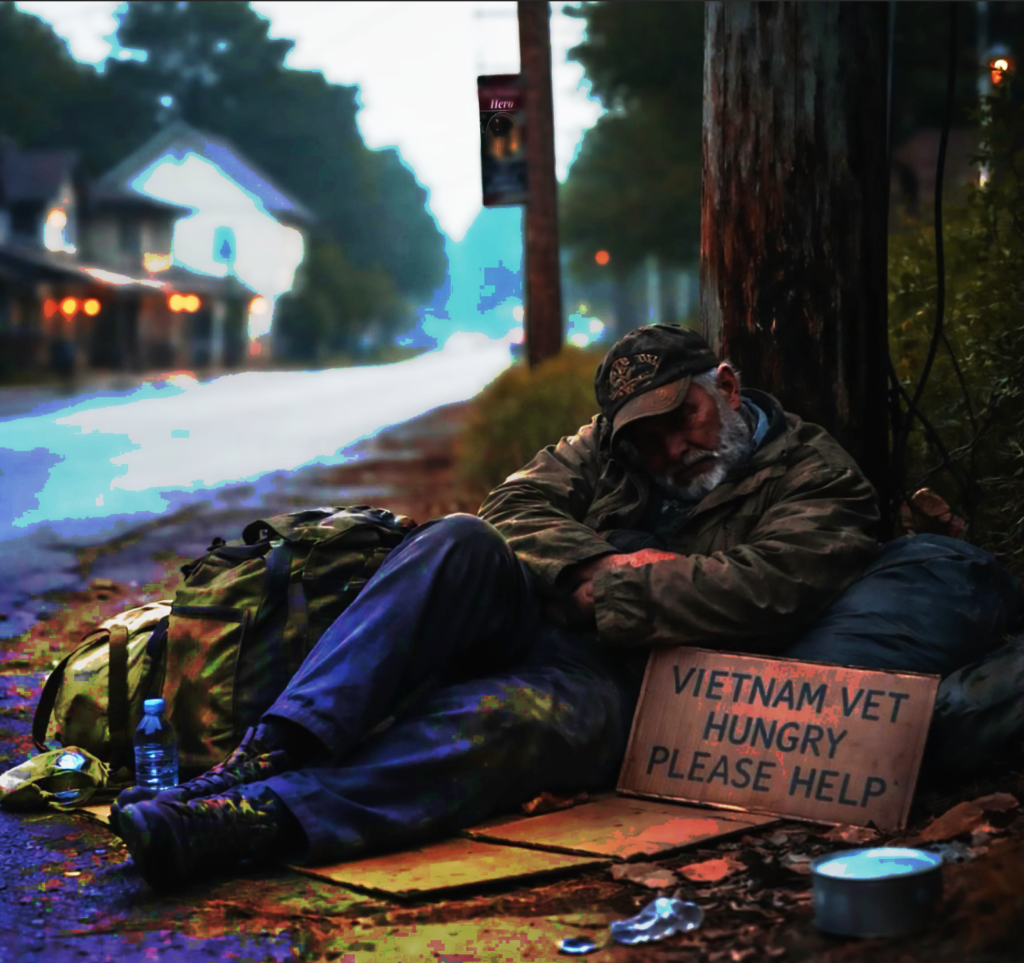
AI art, photography and image manipulation: Michael Lebron © NIA
NEXT
Part Two: Whose Speech?
I just gave the city things to think about with regard to the Hometown Heroes program. How will the city respond to the legal conundrums? Will the city find itself in a bind?
Part Three: Banners Over Our Streets, Or Roofs Over Their Heads?
What does honor and obligation really look like?
Part Four: Coda
Back into the thorny thicket
© Newburgh Is America
I am a one-man band here — writer, editor, copy editor, fact-checker, legal consultant, publisher and moderator wrapped into one, publishing within a time line that is compressed from the weeks or even months of what is normally allowed for long-form investigative writing into sometimes as little as a few days. Errors and omissions are inevitable in work produced under these conditions. I rely on an informed public to identify them, and where they are identified, the record is corrected. This piece reflects my best understanding at the time of publication and is subject to revision as additional information becomes available.
* Rainer Werner Fassbinder’s art-house film Mother Küsters Goes to Heaven, released in 1975, dramatizes how one woman’s grief over her husband’s killing of a personnel director and then killing himself at a factory is taken up and spent by others — a sensationalizing press, a political party that adopts her cause and discards it when she is no longer useful — each converting her mourning into its own currency.
** I conducted an exhaustive open-source search and was unable to turn up any such case. A Westlaw or Lexis search would settle the question definitively; I do not have access, but a colleague does, and I am awaiting the result.
REFERENCES
1 – Pennsylvania Hometown Heroes, Ruth Stonesifer’s project. Opening ceremony May 12, 2007, Harrisburg; about 140 of 183 Pennsylvania Gold Star families participated. Cpl. Kristofor Stonesifer, killed October 19, 2001 in a helicopter crash in Pakistan during early operations of Operation Enduring Freedom. http://www.pahometownheroes.org/ • https://hometownheroesbanners.com/pennsylvanias-hometown-heroes-not-forgotten/
2 – Ruth Stonesifer’s remembrance of her son (“He wouldn’t understand all the fuss … He would not define his death as a sacrifice for his country”). http://www.pahometownheroes.org/ • https://www.suburbanlifemagazine.com/article/158/All-Star-Ruth-Stonesifer
3 – Ruth Stonesifer commissioned Allentown, Pa.–based Holiday Outdoor Decor, which operates several banner businesses under different names (including Rileighs Outdoor Decor) and has claimed a trademark on the “Hometown Heroes Banner Program” and expanded its criteria to include all veterans and first responders. Sales language from holidayoutdoordecor.com. Christina Dolan, “Hartford, Randolph consider how banners celebrate heroes,” Valley News / VTDigger, Feb. 16, 2025. https://vtdigger.org/2025/02/16/hartford-randolph-consider-how-banners-celebrate-heroes/
4 – Clay v. United States, 403 U.S. 698 (1971): conviction reversed, 8–0, Marshall recused. Ali refused induction April 28, 1967; license suspended and title stripped the same day; barred from boxing until October 1970. https://supreme.justia.com/cases/federal/us/403/698/
5 – WWII U.S. Merchant Marine casualty rate roughly 1 in 26. Schumacher v. Aldridge, 665 F. Supp. 41 (D.D.C. 1987); veteran status recognized January 19, 1988. http://www.usmm.org/casualty.html
6 – Lebron v. National Railroad Passenger Corporation, 513 U.S. 374 (1995). https://supreme.justia.com/cases/federal/us/513/374/
7 – Greer v. UC Hometown Heroes Project, Magisterial District Judge Denise Buell, Erie County, judgment September 11, 2024, $6,676.76 (motor home struck by a low banner). https://www.yourerie.com/news/local-news/lawsuit-could-end-hometown-hero-banners-honoring-veterans-in-union-city/ • https://uctoday.org/2024/09/14/union-city-motorist-wins-case-against-uc-hometown-heroes-banners-to-stay-2/ — Hartford, Vt.: the “Hartford Heroes” project honored Dan Hillard, who pleaded guilty in 1999 to embezzling from an elderly Bethel widow; Randolph Selectboard Chair Trini Brassard raised character-vetting concerns. https://vtdigger.org/2025/02/16/hartford-randolph-consider-how-banners-celebrate-heroes/
8 – Hank Gross, “Newburgh councilman proposes Hometown Heroes tribute,” Mid-Hudson News, May 28, 2026. https://midhudsonnews.com/2026/05/28/newburgh-councilman-proposes-hometown-heroes-tribute/
9 – Banner sponsorship and fees, commonly $75–$225 per banner, with hardship or sponsor provisions. Mid-Hudson News reporting and published guidelines of comparable municipal programs. https://midhudsonnews.com/2026/05/28/newburgh-councilman-proposes-hometown-heroes-tribute/
10 – HUD, 2024 Annual Homelessness Assessment Report, Part 1 (Point-in-Time, January 2024): 32,882 veterans homeless on a single night; roughly 467,000 veterans severely rent-burdened; veterans 18–30 about twice as likely, and women veterans two to three times as likely, to experience homelessness as the general adult population. https://www.huduser.gov/portal/sites/default/files/pdf/2024-AHAR-Part-1.pdf • https://www.hudexchange.info/news/hud-releases-2024-ahar-report/
11 – Vietnam: 58,220 U.S. military fatal casualties (National Archives / DCAS). Iraq and Afghanistan: about 7,000 U.S. service members (DoD Defense Casualty Analysis System). Veteran suicide: VA, 2024 National Veteran Suicide Prevention Annual Report; cumulative post-2001 toll exceeds 120,000, about 17.6 per day. https://www.archives.gov/research/military/vietnam-war/casualty-statistics • https://dcas.dmdc.osd.mil/dcas/ • https://www.mentalhealth.va.gov/suicide_prevention/data.asp