The House I Live In performed by Josh White
There is a song most people know from Frank Sinatra. But Sinatra was not the first to record it. Called “The House I Live In”, it is a song about a promise — that the people who built this country, who cleaned its floors and worked its docks and raised its children, deserved to own a piece of it.
It was composed in 1944 by Earl Robinson. Abel Meeropol wrote the lyrics. The first recording was made by Josh White, a Black guitarist and singer from South Carolina.
In 1945 Sinatra made a short film built around it1 — but while shifting the emphasis to religious tolerance, he erased the song’s primary concern about racial and economic justice, cutting the verses “My neighbors white and black” and “land of wealth and beauty, With enough for all to share”, because of it’s pro-labor and socialist overtones.
Yeah, I know: as if “sharing” was a socialist evil to be erased at any cost, but let’s stay focused.
The House I Live In performed by Frank Sinatra
In 1947 Paul Robeson recorded it on Songs of Free Men and restored the verses. Because of course he did: those verses were the whole point.
Josh White was hauled before HUAC, where, among other things, he read the lyrics to “Strange Fruit” (also written by Meeropol). He was blacklisted. Robeson, his passport taken, was also blacklisted. Both: erased. Paul was erased with a thoroughness that required institutional coordination across government, media, and the entertainment industry. As a mere English teacher, Abel — not famous enough to be worth the effort to be erased — escaped this treatment.
Do you want to know who else has been largely erased?
The Black Panthers. The Young Lords. Fred Hampton was murdered at twenty-one, and then erased. And erased along with them: the tradition of community self-determination — the tradition that said working people do not need advocates to negotiate for them — thoroughly enough that organizations that now claim to speak for tenants in rooms like the one I was in on Saturday, March 28, 2026 are likely not very familiar with it.
That is not an accusation of hypocrisy. You cannot betray a tradition you don’t know exists.
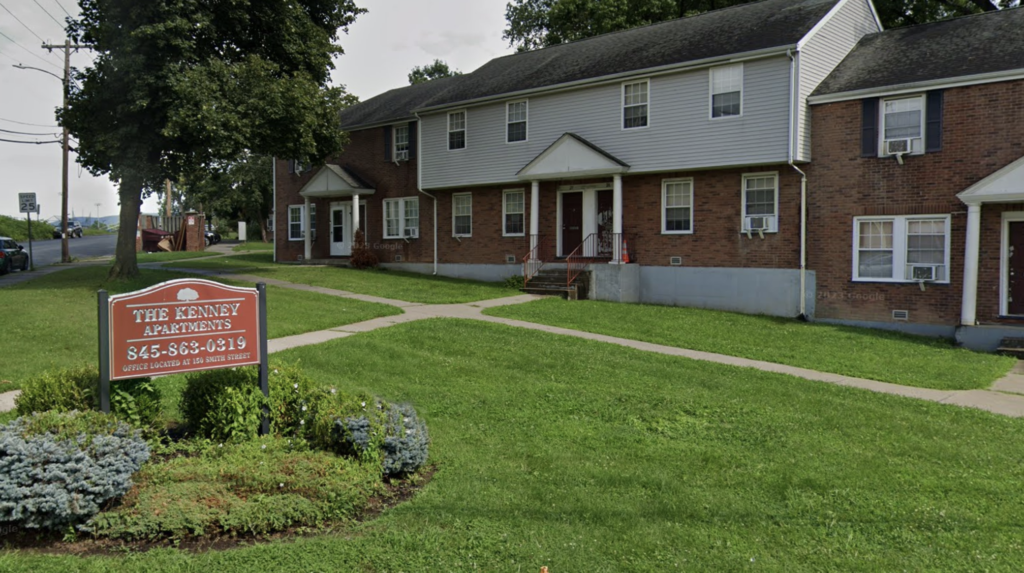
The Kenney apartment complex
How I Got In The Room
Earlier that week, one of the organizers running a meeting with the Kenney Apartment tenants in Newburgh, New York invited me to attend. The Kenney is an approximately 125-unit low-income building complex whose owners have left residents without heat and hot water for months, whose conditions are so atrocious that the Attorney General of New York State has stepped in. The tenants have endured fifteen years of neglect. Broken boilers. Mold. Rodent infestation. Children doing homework in coats.
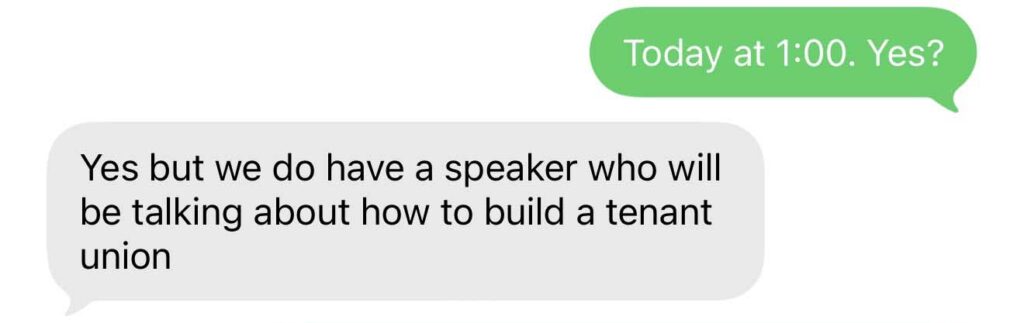
He gave me the wrong time — he said one o’clock, but the meeting started at twelve-thirty. I raced over and somehow arrived in time.
The organizer had one condition: the press was not allowed in, there would be no pictures. Tenants would be intimidated by cameras, he said. I told him I might be writing about the meeting but that I would leave individuals out. I am honoring that agreement. No one other than myself is named in this essay.
He also had another caveat: they would be talking about how to build a tenant union, the implication being other topics were not on the agenda.
Two organizations were running the meeting: Community Voices Heard, funded by the Ford Foundation, the Open Society Foundation, and the Rockefeller Brothers Fund, among others, and Hudson Valley Tenants Union, which receives money through North Star Fund, a fiscal sponsorship vehicle of the Tides Foundation, itself supported by Ford, along with the Dyson Foundation, and fees and dues from members. They have been funding tenant advocacy for fifty years. They have also been defining, through that funding, what tenant advocacy has become.
The track is well established. You document conditions. You organize residents. You negotiate with whoever owns the building. You get the best deal you can on affordability, relocation protections, lease conditions. You write it up. You get a deal done. You move on.
With Newburgh being a one party town, run by Democrats, both organizing groups also operate within the Democratic Party’s conception of tenant advocacy.
Was it a lie? Or an absence?
I did not plan to insert myself into that meeting. I planned to simply listen and observe. I found a seat among the 18 people there and parked myself.
If this meeting was only about “how to build a tenant union”, this presenter almost immediately went off script.
He told the room there were two options for the Kenney’s future. Force the current landlord to fix the building, or sell it to a new developer who will, with the support of a PILOT. He stated it as a fact, the way you state something when you have been in enough rooms like this one to know that nobody is going to contradict you.
But a tenant who has lived at the Kenney for decades did contradict him. She has survived everything that landlord has thrown at her, a landlord who treated her home as an extraction machine and nothing more. When she heard two options, she said NO: there is another. Then she pointed at me.
The organizer had just told a room full of people something that was not true. Whether it was a lie, or simply the honest expression of an agenda so thoroughly internalized that its origin story has been forgotten — I cannot say. I can say that it was false. In this room, on this day, there are not two options. There is a third. And the people in that room had a right to hear it. I had no choice but to respond.
If the judge grants the request of Tish James — the state attorney general — to have the complex put under receivership, the tenants could have an opportunity to own their own homes.
What followed was not a debate. It was a procedure. The tenant organizer looked at me and asked, in an accusatory tone, whether I owned buildings. As if that was a crime, and that was the first tell.
I said yes. I own The House I Live In.
He likely did not know I was giving a shout out across the decades to Abel Meeropol, to Josh White, to Paul Robeson.
He then built a straw man.
Looking at the tenants, he asked “Are you going to be able to get the millions of dollars needed to fix this building? Do you have that?”
The question was designed to produce one answer. And it produced it.
“No.”
“See,” the organizer said, angrily snapping back towards me. “The tenants don’t want it.”
The tenants were not asked whether they wanted to own their building. They were asked whether they personally possessed millions of dollars. When they said no — as any room of low-income tenants would — that answer was repackaged as a verdict on cooperative ownership and presented back to them as their own democratic decision.
The organizer did not tell the tenants about UHAB — the Urban Homesteading Assistance Board https://www.uhab.org/about-us/history/ — which has spent fifty years converting distressed buildings into tenant-owned cooperatives, while facilitating the financing in situations precisely like this one. The organizer did not tell the tenants about limited equity cooperatives, or HDFC structures, or HCR financing, or the specific legal leverage the Attorney General’s action could create for a distressed acquisition at a price that works for residents. The organizer did not tell the tenants that eighty thousand people in New York have done exactly what I was describing — not by scraping together millions of dollars, but by organizing collectively and accessing instruments that already exist precisely for this purpose.
The organizer did not tell them. The organizer handed the tenants a straw man, asked them to vote on it, and recorded their vote as a mandate.
I want to be precise about the role that this question – “Where are you going to get the millions of dollars needed to fix this building? Do you have that?” – played with the people in that room.
It encoded a class assumption so deep the organizer was not conscious of making it. And it goes like this: ownership is for people with capital. You don’t have capital. Therefore, the conversation is over. OVER. Stay in your lane. Your lane is tenancy. My lane is advocacy. The foundations lane is granting. The investors’ lane is ownership. Everyone stays in their lane.
That is not a neutral question. That is a class position dressed as a practical observation. It was delivered to a room full of people who have been told their whole lives that ownership is not for them — by systems, by markets, by institutions, by the compounding weight of fifteen years in a building whose landlord treated them as a revenue stream rather than as human beings with a future.
He made them say out loud, in front of each other, that they are poor. He used their answer to slam a door in their faces. He made them answer for their own dispossession.
In public.
In front of each other.
And then he recorded their answer as a mandate.
Whatever his intention, the effect was cruelty. Cruelty without malice is still cruelty.
That is disempowerment with a union label on it.
Keeping Kenney tenants in their lane keeps them away from wealth building. Rent is a stream, a stream that flows upward, away from them, towards owners, were it builds wealth that appreciates, that can be leveraged, that can be sold, that can be inherited, by others. Every building converted to tenant cooperative ownership is a building permanently removed from that architecture. It can never be flipped. It can never be sold to the next extractive investor. It can never be leveraged against its residents again.
The system doesn’t need the rent of Kenney tenants specifically. It needs them to stay in their lane because a group of people who own their homes, build equity, and pass wealth to their children is a demonstration effect. And demonstration effects are dangerous. If the Kenney tenants own their building, the tenants in the next building start asking why they don’t. The lane exists in part to refute the idea that the lane is optional.
A critic might point out that 65% of Americans already own their homes: what demonstration effect are you talking about?
Those 65% are in the market. Their ownership is subject to it — to interest rates, to foreclosure, to the next crash. It can be taken. It has been taken, millions of times.
Cooperative ownership pursuant to receivership is different. It exits the market permanently. The building cannot be sold to an investor, flipped when the neighborhood gentrifies, or foreclosed into a bank’s portfolio. It is removed from the speculative architecture.
That is the demonstration effect the system is protecting against. Not homeownership per se. Cooperative home ownership. A replicable model that the market cannot take back.
The tenant who had lived there for decades wanted to hear more. She was asked to leave.
They wanted to erase her.
At this point I need to make one other observation, but first, I will say this.
Malcolm X, in his “Speech After the Firebombing”2 at — ironically, the Ford Auditorium — said that “They take one little word out of what you say, ignore all the rest, and then begin to magnify it all over the world to make you look like what you actually aren’t”.
What Malcolm was addressing was the fact people would seize on a single phrase such as “all white people” in order to label him a racist, while ignoring the broader structural analysis of his message.
At this meeting, the tenants — all 19 of them — were people of color. Mostly Black, but enough Hispanic that the meeting slowed due to translation.
The organizers — all save one, the one who eventually suggested I leave — were white, with one white Hispanic. All were quite young. The were assured. They spoke with the idealized confidence that true believers have in what they were doing. Yet they asked the one person who was demonstrating organic intelligence — and I will get to what that means towards the end of this essay — to leave.
At Malcolm’s Firebombing speech, the same one where he famously said that “It ain’t something that will make me loose confidence in what I’m doing”, he also said something else.
The firebombing ruined almost all his clothing. For Nation of Islam members, presentation and dress were a matter of self respect, and respect for your community. He spent a minute or so at the very beginning of his speech … apologizing for his appearance.
The organizer who wanted the tenants to stay in their lane? The one who wanted to smear me as an evil landlord because I owned my home? I could not have come to that meeting dressed the way he did, and this is another tell. In that room, with those tenants, how you present yourself is a statement about how seriously you take them. The Nation of Islam understood this. Malcolm understood it so completely that he spent the opening minutes of his firebombing speech2 apologizing to his audience for his appearance.
Now, you may be asking: why should we hold these guys up to Malcolm’s dress code? Yes: today is a different era, a different culture.
Malcolm had just lost most everything he owned to an arson attack.
He apologized for his sartorial posture.
Seven days later, he was dead.
The Process Matters
I want to be precise about my own position, because it was misrepresented in that room and I will not leave the misrepresentation standing.
I do not believe tenant ownership should be imposed on anyone. I do not believe that because I think that homeownership is the best option, that the Kenney tenants must therefore want it also. I am insisting on exactly one thing, and that is proper process: that before tenants vote on their future, they must be told what their options actually are. All of them.
Organize first. Present all options. Then vote.
If the Kenney tenants hear the full case for cooperative ownership — the financing mechanisms, the UHAB track record, the legal pathway the AG’s action may open, the eighty thousand people who have done it — and they decide they would rather have a new landlord, that is their right.
But they cannot make an informed decision if the option is never named. They cannot vote on a choice they are not offered. What happened in that room tonight was not democracy. It was the management of a predetermined outcome by people whose funding, whose career tracks, and whose institutional imagination had already decided what the tenants were allowed to want. It is even arguable that HVTU has a conflict of interest: their own membership goals may not serve the Kenney tenants, who may first need to build an independent tenant group of their own, limited to the complex only, and once that is accomplished, maybe a city-wide tenants group could be built on that foundation.
What I saw that afternoon was not organizing. It was administration.
The Conservative Case No Democrat In That Room Would Make
Here is something that should be said plainly, in a one-party city.
Homeownership teaches stewardship. It teaches responsibility. It builds intergenerational wealth. It creates a personal stake in the condition of a community. It reduces dependency on government subsidy. It produces the kind of citizen that conservatives have always said they want to produce — self-sufficient, invested, rooted, building something that can be passed to children.
Cooperative ownership of the Kenney Apartments would do all of those things for the families who live there. It would convert rent payments — money that currently flows to an extractive investor and will flow to the next one — into equity. It would give residents a direct stake in the maintenance and governance of their building. Once the conversion is complete, it requires no ongoing government subsidy. The residents own it. They govern it. They build wealth in it.
This PILOT — this tax break being negotiated in rooms like tonight’s — is the liberal solution. It is a government intervention in the market on behalf of an investor, structured to attract private capital to a building that private capital has already destroyed once. It is a subsidy that shifts the tax burden onto primarily other working families in the municipality who are homeowners and pay their taxes. It requires ongoing monitoring, compliance enforcement, and political management. It shifts costs to other municipal taxpayers. It produces tenants. It does not produce owners.
Cooperative ownership is both the conservative solution and the more radical one. It is the solution that the Democratic Party’s liberal tenant advocacy infrastructure did not put on the table in that room.
Republicans who believe what they say they believe about ownership, responsibility, and wealth-building should be for this. The fact that they have not shown up to say so in Newburgh is their failure. The fact that the Democrats running this city’s tenant advocacy have actively blocked the conversation is theirs.
The tenant who has lived in that building for decades should not have to wait for either party to find its conscience. She has already waited fifteen years. Instead, she was asked to leave the room.
What Was Erased And Why It Matters
The Black Panthers put community control of housing in their Ten Point Program. Point 4 of the Ten Point Program reads: “We want decent housing, fit for the shelter of human beings. We believe that if the landlords will not give decent housing to our Black and oppressed communities, then the housing and the land should be made into cooperatives so that the people in our communities, with government aid, can build and make decent housing for the people.”
The Young Lords organized in East Harlem and the South Bronx against displacement, absentee landlords, and urban renewal policies that were destroying Puerto Rican neighborhoods block by block. Their Thirteen Point Program called for community control of the institutions that governed their lives — schools, hospitals, housing. They didn’t wait to be given anything. They occupied a church and renamed it The People’s Church. They occupied Lincoln Hospital and renamed it The People’s Hospital. They occupied abandoned apartment buildings. The principle was consistent: the people who live in a place have the right to control it.
Fred Hampton built the Rainbow Coalition on the understanding that the professional advocacy class was a buffer between working people and power, not a bridge to it.
Huey Newton’s theory of intercommunalism placed community self-governance — not better-negotiated tenancy — at the center of what liberation meant.
These were not marginal positions. They were the conclusions serious people reached after serious analysis of how power works. They understood that advocacy without ownership is a managerial arrangement: that as long as someone else holds the deed, the advocate’s services will always be needed and the tenant’s situation will always need to be negotiated.
But they were erased. The Panthers were dismantled by COINTELPRO. The Young Lords dissolved. Hampton was murdered.
In that room, no one invoked the Panthers or the Young Lords, or Hampton or Newton. They cannot invoke what they do not know. They operate in a different tradition entirely — the liberal Progressive Era tradition of professional management, in which trained advocates process cases through established channels on behalf of people assumed to need representation rather than power, and then shift the costs elsewhere. They posed a question engineered to make people feel the full weight of their powerlessness.
How I Know The Journey Is Possible
In the 1970s I was an artist with no money living in a Manhattan loft I had no legal right to occupy. The building was zoned for manufacturing. My landlord knew it. The city knew it. I knew it. I had a commercial lease, no heat rights, no water rights, no legal standing. We were tolerated as long as we were invisible and evictable the moment we became inconvenient.
We organized … ourselves. The Lower Manhattan Loft Tenants movement fought for years — against landlords, against the city, against the indifference of institutions that had decided our situation was too complicated to remedy. We testified. We demonstrated. We built coalitions. We legislated. We sued. We won. The Loft Law established our legal right to be there. And over time I went from an illegal tenant with no leverage against a billion dollar landlord to an owner — of my loft fixtures, of my lease, while building my own equity, an equity that I eventually converted into The House I live In, the house I own, where I live with my wife today.
That ownership changed everything. It even changed my landlord. He grew to regard us as his favorite tenants. Why? Because we not only took care of his building, we improved it. We were his only tenants to always pay the rent on time. That goes back to my earlier point about learning stewardship.
It gave my family security. It gave me the platform from which I do the work I do now.
The loft movement succeeded because we refused to accept that our situation was fatally constrained: we imagined, then self-organized, then built our way forward together. The people running the meeting tonight instead accepted the opposite on behalf of the Kenney tenants. They have decided, in advance, in other rooms, with their funders and their colleagues and their established track, that the Kenney tenants are tenants and will remain tenants and the best that can be done is to find them another landlord.
What Happens When The PILOT Fails.
What if the property does not go into receivership? Receivership is a precondition to tenant cooperative ownership. It may not go into receivership.
But what if the city does not grant a PILOT, a precondition of the prospective owner? These organizers were presenting as though a new investor and a PILOT tax break are a foregone conclusion. They are not. There are members of this council with serious reservations. There are residents of this city who have been building the case against it for months: why should working class homeowners bail out a failed landlord, or subsidize his failures through the one who may come in? If the PILOT does not win the necessary votes — and it may not — then what was being presented about a new landlord is moot. The investors walk. The affordability commitments, the relocation protections, the affordable rents, all of it walk with them.
Then, what remains is the Attorney General’s action, which has already created something more powerful than any PILOT negotiation: legal leverage over a financially disabled owner whose building cannot be sold until violations are remediated, who faces thousands of dollars a day in fines, and who has no exit that doesn’t run through the AG’s office.
The city has a constructive role to play here … should they choose to do so. If the city refuses to grant a PILOT, then the current owner is likely trapped, and tenant ownership probably becomes both the long and the short term solution.
UHAB understands this. When a Newburgh city councilmember reached out to them, their response was: with the AG involved, this is exactly the time to strike.
The House That UHAB Built
Imagine a city nearly three times the size of Newburgh where everyone was once in the situation that the Kenney tenants find themselves in, and at the end of a process, ended up owning their own home.
UHAB built that “city”.
With limited equity cooperatives that remove buildings permanently from the speculative market. With financing that low-income tenants do not have to personally provide. With fifty years of doing exactly what was done tonight in that room — telling people that a third option exists — and then helping them take it.
Eighty thousand people own their homes in New York because someone named the third option and refused to leave the room until it was heard.
The Apology In The Hallway
The meeting ended. I left. The organizer who had invited me followed me out of the building. He apologized. He said the meeting was supposed to be only about organizing — that the conversation about ownership transfer had not been part of the plan.
I told him that clearly was not what had happened inside. The materials projected onto the wall were proof of its preconception. Once the organizer claimed there were only two options, once the longtime tenant challenged him and pointed at me, I had no choice but to name the third. You cannot stand in a room and watch a false premise go unchallenged when the people being misled are the ones with the most at stake.
What was most damning to me was the fact that the organizers expressed no curiosity about what I was telling them. None. What … so … ever. When we started the Lower Manhattan Loft Tenants Association, all ideas were welcomed. We were all equals: the ideas could come from anywhere.
Instead, when challenged on a false premise, they did not ask questions. They got angry, they pushed back, hard. They were territorial. They were not open to other views … to being wrong.
Paulo Freire, author of The Pedagogy of the Oppressed3, called this type of organizing the banking model — the educator deposits, the student receives, and the question of what the student already knows, already wants, already imagines is never asked. That room was a bank. The tenants were the account.
But I accepted the apology. We shook hands. He is not the institution. He is a person who invited me in good faith, gave me the wrong time, and had the decency to follow me into the hallway and own the mistakes.
A tenant stood up and said there is a third way.
People like that tenant are the organic intelligence in the room. Per Gramsci: she is the person who emerges from within a group to give it power through internal consciousness.
When Gustavo Gutiérrez – in The Theology of Liberation4 — spoke of the preferential option for the poor, he was prioritizing truth recognized from within over charity administered from above.
And if you go back a couple millennia, there’s Luke 17:21: the kingdom of God is within you. Not delivered. Not administered. Not from anyone else’s agenda. The truth and the power: it is yours.
The tenant who has lived there for decades wants to own The House She Lives In.
She leaned forward.
She was asked to leave. By then, she had heard enough. She was frustrated. She was angry. She was done. The ask was her door, and she took it. But she will not be erased.
The House I Live In performed by Paul Robeson
Before Martin. Before Malcolm. There was Paul.
Besides being an advocate for civil rights, economic justice, and racial and class solidarity, Paul Robeson was one of the two greatest bass baritones of the twentieth century. The other was Fyodor Chaliapin of Russia. Fyodor trained his voice over decades. Paul’s voice was simply the one he was born with. What a voice it was. The United States government did everything in its power, short of assassination, to silence it, but it was once known around the world.
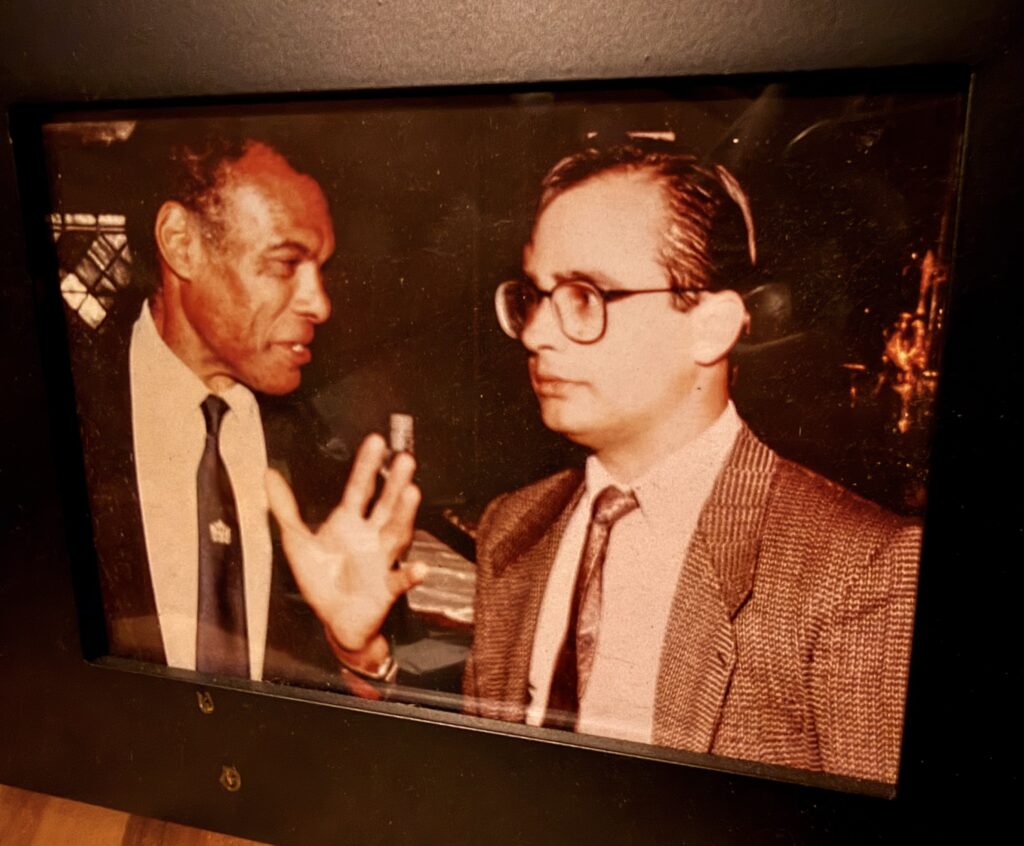
photograph by Paul Dix: Paul Robeson Jr. – Paul’s son – left, and Michael Lebron at an event that they worked on together, 1987
© March 31, 2026 Michael Lebron
Michael Lebron is the founder of Newburgh Is America. He lives in Newburgh with his wife.
Notes:
1 https://en.wikipedia.org/wiki/The_House_I_Live_In_(1945_film)#Title_song The House I Live In is a ten-minute short film written by Albert Maltz, produced by Frank Ross and Mervyn LeRoy, and starring Frank Sinatra. Made to oppose anti-Semitism at the end of World War II, it received an Honorary Academy Award[1] and a special Golden Globe Award in 1946.
2 https://www.wilmadykemanlegacy.org/articles-and-resources/malcolm-x-speaks-in-detroit—february-1965 This audio recording of Malcolm X’s full speech as been downloaded from the C. Eric Lincoln Collection of the Atlanta University Center Robert W. Woodruff LIbrary.
3 https://en.wikipedia.org/wiki/Pedagogy_of_the_Oppressed This text argues that the conditions of the poor are the direct result of the whole economic, social and political domination. The book suggests that in some countries the oppressors use the system to maintain a ‘culture of silence’. Through the right kind of education, the book suggests, avoiding authoritarian teacher-pupil models and based on the actual experiences of students and on continual shared investigation, every human being, no matter how impoverished, can develop a new awareness of self, and the right to be heard.
4 https://www.amazon.com/Theology-Liberation-Salvation-Anniversary-Introduction/dp/0883445425 This is the credo and seminal text of the movement which was later characterized as liberation theology. The book burst upon the scene in the early seventies, and was swiftly acknowledged as a pioneering and prophetic approach to theology which famously made an option for the exploited, the alienated, and the economically challenged at the centre of a programme where “the oppressed and maimed and blind and lame” were prioritized at the expense of those who either maintained the status quo or who abused the structures of power for their own ends.