Councilman Omari Shakur, who represents the City of Newburgh at-large, addressed the Newburgh Community Land Bank from the council floor on the evening of April 22’s council work meeting. He had been listening to the Land Bank’s executive director walk the council through a slide presentation describing fourteen years of operation, and he had been doing the arithmetic in real time. When the executive director finished, Shakur read the numbers back.
“138 properties acquired for the city of Newburgh. 119 activated and restored in the city. The city is 80 percent Black and Hispanic and only 12 went to Black and Latino families.1 I think we know who you are here working for.”
The 138 and the 119 are the institution’s own numbers, displayed on the slide titled “NCLB Impact Since 2012.”2 The 12 is Shakur’s reading of the slide that came later in the deck, where House to Home program sales were described as having gone to “Black, Latino, and local homebuyers.” Whether the 12 is, strictly, the count of Black and Latino dispositions out of 119, or, more narrowly, the count of dispositions through the House to Home program on Lander, Johnston, S Miller, and Farrington, the slides do not parse precisely. The institution’s own framing groups Black, Latino, and local homebuyers in the same descriptor on the same line, suggesting the institution itself treats the three as overlapping or sequential categories rather than as distinct categories worth disaggregating. Shakur read the slide as anyone in the room could have read it. The arithmetic was his. The verdict was his.
The Land Bank built its case and projected it onto the wall. What follows is my parsing of what their own slides said. Let’s see if Shakur’s outrage is justified.
Slide one: the impact summary
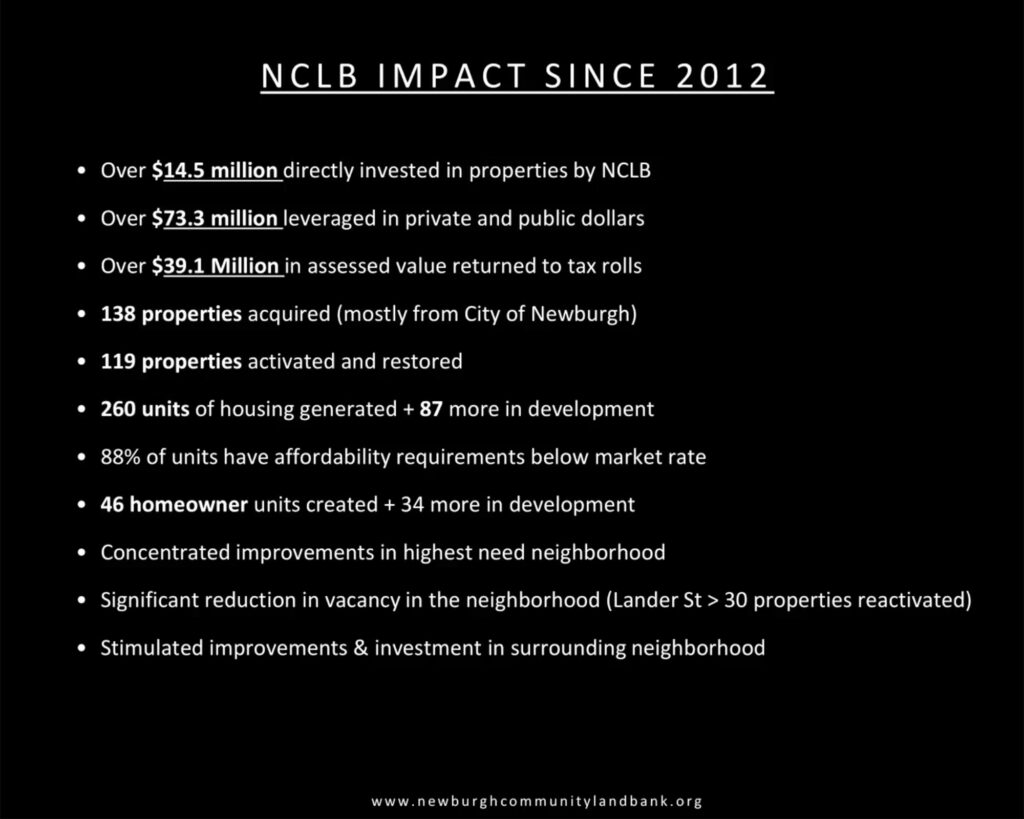
This first slide of the presentation was titled “NCLB Impact Since 2012.” It listed eleven bullet points of self-reported achievement.2 The numbers, taken at face value, are:
Direct investment by the Land Bank: $14.5 million. Leveraged public and private dollars on top of that: $73.3 million. Total project investment across the portfolio: approximately $87.8 million. Properties acquired: 138, mostly from the City of Newburgh. Properties activated and restored: 119. Housing units generated: 260, with 87 more in development. Affordability requirements below market rate: 88 percent of units. Homeowner units created: 46, with 34 more in development. Assessed value returned to the tax rolls: $39.1 million.
That last number is the slide’s most damaging self-disclosure. The Land Bank reports that $87.8 million of total project investment has produced $39.1 million in returned assessed value.
For every public-and-leveraged dollar poured into these properties over fourteen years, the city has recovered, in tax-assessable form, approximately 45 cents.
The slide also reports that 88 percent of the units carry below-market affordability requirements. Affordability requirements are imposed on rental projects through tax-credit financing and other public subsidy mechanisms. The 88 percent figure tells you the disposition outcome: institutional ownership of restricted-rent rental inventory. Of the 260 units generated, 46 are homeowner units. The remaining 214 are rental. The institution chartered, under New York General Municipal Law Article 16, to prioritize community benefit and homeownership, has produced rental at a 4.6-to-1 ratio over ownership.
The fourteen-year production rate is also worth marking. 119 activated properties over fourteen years is 8.5 properties per year. That is the operational scale of the most heavily resourced municipal land bank in the Hudson Valley.
Slide two: the projects, by name
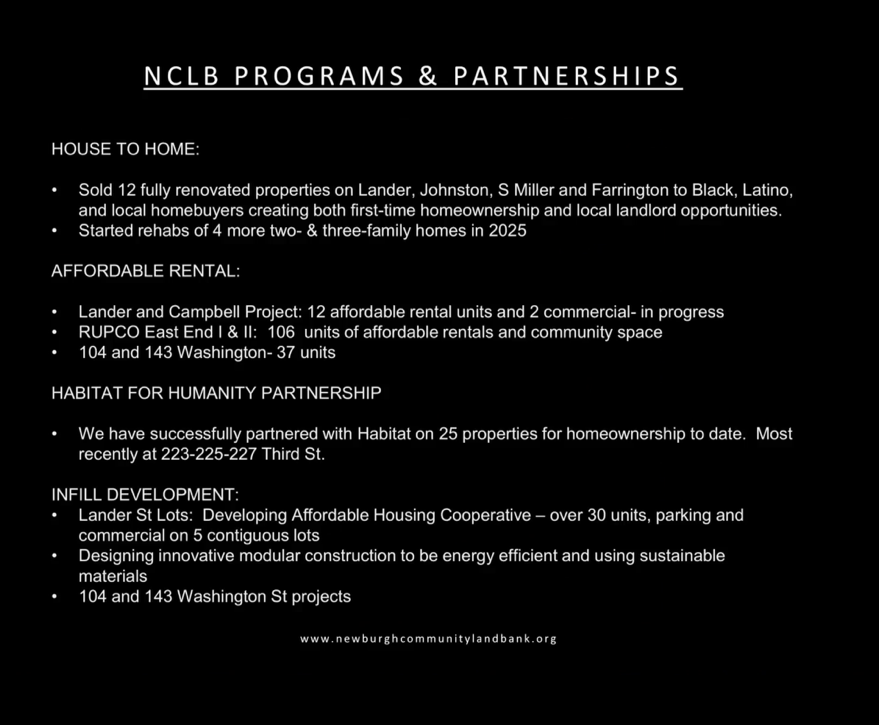
This second slide, titled “NCLB Programs & Partnerships,” named the actual projects. Under “Affordable Rental,” the slide listed three: the Lander and Campbell Project, with 12 affordable rental units and 2 commercial spaces in progress; RUPCO East End I and II, 106 units of affordable rentals and community space; and 104 and 143 Washington Street, 37 units. These three projects alone account for 155 units of institutional-rental disposition.
Under “House to Home” — the homeownership program — the slide reports 12 fully renovated properties sold on Lander, Johnston, South Miller, and Farrington Streets to “Black, Latino, and local homebuyers.” That phrase “and local” is doing work. The Land Bank’s own slide is acknowledging that not all 12 of the homeowner-disposition properties went to Black or Latino buyers. The actual count of Black and Latino owner-occupant placements is some subset of 12. The Land Bank knows the breakdown. It is FOIL-able. It is not been disclosed here publicly.
Under “Habitat for Humanity Partnership,” the slide reports 25 properties for homeownership through Habitat — a credit-tolerant, sweat-equity ownership pathway. The Land Bank, the slide demonstrates, knows that non-conventional ownership financing produces homeowner outcomes. They have been using one such pathway, with Habitat, at modest scale. They do not cite others — NACA, SONYMA Give Me Credit, CDFI alternatives, limited-equity cooperatives — that would expand the homeowner share further.
Under “Infill Development,” the slide reports a Lander Street project: “Developing Affordable Housing Cooperative — over 30 units, parking and commercial on 5 contiguous lots.” The chair of the Land Bank, Lisa Daily, who also serves on the city planning board, said in the same meeting, in response to a question from Councilwoman Tamika Stewart of Ward 3:
“Education is a huge part of this. I don’t know how a coop operates and I’ve been doing this work for four years. So a brand new possible homeowner won’t have a clue and they are going to need a lot of opportunities for education.”3
The instinct behind that answer was honest. The chair was not performing competence she lacked. But the substance described a void at the institutional center of Newburgh’s property disposition apparatus. Cooperative ownership is not esoteric. It is one of the three basic forms of multi-unit housing tenure in New York State. Limited-equity coops are the primary vehicle by which working-class New Yorkers have historically accessed ownership. Hundreds of thousands of New York households live in them.
The slide and the chair’s admission cannot both be fully accurate descriptions of the institution’s competence. Either the Lander Street project is not actually a cooperative in the resident-owned, limited-equity sense, or it is a cooperative whose development is being supervised by a chair who has publicly disclaimed knowledge of the form. Either reading is consequential.
Stewart, having received the chair’s answer, pivoted. Without breaking stride, she named the working alternative. She described buying her own home in Newburgh in 2019 through NACA — the Neighborhood Assistance Corporation of America — with full down-payment assistance, with a bought-down mortgage rate in the low twos, and without the credit-score gate Daily had invoked a moment earlier as a categorical barrier. Stewart walked the Land Bank through what the program actually does, step by step.
Daily’s response: “We need more career work here. If you have a credit score of 4 or 500, you are not going to get a mortgage. It takes a long time to move that needle.”
Stewart, with calm restraint, corrected her by repeating: “NACA is not credit based.”
Daily … softly replied: “Oh, that’s great.”
That exchange is the entire institutional problem of the Land Bank in thirty seconds of videotape. The council member, working from lived experience, appears to have had more operational knowledge about accessible homeownership financing than the chair of the Land Bank did. The chair’s response was not to update the institution’s operating premise. It was to register mild surprise and move on.
The Land Bank is not producing disparate outcomes because it is biased. It is producing disparate outcomes because its operating framework is calibrated to financing pathways that embed the downstream effects of historic discrimination. Urban renewal destroyed Black equity. Six decades of post-displacement wage suppression and predatory lending damaged Black credit scores. The Land Bank has built its disposition framework around the credit-score and down-payment gates produced by that history, then expresses mild surprise when its disposition outcomes track the demographic distribution of credit scores and down payments in the city. The pattern is reproductive. It reproduces the harm it claims to remedy, through the mechanism of what it accepts as a normal prerequisite for homeownership.
Asked by Stewart whether she had connected with this writer about cooperatives, the executive director said she had spoken with him before. For the record, and to the best of my knowledge, I had not seen Jennifer Welles before that evening. After her presentation she walked past my seat. I glanced up. She did not attempt to make eye contact.
Stewart stood in front of the Land Bank as proof of concept. The institution said “oh, that’s great” and the conversation moved on.
Slide three: the per-home economics
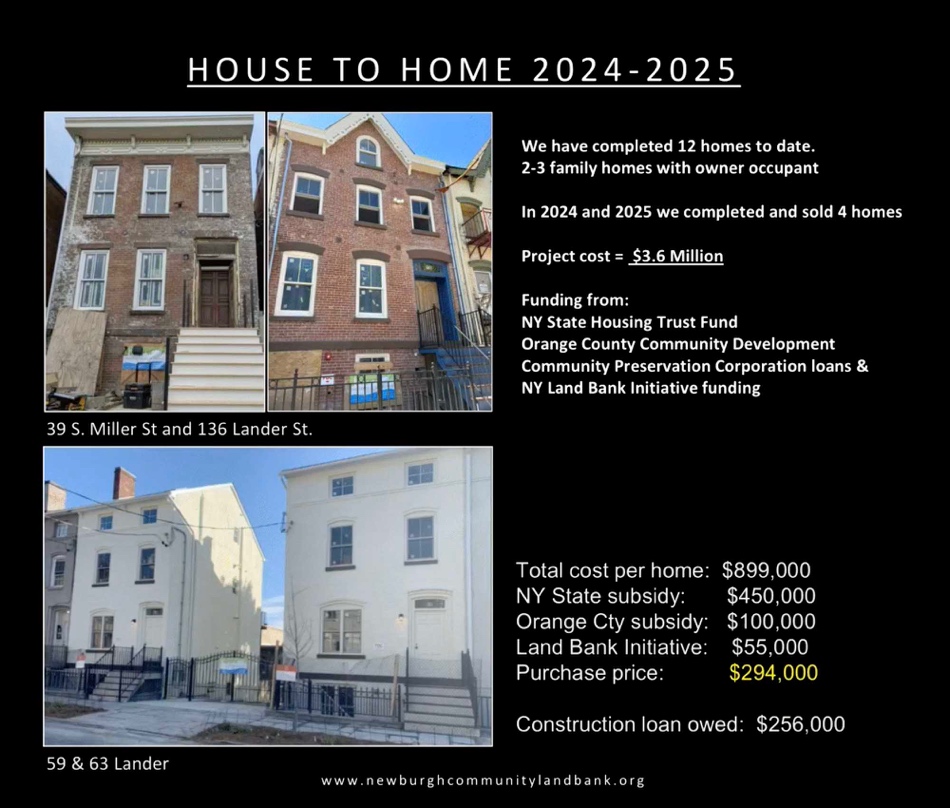
This slide gave the council the per-home economics. Title: “House to Home 2024-2025.” The slide reported that the Land Bank had completed and sold four homes in 2024 and 2025. Total project cost across those four homes: $3.6 million. Per-home cost line items, reported by the Land Bank itself:
| Line | Amount |
| Total cost per home | $899,000 |
| New York State subsidy | $450,000 |
| Orange County subsidy | $100,000 |
| Land Bank Initiative subsidy | $55,000 |
| Public subsidy total | $605,000 |
| Final purchase price to buyer | $294,000 |
| Construction loan buyer carries | $256,000 |
The homes in question were 2-3 family historic buildings on Lander and South Miller Streets. Assume an average of roughly 2,500 square feet per home, which is reasonable for Newburgh historic two-and-three-family construction. That puts the per-square-foot cost at approximately $360. If the homes are 3,000 square feet, the figure drops to $300.
The subsidy is not flowing to the buyer in any meaningful sense. The buyer pays $294,000 and assumes a $256,000 construction loan obligation — a debt that, at the median Black household income in Newburgh of approximately $30,578,4 requires roughly 70 to 80 percent of monthly gross income to service at current mortgage rates. The “affordable” purchase price is, for the population the program ostensibly serves, still not affordable. The $605,000 in public subsidy is a transfer to the institutional construction apparatus the Land Bank’s chosen model requires. The State of New York, Orange County, and the Land Bank Initiative are paying that institutional premium so that the Land Bank can produce homeowner outcomes at a rate the slide also discloses: two homes per year over the most recent reported period.
Two homes per year. That is the operational scale of the Land Bank’s most heavily subsidized owner-occupant program in the years 2024 and 2025.
Slide four: the Lander Street cooperative
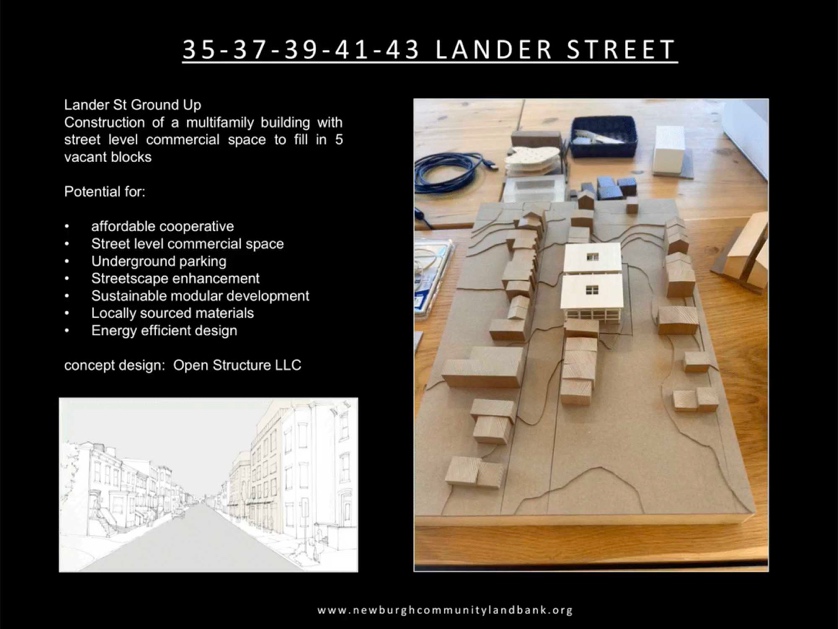
This slide showed a rendering of the proposed Lander Street cooperative project — addresses 35, 37, 39, 41, and 43 Lander Street, five contiguous lots. The architectural concept is by Open Structure LLC. The image depicts a contemporary modular residential building, three to four stories tall, executed in white panel cladding with regularly punched window openings, a flat roofline, and minimal architectural detail. Ground-floor commercial space at one end. The building bears no relationship to the surviving brick masonry buildings of nineteenth-century Lander Street.
The slide describes the project program: “Construction of a multifamily building with street level commercial space to fill in 5 vacant blocks.” Listed potential uses: affordable cooperative, street-level commercial, underground parking, streetscape enhancement, sustainable modular development, locally sourced materials, energy-efficient design.
The proposed building is not architecturally responsive to the East End. It is responsive to the cost-and-schedule logic of modular factory construction, with the architectural consequences that follow from that logic — generic massing, standardized fenestration, materials that may be imported rather than indigenous, and a relationship to historic context that is often contradictory. The descendants of the displaced East End community lived, before urban renewal, in buildings of a specific kind. The Land Bank’s proposed reconstitution of Lander Street is not a reconstitution. It is the construction of a building in the contemporary modular vocabulary on land the city’s earlier decisions emptied. The cooperative ownership structure, if it is in fact structured as a resident-owned limited-equity cooperative, is the most reparative element of their projects. But the architectural choice does not restore what was lost. It overlays the loss with something else.
There is also a separate architectural argument that bears on the wealth-building case the Land Bank makes for its work. Restored historic buildings command premiums in the marketplace. Buyers and tenants pay more for historic character. Lenders underwrite at higher values for restored historic stock. Owner-occupants accumulate equity faster in restored historic buildings whose architectural value is rising than in contemporary modular construction. The Land Bank, in choosing modular new construction over historic restoration, is choosing the path that produces less long-term equity for the eventual owners.
Slide five: the property acquisition list
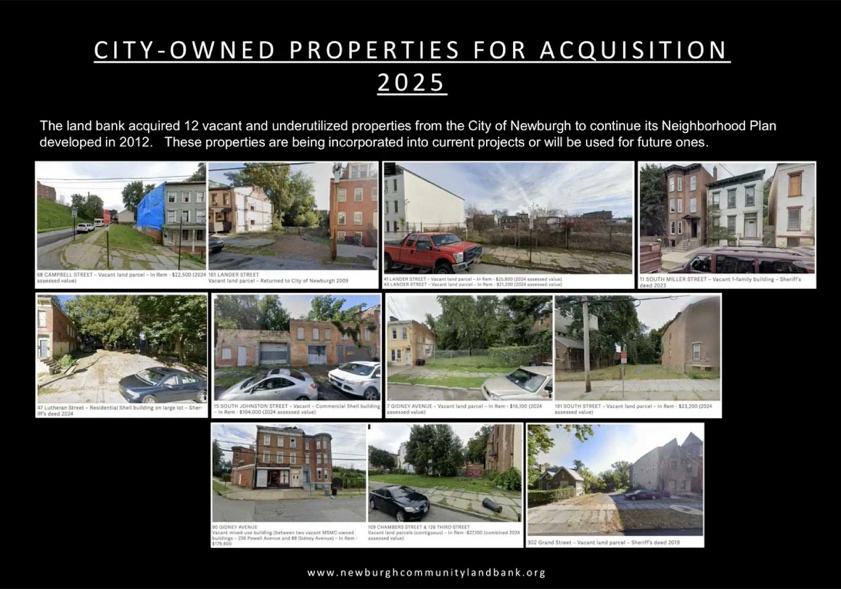
This slide was titled “City-Owned Property Acquisition 2025.” It listed fourteen city-owned properties the Land Bank was requesting the city transfer to its inventory in 2025. Each parcel was listed with its address, its 2024 assessed value, the proposed disposition use, and a designation as “structure” or “vacant lot.”
Five contiguous Lander Street parcels — including 41 and 43, with neighboring parcels referenced as 35-37-39 — are queued for the cooperative project. A buildable lot at 302 Grand Street is queued for “new construction 40 x 175.” A “Residential Shell building” at 47 Lutheran Street is queued for “new construction” — meaning, in the slide’s own framing, demolition of the surviving structure and ground-up replacement.
The single most revealing line on the slide is in the proposed-use column for 90 Gidney Avenue, a vacant mixed-use building assessed at $179,600: “stabilization/rehab — sale to local small landlord — or acquire adjacent buildings for bigger affordable housing project.”
The Land Bank’s proposed-use language places the local small-landlord disposition and the institutional assemblage side by side as alternatives. The institution treats the two as equivalent dispositions, presented as live options under consideration. Shakur’s 12-of-119 may be the record of how those alternatives have actually resolved across 119 dispositions over four years. It can be FOILED. The slide is asking the council to extend the framework that produced that record.
Slide six: the institution complains
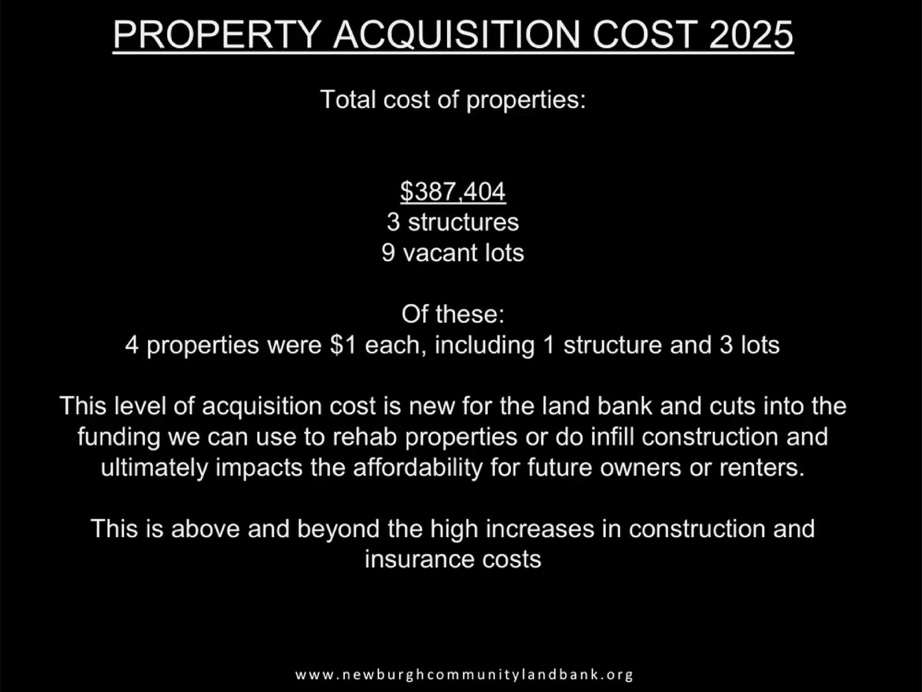
This sixth slide was titled “Property Acquisition Cost 2025.” Total cost of the property package: $387,404. Three structures and nine vacant lots. Of these, four properties were $1 each, including one structure and three lots.
Then came the slide’s argument:
“This level of acquisition cost is new (pursuant to new law, author’s note) for the land bank and cuts into the funding we can use to rehab properties or do infill construction and ultimately impacts the affordability for future owners or renters. This is above and beyond the high increases in construction and insurance costs.”5
The slide concedes, that institutional cost structure passes through to end-user affordability. Higher acquisition costs cut into rehab funding, which “ultimately impacts the affordability for future owners or renters.” The Land Bank is admitting, on its own slide, a principle on which this entire piece’s critique rests: institutional overhead shows up in the prices end users pay.
Lander Street, five years ago
It is at the risk of making myself vulnerable to charges of being a person with an ax to grind that I bring this next concededly anecdotal and personal matter up. I do so because it possibly illustrates a pattern.
In 2020, I tried to purchase a property at 116 Lander Street, a few doors from my sister-in-law’s home. I had signed an agreement with the City of Newburgh. The city instead transferred the property to the Newburgh Community Land Bank and directed me to purchase it from them.
My architect for the project was CB Wayne — a degree in architecture from The Cooper Union’s world-class 5 year program, with a Master’s in Construction Management from Harvard’s Graduate School of Design, and a portfolio that included historic rehabilitation work in Newburgh. CB and I prepared a $275,000 rehabilitation budget for the 2,700-square-foot building. The Harvard credential is not incidental to that number. Construction Management is the specific discipline that trains professionals to estimate rehabilitation costs and produce defensible construction budgets. His estimate was not an opinion. It was a professional cost projection from the exact intersection of disciplines that such an estimate requires.
We presented it to the Land Bank. The executive director at the time was Madeleine Fletcher. The Land Bank responded that we would have to demonstrate proof of funds of $775,000 — roughly three times my architect’s budget — before the disposition could proceed.
CB gave me a slight kick under the table as he said: “If that is your final position, I don’t think there’s anything more to discuss here.”
I was surprised at CB’s abrupt end to the meeting, and somewhat resistant, but I followed his lead. Outside, on the sidewalk, he said: “You and I both know it does not cost anywhere near $300 a square foot to fix that building. They are warehousing that building. We are not going along with that.”
The Land Bank set a liquidity gate — proof of funds at roughly three times a credentialed construction manager’s rehab budget — that no individual owner-occupant could clear. The gate was not described as a preference for institutional buyers. It was described as an underwriting standard. But its effect was the effect of a preference. Individual buyers were filtered out. The property was to be held to be transferred to an institutional developer with the capital stack to clear the gate that most individuals could not, that this individual would not.
At the time, I was resistant to CB’s assessment. I – naively, as it turned out — did not want to believe the Newburgh Land Bank would conduct business this way. But I was paying CB for his professional judgment. In that meeting he delivered it.
The building was in fact subsequently bundled with approximately a dozen other parcels and disposed of to RUPCO, a regional nonprofit housing developer headquartered in Kingston. RUPCO then converted the bundled portfolio into mostly Section 8 rental inventory.
When I pointed this out to Fletcher when we ran into each other at a subsequent art event in the city, she replied: “Well, they have far more experience than you.”
The $775,000 proof-of-funds requirement was the financial form of the preference (In hindsight, I wish we had called their bluff, to see if they would go with RUPCO anyway).
Fletcher’s sentence was the preference itself.
How many others might have experienced this treatment?
The Architectural Review Commission
Here is another anecdote, with the same caveat.
Some time after the Lander Street denial, I attended an Architectural Review Commission meeting at which RUPCO requested permission to demolish two historic buildings it had acquired from the city.8 RUPCO’s stated grounds for demolition: rehabilitation would cost more than $400 per square foot, which the institution represented as economically unworkable. Several ARC members were furious. Demolition of historic buildings on cost grounds is the kind of argument the commission exists to prevent.
During the public comment period, I suggested to the commission that if RUPCO could not rehabilitate the buildings at a defensible cost, the city should take them back and convey them to my wife and myself, and we would do the work for less than $200 per square foot. The offer was made on the public record, in the same meeting and the same room as RUPCO’s $400-per-square-foot demolition argument.
After the meeting, Madeleine Fletcher came over to me privately and suggested she would find two other buildings for us. She never did: she soon resigned her position to take up another elsewhere in the county.
The two buildings RUPCO wanted to demolish were not buildings the Land Bank was willing to dispose to qualified owner-restorers. The institutional pipeline was preserved. The public confrontation was converted into a private deferral. The private deferral was never honored. The buildings were demolished.
Artists in Vacancy
Speaking of art.
Around 2018, the Land Bank sponsored a program called Artists in Vacancy. It solicited proposals from artists to install temporary works in the institution’s vacant building inventory. Few if any of the selected artists were people of African American or Hispanic origin, most, if not almost all, were from Brooklyn. The work spoke the language of international artspeak rather than the language of East End residents. Few of the installations engaged the history of the buildings they occupied. Two installations — one of scaffolding with brownstone steps salvaged from a demolished building, the other a field of sawgrass bounded by corrugated steel — created safety hazards. Children climbed the steps. The corrugated steel had sharp edges. It took weeks of pressure to get the city to fence the installations. The fences around the steps were simply orange vinyl construction fencing that did nothing to keep children out. A sign on the chain link fence surrounding the corrugated sawgrass named the space, without irony, “Community Park.”
The institutional preference visible in the Land Bank’s disposition record has a cultural counterpart. It is called artwashing. The buildings the institution chose not to dispose to community owner-restorers were, while being held, made available as raw material for an outside artistic practice that referenced its own discourse rather than the East End’s history. Both operate on the same premise: that the buildings, the streets, and the conditions belong to whoever the institution chooses to invite in. The title of the program is itself a tell: the buildings were not vacant. Their history resides in their walls. Who bothered to read them?
The Newburgh pattern is the statewide pattern
The New York Land Bank Association publishes an aggregate summary of the statewide land bank system’s operating record. The summary is presented as a record of “transformative investment.”9
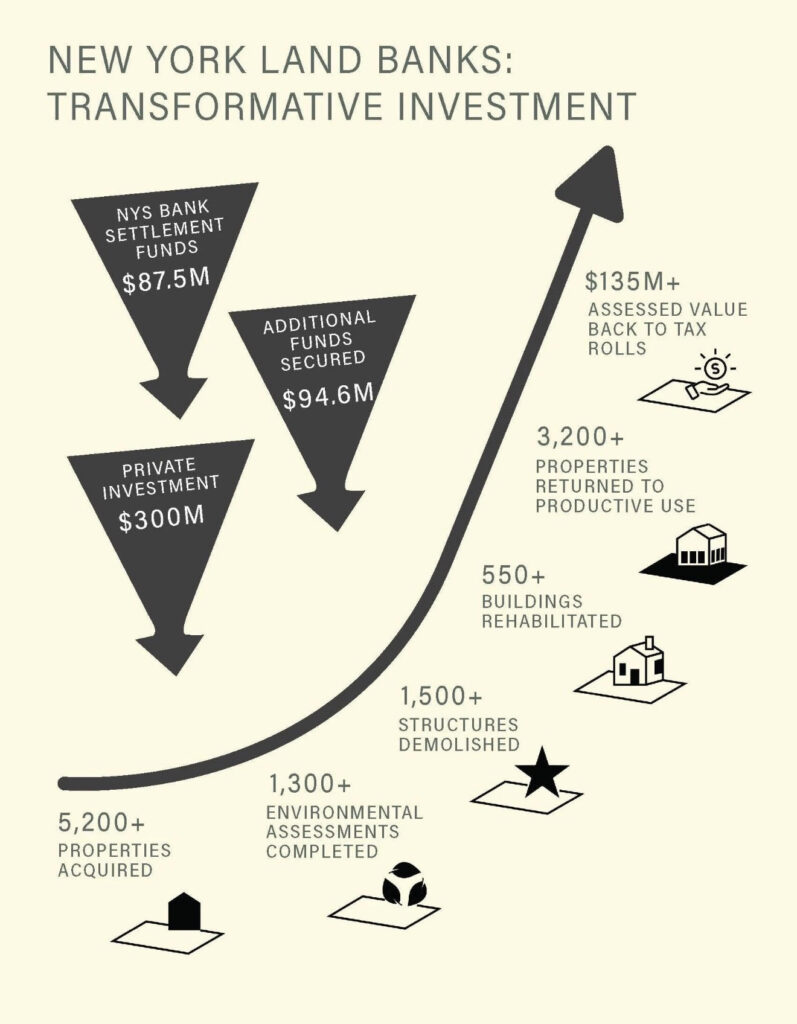
The arithmetic underneath the visual rhetoric is worth working through.
Total inputs across all New York land banks: $87.5 million in NYS bank settlement funds, plus $94.6 million in additional secured funds, plus $300 million in private investment leveraged on top. Total project investment statewide: approximately $482 million.
Total outputs: 5,200 properties acquired. 1,300 environmental assessments completed. 1,500 structures demolished. 550 buildings rehabilitated. 3,200 properties returned to productive use. $135 million in assessed value back to tax rolls.
The state-level value-recovery ratio is 28 percent. For every dollar of public-and-private investment poured into the New York land bank system, the state has recovered, in tax-assessable form, approximately twenty-eight cents. The Newburgh Community Land Bank’s reported 45 percent recovery ratio is, by this measure, well above the statewide average. The pattern this piece has documented in Newburgh is the better-performing version of a statewide pattern that is, in aggregate, recovering less than thirty cents on the dollar of institutional investment.
The demolition number is the most consequential statistic on the infographic. 1,500 structures demolished against 550 buildings rehabilitated. The land bank system, statewide, demolishes buildings at nearly three times the rate it rehabilitates them. The architectural fabric of upstate New York’s historic working-class neighborhoods has been reduced, through the operation of this system, by 1,500 buildings that no longer exist.
The cost-per-rehabilitated-building calculation is severe. $482 million of total investment producing 550 rehabilitated buildings is roughly $876,000 per rehabilitation. That figure is, almost exactly, the Newburgh Land Bank’s reported $899,000-per-home cost on slide three of the April 22 presentation. Newburgh is not the outlier. Newburgh is the median. The institutional cost premium this piece has documented is the standard cost premium of the New York land bank system, replicated city by city.
And by the way
Speaking of experience, or lack thereof. Here is more personal experience, offered as evidence.
Dwellstead is the proof-of-concept project my wife and I undertook back in 2017 to demonstrate that distressed historic Newburgh buildings could be restored to near-passive-house performance at approximately half the cost of conventional passive house construction. Conventional passive house construction at the time was running approximately $240 per square foot. Our target of $125 a sq ft was something more in line with what a community member could afford to finance. We completed three buildings: 153 Lander Street, 284 Liberty Street, and 279 Grand Street, and ran community workshops on what we were doing, before heart surgery sidelined me. The numbers below are the documentary form of the thesis dwellstead was built to test.
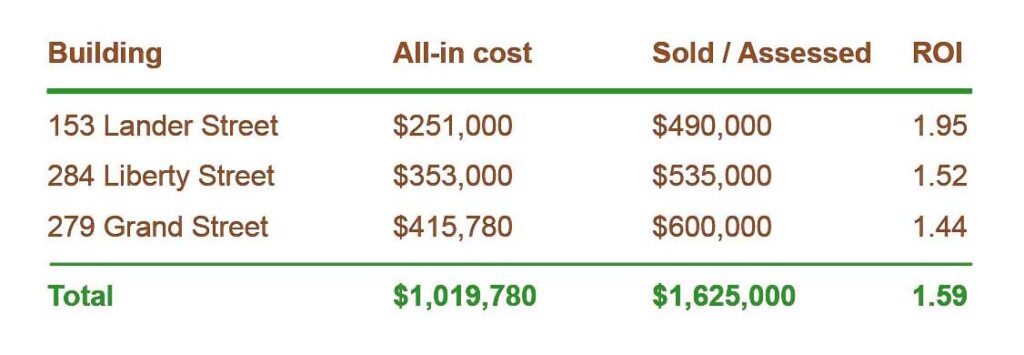
All these buildings were abandoned at the time of acquisition. All were distressed and required major rehab, especially 279 Grand, which required the hauling out of 82.5 tons of garbage and construction debris before we could start. 279 and 284 were started and completed before RUPCO began work on 116.
Aggregate all-in cost including the value of labor we contributed ourselves: $1.02 million across 9,500 square feet. Approximately $107 per square foot. Aggregate market value at sale or current assessment: $1,625,000. Recovery ratio: 159 percent.
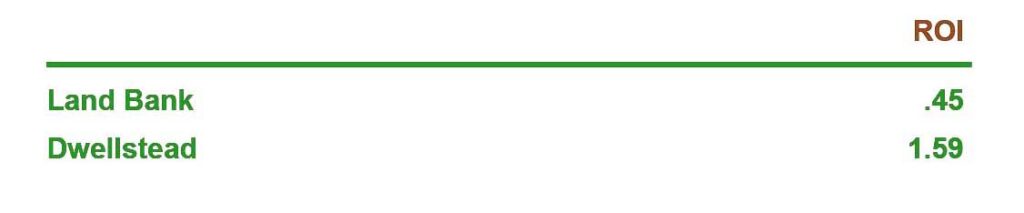
A swing from 50% profit to 50% loss cannot be explained away with the phrase “administrative overhead”.
Regarding our farmhouse in Cochecton NY that we restored in 2002-2003, and sold around 2013:
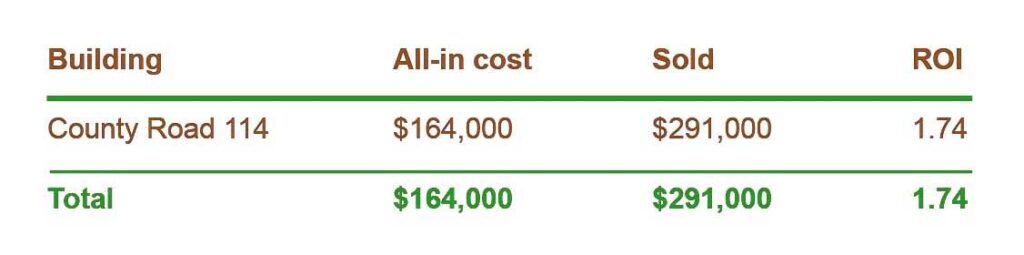
The number that I offered to the Architectural Review Commission — two RUPCO-held buildings for less than $200 per square foot — was not a wild guess. It was a good number that gave me a lot of room to work with.
279 Grand Street, our home, was included this year in the Newburgh Historical Society’s annual Candlelight Tour, the December walking tour that selects fifteen historic properties for public viewing. During the tour, former councilperson Bob Sklar said, unprompted: “This is the second building of yours I have seen. You guys do excellent work.”
The city’s code inspector, examining the two-story rear porches on one of the buildings, said: “You guys are the opposite of what we usually encounter. You overbuild”.
The institutional cost premium is not the cost of doing the work well. It is not the cost of doing the work safely. It is not the cost of doing the work to a standard the city’s preservation community recognizes or the city’s regulatory apparatus credits. It is the cost of doing the work through institutions. The work is the work. The cost is the cost. The three-to-one premium is the institution’s, not the work’s, and this is why there are so few home buyers out of so many opportunities. The Newburgh Community Land Bank is chartered to help return distressed property to community ownership. On the institution’s own numbers, it is not fulfilling that purpose.
What the law requires
The New York Land Bank Act, General Municipal Law Article 16,6 was enacted in 2011 to give municipalities a new tool — the land bank — to return tax-delinquent and vacant property to productive community use. The Act gives land banks preferred standing in tax foreclosure auctions and the authority to discharge tax liens on properties they acquire. These are unusual statutory powers. They were granted on the explicit premise that they would be used for community-benefit dispositions.
Section 1611 of the Act gives land banks broad discretion in disposition, including the explicit authority to sell at below market value when the disposition serves the public purposes the Act was created to advance. Most public asset disposition is subject to fair-market-value requirements. Land banks were exempted from that constraint precisely so they could prioritize community-benefit recipients over the highest bidder.
The Center for Community Progress, which provided the model legislation New York’s Act is based on,7 has consistently advised that land banks should establish disposition priorities that favor owner-occupants seeking to purchase a home for themselves, community land trusts and shared-equity structures, locally based nonprofit developers, and minority-owned and women-owned developers. Institutional regional developers headquartered outside the municipality are typically the lowest-priority recipients in well-run land banks.
The Newburgh Community Land Bank, on the operational record its own slides display, appears to not have followed that priority structure. It has channeled residential property to institutional nonprofit developers — RUPCO, in particular — at a scale and frequency that the slide-by-slide record above documents. It has imposed liquidity gates that filter out individual owner-restorers in favor of institutional buyers. It has routed the resulting public subsidy through a cost structure the institution has acknowledged passes through to end-user affordability. And it has, on slide six of the same evening’s presentation, complained that it is increasingly being asked to pay for properties it has historically received for free.
The disposition pattern is the inverse of the statutory purpose. That is the strongest single charge available against the Newburgh Community Land Bank, and it is supported entirely by the institution’s own numbers, projected onto the institution’s own meeting wall, on April 22, 2026. This is not about individuals. It is about programmatic disposition, and, given how our public officials and the institutions own officials often respond to data such as this, inertia.
Where the money actually goes
The Newburgh Community Land Bank, on its own numbers, has produced rehabilitations at a cost-per-building almost identical to the New York statewide figure of approximately $876,000. The $48.7 million in Newburgh’s local investment that does not appear as recovered assessed value did not vanish. It was paid to the professional ecosystem that administers the institutional apparatus — tax credit syndicators, project managers, compliance officers, consultants, executives, attorneys, architects who specialize in affordable housing, and contractors who bid LIHTC projects.
During the Great Depression, Roosevelt’s Works Progress Administration paid wages to unemployed labor and produced bridges, post offices, trails, and murals as the work the wages bought. The arrangement was honest about itself. Public investment, paid to people who needed work, in exchange for public infrastructure that the market was not producing. The contemporary affordable-housing apparatus inverts that arrangement. Public investment is paid to a professional class that does not lack employment, in exchange for housing units that the market is able to produce more cheaply if the institutional apparatus were not standing between the building and the buyer. The community never sees the dollars that move through these buildings. The dollars go to the professionals. In this ecosystem, the buildings, when they are built, are almost mere byproducts.
So. Back to Omari Shakur. Remember Omari? 5,000 words ago?
The outrage that Omari read into the record, in my view, is warranted, and should be the response the record warrants from everyone who reads it. Unfortunately, not nearly enough read it, because out of a city of 28,000, a hand-full — usually the same hand-full — of people show up. Hey, it’s a republic, if you can keep it.
This piece is the first of several. The second, “Reparations: The ‘Preferential Rental Option,'” addresses the parallel disposition of urban renewal land to Kearney Realty & Development Group, governed by a different statute and producing a different but structurally related outcome. The Newburgh Community Land Bank’s complete disposition record for the four-year period referenced has today been requested under the Freedom of Information Law.
© Newburgh Is America
I am a one-man band here — writer, editor, copy editor, fact-checker, legal consultant, publisher and blog administrator wrapped into one, publishing within a time line that is compressed from the weeks or even months of what is normally allowed for long-form investigative writing into sometimes as little as a few days. Errors and omissions are inevitable in work produced under these conditions. I rely on and encourage an informed public to identify them, and where they are identified, the record will be updated. This piece reflects my best understanding at the time of publication and is subject to revision as additional information becomes available.
Footnotes
- City of Newburgh City Council Work Session, April 22, 2026. Video documentation on the City of Newburgh website. Councilman Omari Shakur’s statement is approximately one hour into the meeting.
- Newburgh Community Land Bank presentation slides, displayed at City of Newburgh Council Work Session, April 22, 2026. Slides visible in the meeting video on the city website. The presentation is also referenced at newburghcommunitylandbank.org.
- City of Newburgh City Council Work Session, April 22, 2026. Lisa Daily, chair of the Newburgh Community Land Bank, in response to a question from Councilwoman Tamika Stewart.
- Various sources, including U.S. Census Bureau American Community Survey data and Habitat Newburgh community housing assessments.
- Newburgh Community Land Bank presentation, April 22, 2026, slide titled “Property Acquisition Cost 2025.”
- New York Consolidated Laws, General Municipal Law, Article 16 (Land Bank Act), §§ 1600-1616.
- Center for Community Progress, Frequently Asked Questions about Land Banks and related model legislation guidance, communityprogress.org.
- City of Newburgh Architectural Review Commission, meeting record approximately early-to-mid 2018. Madeleine Fletcher served as executive director of the Newburgh Community Land Bank until mid-2018.
- New York Land Bank Association, New York Land Banks: Transformative Investment, nylandbanks.org.