A Brief History of the Loft Tenant Struggle in New York City, the parallel Squatters Movement, and the lessons they hold for City of Newburgh tenants.
1960 – 2000
The loft tenants movement is one of the most consequential and most untold organizing stories in New York City history — a decades-long campaign by artists and working-class residents to convert illegal occupancy into legal tenure, and ultimately into ownership. Born in the industrial districts of SoHo and Tribeca in the early 1960s, it spread north and east through the 1970s and 1980s, culminating in landmark state legislation and a model for community-controlled conversion that influenced housing policy far beyond New York. What began as a practical necessity — artists needed large, cheap spaces to live and work — became a sustained challenge to landlord power, real estate speculation, and municipal neglect.
The loft tenants movement has no serious historian. This essay is an attempt to begin filling that gap, written by someone who was inside the organizing from its formation, and who — after forty years, seeing that no one else has started — decided to take the first step.
I. Industrial New York and the Origins of Loft Living
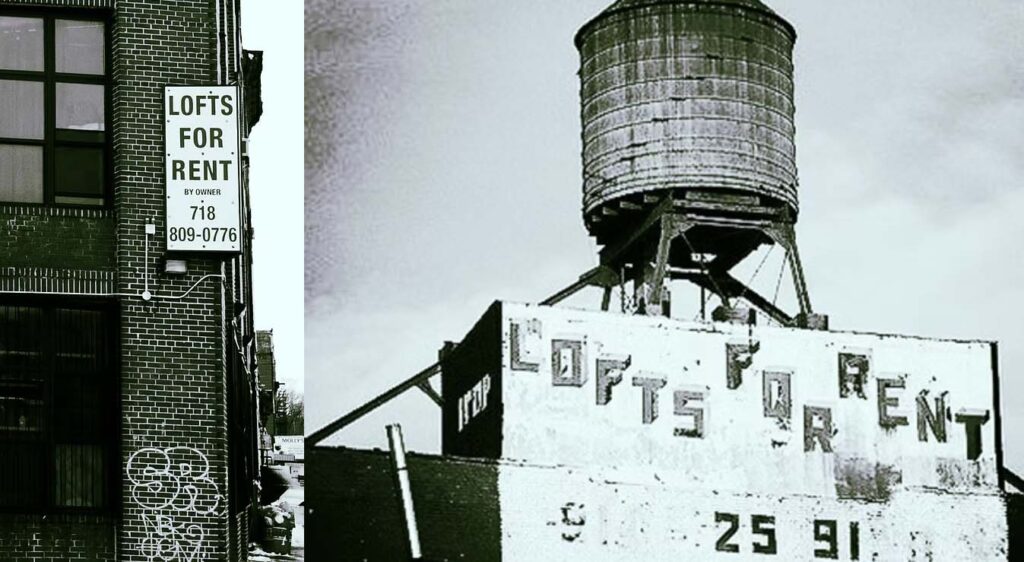
The physical precondition of the loft movement was the deindustrialization of lower Manhattan. From the late nineteenth century through World War II, the cast-iron buildings of SoHo (South of Houston Street), NoHo (North of Houston Street), and the warehouses of Tribeca (Triangle Below Canal) housed garment manufacturing, printing, light industry, wholesale trade, and a concentrated electronics industry that extended into the blocks now occupied by the World Trade Center site. The floors were vast — often five thousand square feet or more — the ceilings high, and the windows large to admit the light that factory work required. By the early 1950s, manufacturing in Manhattan was in systemic decline. Firms relocated to New Jersey, the outer boroughs, or the South. Buildings emptied. Rents plummeted.
In Greenwich Village, painters and sculptors had been occupying studio buildings since the 1940s, but the Village was becoming expensive. SoHo offered something the Village could not: raw, industrial space on a scale no residential building could match. A sculptor needed room to work; a painter needed north light and unobstructed walls. The lofts, abandoned by their commercial tenants, offered both. By the mid-1950s, artists were at first renting them for studios, then quietly moving in — illegally, since the buildings were zoned for manufacturing, not residential use.
This was not bohemian romanticism. It was economic calculation. Painters earning little from sales of their work could not afford a separate studio and apartment. The loft solved both problems at once. The illegality was understood, tolerated by landlords who preferred a tenant paying something to a vacancy generating nothing, and largely ignored by the city, which had other priorities. But the status of these residents was entirely precarious: they had no legal right to occupy their buildings, no heat requirements, no fire safety protections, no recourse against arbitrary eviction.
II. SoHo and the First Confrontation with the City
By the early 1960s, the artist population in SoHo was substantial enough that it was a constituency to be reckoned with. The city’s planning establishment, under Robert Moses and his successors, had long viewed lower Manhattan’s industrial districts as either renewal opportunities or as sites for infrastructure. In 1962, the proposed Lower Manhattan Expressway (LOMEX) — which would have run across Canal and Broome Streets, demolishing hundreds of buildings — threatened the nascent loft community not because Moses was targeting artists, but because they were simply in the way. The fight against LOMEX, eventually won in 1969 largely through the advocacy of the great urban philosopher activist Jane Jacobs and a coalition of community groups, was the loft movement’s first political education.1
Even as the expressway fight continued, artists began organizing around their housing status. The key early organization was the Artist Tenants Association (ATA), founded in 1961.2 The ATA lobbied the city to recognize the reality of artist habitation and to create a legal framework. Their argument was pragmatic: artists were de facto residents of these buildings; they had invested substantial labor and money in making them habitable; evicting them would destroy functioning live-work communities that gave these dying industrial neighborhoods whatever life they had. The city, they argued, should legalize and regulate what already existed rather than criminalize it.
In 1964, the city took a first, cautious step. The Department of Cultural Affairs created a system for certifying artists as “AIR” (Artist in Residence), which allowed building owners to apply for a variance permitting residential use by certified artists. The AIR program was a compromise that satisfied almost no one. The certification process was bureaucratic and exclusionary3 — it favored artists with institutional credentials and exhibition records over working artists without gallery representation. And the variance applied to buildings, not tenants, meaning that if a building changed hands, the entire arrangement could be undone.
Nevertheless, the AIR program established the precedent that artist residence in manufacturing zones was a legitimate land use to be managed, not simply a violation to be suppressed. When SoHo was formally rezoned as the “Artists In Residence” district in 1971 — the first such zoning designation in the country4 — it ratified a community that had built itself from the ground up over two decades. The 1971 rezoning protected SoHo’s loft tenants from immediate demolition or conversion but left unresolved the deeper questions of tenure, ownership, and displacement.
III. The Fiscal Crisis, Abandonment, and the Expansion of a Movement
New York City’s fiscal crisis of 1975 transformed the political landscape of urban housing. As the city teetered on the edge of bankruptcy and implemented savage cuts to services, hundreds of landlords in poor and working-class neighborhoods stopped paying property taxes and simply walked away from their buildings. In the South Bronx, Harlem, the Lower East Side, and parts of Brooklyn, wholesale abandonment created a landscape of fire-damaged shells and empty lots. The city, unable to manage the tide of tax-delinquent properties it was inheriting through in rem foreclosure, became, against its will, New York’s largest slum landlord.
In this context, the loft movement’s experience unfolded alongside a parallel struggle by a very different population. In the abandoned tenement districts of the South Bronx, Harlem, and the Lower East Side, families — overwhelmingly Latino and Black, overwhelmingly poor — were doing something structurally identical to what the artists of SoHo and NoHo had done: moving into spaces the market had discarded, investing their own labor to make them habitable, and asserting the right to remain. The two movements were separated by race, class, and culture. They did not share organizing tables or political networks. But they shared a logic, and that logic was the same: occupancy plus improvement equals claim.
The homesteading movement in those neighborhoods did not draw its inspiration from the loft tenants—it had its own genealogy, rooted in the Young Lords, the Black Panthers, and the radical housing organizing of the late 1960s. The Young Lords, whose membership overlapped with the Nuyorican cultural world centered at the Poets Cafe on East Third Street, had staged dramatic occupations of abandoned buildings and demanded that the city serve its poorest residents rather than warehouse them in deteriorating housing. The Black Panthers had run similar programs in Harlem. Operation Move-In, in 1970, installed over three hundred families in vacant Upper West Side apartments as a direct political action.5 These were not movements that needed SoHo as a model. They had their own theory of the case, and it ran deeper than real estate: housing was a right, and the state’s failure to provide it was a political crime. What the two movements shared was not influence but structural convergence — two entirely different class factions of New York’s population arriving independently at the same conclusion: that in a city allowing buildings to rot while people had no shelter, the act of moving in and fixing up was both necessary and legitimate. The Urban Homesteading Assistance Board (UHAB), founded in 1974, became the institutional vehicle6 that connected this logic to the legal mechanisms for ownership. UHAB’s model was simple but transformative: rather than managing abandoned city-owned buildings as perpetual welfare housing, work with the existing tenant communities to convert them into limited-equity cooperatives under the city’s Tenant Interim Lease (TIL) program. Tenants would take on management, rehabilitation, and eventual ownership for a nominal price, provided they met income limits and maintained the cooperative structure.
UHAB’s work in the TIL program over the following decades converted thousands of formerly abandoned units into tenant-owned cooperatives, primarily in Harlem, the South Bronx, and Washington Heights. The program’s achievements were real and substantial, though always constrained by city budgets, administrative indifference, and the relentless pressure of real estate interests who preferred that these properties find their way back to the private market.
The city’s eventual acceptance of this model was not ideological. It was fiscal. A vacant, tax-delinquent building costs the city money to hold, money to secure, and money to demolish if it deteriorates past saving. A building occupied by organized tenants who rehabilitate it with their own labor, pay a nominal purchase price, and then pay property taxes as owners costs the city nothing and generates revenue. Prosecuting squatters was expensive and politically difficult. Legalizing them produced neighborhoods and taxpayers. The city did not embrace the squatters’ movement out of solidarity. It made a calculation.
Here I’d like to interject a personal aside: I came from a family living close to the economic margin — not destitute in the sense of homelessness, but without cushion, without assets, and without the stability that comes from having either. Though my dad had a steady job, we moved around a lot: 5 homes in my first 9 years: we rented bungalows, shotgun shacks and units in two family homes. In sociological terms, I came from the “housing-insecure working poor” — people who work but can’t get ahead.
In my Junior year at art school, I moved into a 4th floor walkup at 505 East 6th Street in Alphabet City — also known as Loisaida, as I soon learned — in the Lower East Side from 1974 to 1975. In October of 1974, the Nuyorican Poets Cafe moved into the ground floor space of the former Sunshine Cafe, a Polish bar at that same address.7 I got to know Miguel Piñero and Miguel Algarin as neighbors, and then as friends and colleagues, as well as a number of Young Lords.
Up until than, I was under the impression that I was half Polish, and half Spanish/French. My father had constructed that identity scrupulously enough that even childhood visits to my grandparent’s home — with darker-to dark-skinned relatives moving through the house — had not broken through it.
About a month after the Nuyorican had opened, I am hanging out at the bar with Algarin waiting for the first readings that evening. Algarin asked where my parents were from. I said “St. Louis and Detroit.” Algarin pressed forward: “And what about your grandparents?” And I said “Poland and Puerto Rico.” Miguel concluded: “I thought so: you are Puerto Rican, my brother! Of course, with a name like Lebron!” I sat there, sort of dumbfounded. Not that I was upset. Surprised. That evening, Miguel gave me both recognition and a road to discovery: I sat there for a moment, putting my life on re-wind, thinking that the language that was suppressed around my home (that in hindsight must have been what led to an early childhood speech impediment and learning disability), was in fact a language that I could someday own, a language filled with faces and fury that corresponded to something I had been carrying without grasping.
The 500 block of East 6th was was surrounded by many other blocks with buildings that squatters were taking over. But the 500 block itself was mostly intact, disturbed only by the gunshots that could be sometimes heard coming from Tompkins Square Park, colloquially known to the locals as Killer Park. I lived among many squatters, and I got to know a few of them. But I was not of them. In spite of my own background, relative to the squatters, I was privileged: I was going to an elite art school, with most of my time taken up with classes.
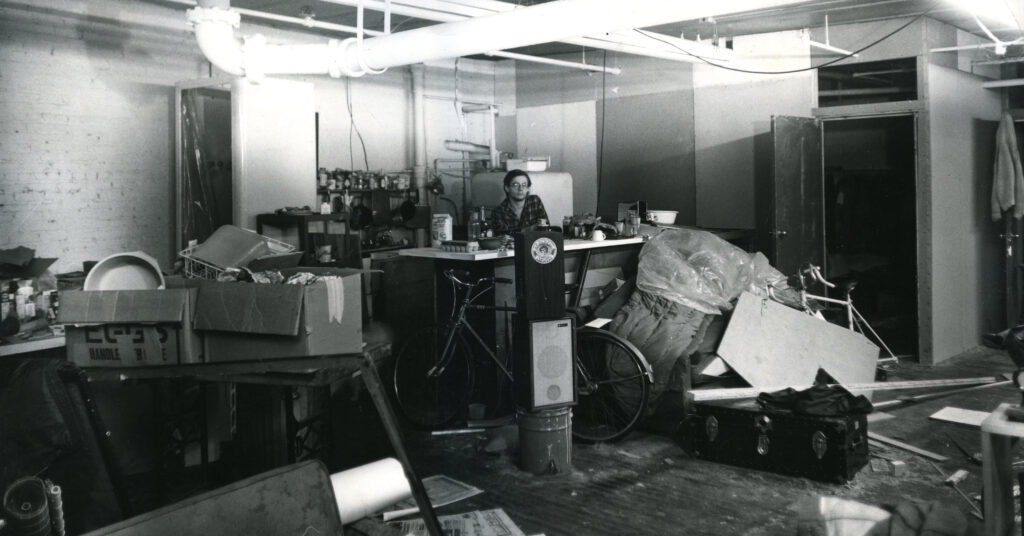
That’s me, August/September 1976, in my new “home” at 36 Cooper Square, 7th floor front, overlooking the square and The Cooper Union itself. No, I don’t always look that grumpy. The rent was $331 per month. That was a lot of money for a graduating art school student in those days: I had to take on TWO roommates. All that stuff belonged to them (Really. Well, almost all: the three-way Lafayette Criterion speaker was mine). Yes: that is a shower in the “kitchen”, with a nice 1950s vintage General Electric fridge. That fridge found it’s way to our farmhouse in 2000, but that’s another story.
By the time I finally moved into my NoHo loft in April 1976, I had left a family and then a community that survived on the edge. Each experience gave me the emotional wherewithal to make the leap: to make a calculated gamble, sign a commercial lease, and move into a loft. While I myself was still on the edge, and while I still hung out at the Nuyorican, eventually meet my wife there and married her there, I was not yet a bridge in any political sense between the two worlds.
IV. The Loft Law: A Decade of Organizing
While UHAB and the TIL program addressed the abandoned tenement stock, the loft movement faced its own evolving crisis. By the early 1980s, SoHo was becoming fashionable. Many galleries had already firmly established themselves. Fashionable bars and restaurants followed. The opening of The Odeon in TriBeCa, and Chanterelle in SoHo in late 1979, could be said to be signal events.8 Real estate values rose sharply, and the artists who had pioneered the neighborhood found themselves at risk of displacement by the very market forces their presence had helped create — a pattern that would later be given the name gentrification and studied exhaustively, though the loft tenants living through it had no need of academic vocabulary to understand what was happening to them.
More immediately, the loft movement was expanding geographically. As SoHo became expensive, artists and other residents moved into adjacent manufacturing districts: NoHo (North of Houston Street, my neighborhood), Tribeca, Chelsea, the Flower District, the garment district lofts north of Penn Station, sections of Long Island City in Queens, Williamsburg and DUMBO in Brooklyn. SoHo’s 1971 AIR zoning designation had acknowledged that artists lived there; but it had not fully protected them. These newer communities were in the same position—no rent protections, no eviction safeguards, no code requirements—and faced landlords emboldened by rising real estate values who were determined to cash in by evicting existing tenants and converting to luxury residential or commercial use.
The organizing response was the formation, around 1979, of the Lower Manhattan Loft Tenants (LMLT), known today as NYC Loft Tenants. The organization operated simultaneously as tenant advocacy organizations — providing legal assistance, organizing buildings, negotiating with landlords — and as a political lobbying coalition pressing the state legislature for comprehensive loft legislation. The campaign was long, difficult, and frequently frustrated by opposition from real estate interests, the city’s own ambivalence about manufacturing zoning, and the divisions within the loft community itself. The organization was founded and led by Chuck DeLaney, a photographer who had moved into a loft in 1976 and who would go on to serve as the tenants’ representative on the New York City Loft Board from its creation in 1982 — a position he still holds. Chuck is possibly the most astute organizer I have ever met, and I have met a lot of them. I knew he was serious business when, during the 3rd meeting that I attended, he assigned us all a book to read: Robert Caro’s formidable The Power Broker: Robert Moses and the Fall of New York.
It is worth stating plainly: the city of New York did not support the loft tenants. The municipal government’s interest was in preserving manufacturing zoning and, later, in capturing the rising real estate value of these neighborhoods for tax purposes. Loft tenants were tolerated when they were invisible and inconvenient when they organized. The city’s cooperation came only after the movement had made non-cooperation politically and legally untenable.
To understand what the movement was up against, consider a single concrete fact: I was one of those loft tenants, helping to organize my building in NoHo at this time, facing a landlord worth $400 million — Leonard Stern of Hartz Mountain Industries, heir to the pet supply fortune his father Max Stern had built into one of the largest private real estate portfolios in the country, and the developer behind the Meadowlands complex in New Jersey. This was not an unusual asymmetry. While the Lower Manhattan landscape was littered with mom and pop landlords, this was the normal condition of the loft tenants’ struggle: artists and working people with no legal standing, organized against some of the wealthiest real estate interests in New York. I joined the LMLT the year it formed, eventually participated in a citywide rent strike, and had a hand in drafting language in the Loft Law.9
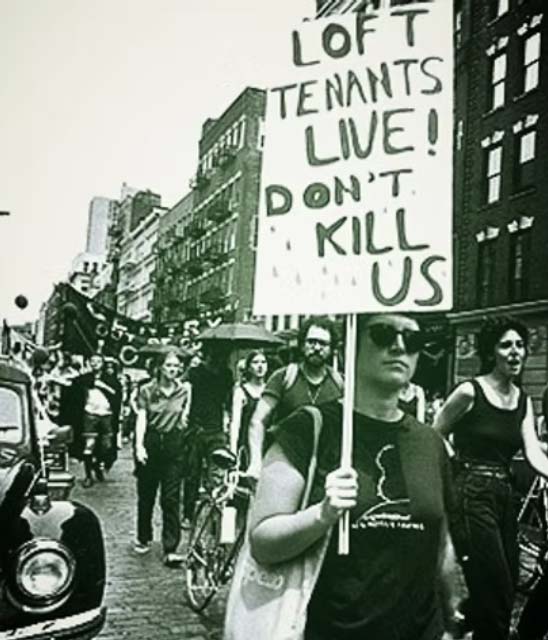
An early demonstration with an egregiously hyperbolic placard.
Hey, we are artists: of course we will trend towards the dramatic.
The legal fulcrum of the entire movement was Lipkis v. Pikus (99 Misc 2d 518, affirmed 72 A.D.2d 697, 1979–1980).10 The facts were representative of the standard loft situation: tenants at 71–73 Franklin Street in Tribeca had signed commercial leases, converted their spaces to residential use with the landlord’s knowledge, and built out their lofts at their own expense. When the landlord moved to evict them and appropriate the improvements they had made, the tenants sued. The court’s ruling was a landmark. By knowingly permitting tenants to convert commercially-leased space to residential use, the court held, the landlord had created a de facto multiple dwelling. That single finding had consequences the landlord could not escape: the building was now subject to the Multiple Dwelling Law. The tenants could not be evicted. And because the building was not up to residential code, the landlord could not collect rent until the violations were corrected.
The practical consequences were immediate and seismic. Tenants placed their rent in escrow accounts. Then thousands of loft tenants across lower Manhattan went on rent strike — not as an act of civil disobedience but as a legally grounded response to a ruling that had stripped landlords of their collection rights. The New York state court system, already overburdened, was suddenly hit with a tsunami of cases. The pressure on Albany became irresistible. The legislature had to act.
The result was the Loft Law — Article 7-C of the Multiple Dwelling Law, passed in 1982. The law formalized what Lipkis had established judicially: loft tenants in qualifying buildings were brought under the rent stabilization umbrella, landlords were required to legalize their buildings, and tenants were protected from eviction during the legalization process. Critically, the law recognized that tenants owned their “fixtures” — the improvements, buildouts, plumbing, wiring, walls, and kitchens they had constructed at their own expense. This was not incidental language. It was a direct legal acknowledgment of the sweat equity argument the movement had been making for years: that the people who built a space have a property interest in what they built. The law contained one provision whose concept I came up with during the drafting process: Section 3, which exempts owners of interim multiple dwellings from paying the conversion contribution required by the New York City zoning resolution for the portion of any building determined by the Loft Board to be an interim multiple dwelling. The provision removed another cost that landlords would have simply passed on to tenants in the form of rent.11
The divisions within the movement had to be navigated in the drafting. Some wanted protection specifically for live-work artist spaces and worried that broader coverage would complicate zoning. Others, occupying loft spaces not as studios but simply as affordable housing, resisted the artist-certification framework entirely. There were contentious debates about income limits, the definition of “loft,” and qualifying occupancy windows. The coalition held together long enough to pass the law, but the compromises embedded in it would require years of amendment to partially correct. The coverage windows were narrow, the legalization process slow and expensive, and the Loft Board established to administer the law chronically underfunded and often led by someone who was not evenhanded, but sympathetic to landlord interests .
There was also a long endgame that the movement’s success inadvertently set in motion. As the neighborhoods loft tenants had pioneered became among the most valuable real estate on earth, the calculus around fixture ownership inverted. The lease itself — the right to occupy one of the most desirable addresses in Manhattan under rent stabilization — became worth far more than the physical improvements the tenant owned. Landlords began offering buyouts: cash payments to tenants willing to surrender their leases and vacate. They could not evict tenants, whom the law protected. They could buy back the lease that the tenants’ own organizing had made extraordinarily valuable. The movement that had transformed tenants with no rights into owners ended, for many, with a negotiated exit from a market whose conditions they had helped to create.
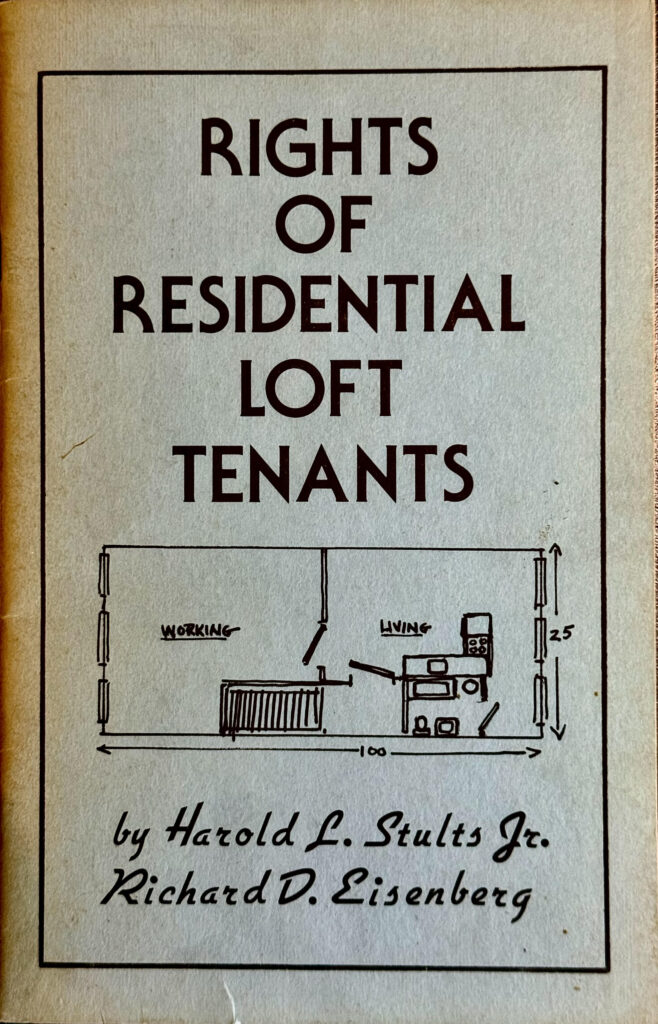
Published in 1979
V. Amendments, Litigation, and the Consolidation of Rights
The Loft Law of 1982 was the beginning, not the end, of the legislative struggle. Over the following decade, the loft tenants movement returned repeatedly to Albany to expand coverage, close loopholes, and defend the law against landlord challenges. Amendments in 1987 and 1993 extended the qualifying occupancy window, brought additional buildings under coverage, and strengthened the enforcement mechanisms of the Loft Board. Each amendment was the product of sustained organizing, coalition building, and political negotiation — and each was contested by real estate industry lobbying.
Parallel to the legislative battles, loft tenants were fighting in the courts. Landlords challenged the constitutionality of the Loft Law on multiple grounds — arguing that it constituted an uncompensated taking of property, that it interfered with vested zoning rights, that its definitions were unconstitutionally vague. New York’s courts consistently upheld the law. The litigation established important precedents about the state’s police power to regulate housing conditions and protect existing residential communities, precedents that would prove useful in subsequent housing policy contexts.
By the early 1990s, thousands of loft buildings had completed or were undergoing the legalization process. The Loft Board had processed tens of thousands of tenant applications. Many loft tenants had achieved stable, code-compliant, rent-regulated housing in spaces they had built and occupied for years or decades. The character of the neighborhoods they had pioneered — SoHo, NoHo, Tribeca, Williamsburg, DUMBO — had been transformed, though not always in ways the original tenants would have chosen.
VI. The Permanent Contradiction: Protection and Displacement
The loft movement’s success contained the seeds of its own partial defeat. Legal recognition and improved conditions made the neighborhoods more attractive to capital. As loft buildings were legalized and stabilized, they became more valuable. As the neighborhoods gained the cachet of artistic production and bohemian culture, commercial and residential development followed. The art galleries that had moved into SoHo in the 1970s attracted restaurants, boutiques, and eventually the luxury real estate market. By the 1990s, SoHo was no longer just an artist district—it had become one of the most expensive retail strips in the world. The trajectory of the adjacent neighborhoods that loft tenants pioneered tells the same story in concentrated form: Tribeca is today the most expensive residential neighborhood in New York City, and NoHo — the district north of Houston Street where many of the earliest loft tenants lived and organized, including myself — is the second most expensive. The artists who made those neighborhoods are, for the most part, gone.
The loft tenants who had won legal protection could remain in their rent-stabilized spaces, but the communities around them were transformed beyond recognition. The working-class families who had been their neighbors, the small manufacturers and tradespeople who had occupied the ground floors, the ethnic restaurants and bodegas that had served the original population — all were displaced by the market forces that legal protection could not fully contain. The loft movement had won the battle for individual tenure while losing the larger struggle for neighborhood preservation.
This contradiction — the gap between individual legal protection and community-level displacement — was not unique to the loft movement. It recurred throughout New York’s housing history and continues to define the limits of tenant protection as a response to speculative real estate development. Rent regulation protects sitting tenants; it cannot prevent the transformation of neighborhoods, the displacement of populations who lack legal standing, or the ultimate conversion of affordable districts into luxury enclaves as buildings turn over and deregulation accumulates.
The more durable response to this contradiction — and the one most directly descended from the loft movement’s practical experience—was the turn toward collective ownership. Community land trusts, limited-equity cooperatives, mutual housing associations: these models, which remove property from the speculative market permanently by placing it in collective ownership with restrictions on resale, represent the logical extension of what UHAB had done with the TIL program and what the loft movement had done organizationally. When individuals cannot be evicted, but buildings can still be sold and neighborhoods still transformed, the only permanent protection is taking the building itself off the market.
What made this possible — legally and morally — was something the loft movement had established from the beginning: that the investment of labor and capital loft tenants made in their spaces before the law existed gave rise, after the law was passed, to a property interest the law was bound to acknowledge. They had already built what they occupied. The law was not creating their claim. It was recognizing one that sweat equity had already established. The broader implication deserves to be stated plainly: if the basis for ownership rights is demonstrated investment, use, and community-building rather than market purchase, then the loft precedent challenges the foundational assumption of property law that title follows transaction. What the loft movement won — imperfectly, incompletely, against fierce resistance — was a partial legal recognition that people who build a place into something livable have a claim on it that precedes and supersedes the landlord’s paper title. That is a radical proposition dressed in the language of housing regulation. Its implications extend well beyond lofts.
VII. From Tenant to Owner: A Conversion of Mind
That recognition had consequences for how loft tenants understood themselves — and for the political transformation the movement demanded of its participants. Legal rights do not automatically produce the consciousness to use them. The most underexamined dimension of the loft movement’s history is the internal transformation it demanded of its participants — the shift from a tenant mentality to an owner mentality, from a defensive posture to a generative one. This is not a psychological curiosity. It is the movement’s deepest political achievement and its most portable lesson.
The tenant mentality is a rational one. It is the rational adaptation to a condition of legal vulnerability and economic precarity. When you do not own, when your tenure is temporary, when your landlord can displace you, the rational response is to minimize investment, and maintain optionality. The tenant who takes ownership is making a longer term commitment.
What is striking about the loft tenants’ experience is that many of them had already broken with the tenant mentality before the law gave them any reason to do so. They invested massively in their spaces — in labor, in materials, in the patient accumulation of improvements — at a time when they had no legal standing whatsoever. They did this not out of naivety about their legal exposure but out of necessity and, in many cases, out of an implicit conviction that the investment itself would somehow constitute a claim. They were acting like owners before the law recognized them as anything of the kind. The organizing that produced the Loft Law was, among other things, an effort to make the law catch up to the social reality that loft tenants had already created.
Once the law did recognize them — once ownership became a legal possibility rather than an act of defiant squatting — the conversion of mentality that many loft tenants had already undergone informally was ratified and deepened. Owners think differently about time. A tenant optimizes for the near term; an owner plans in decades. Owners think differently about neighbors: shared ownership of a building creates mutual accountability and mutual interest that a rental building, where each tenant’s primary relationship is with the landlord rather than with each other, rarely produces. Owners think differently about politics: the person with a stake in a place has a fundamentally different relationship to local governance than the person who can be displaced from it.
This transformation also operated in the squatters movement at the collective level. Buildings that converted to cooperative ownership process became laboratories of self-governance. Shareholders had to manage maintenance, finances, and the inevitable disputes of shared life without recourse to an external landlord to mediate or absorb blame. The skills this required — meeting facilitation, financial management, conflict resolution, long-term capital planning — are the skills of democratic self-governance more broadly. Buildings that worked through these challenges successfully became communities in a sense that rental buildings rarely achieve: people with a shared stake in a shared future, accountable to each other in ways that market tenancy never demands.
The political implications are significant and underappreciated. Tenant organizing, however militant, is structurally reactive: it mobilizes in response to threats from landlords or the state and demobilizes when the immediate threat recedes. Owner organizing can be proactive: it mobilizes around a positive vision of what a place should become and sustains itself through the ongoing work of collective stewardship. Both squatters and the loft movement produced both kinds of organizing, but the buildings that completed the conversion to ownership moved decisively into the second mode. They stopped fighting to keep what they had and started building what they wanted. That is a qualitatively different political condition — and one that cities desperate for genuine civic engagement, rather than the managed participation of stakeholder consultation, need to understand and cultivate.
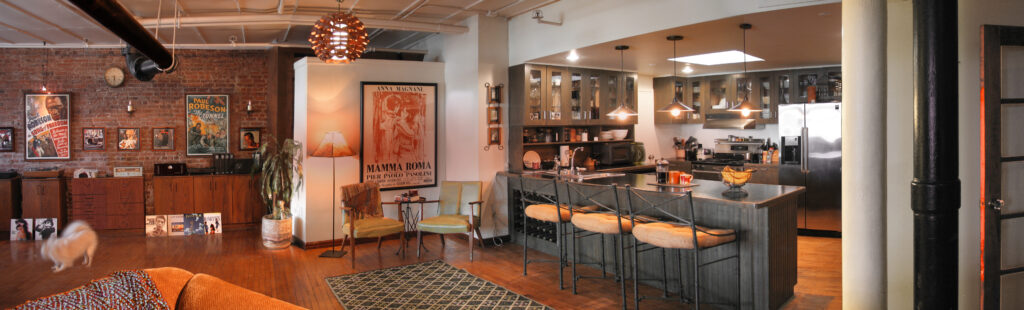
My loft, September 2015. The third and final renovation was done in 1996, the year I got married. The shower is now in the bathroom — behind the kitchen — where it belongs. After we moved out in September 2017, the landlord converted the entire loft to office space for what The Village Voice Archives. The Voice then moved out, and with the office market glutted, the landlord is now converting to residential condos.
We moved to Newburgh. Our friends and neighbors thought we were nuts to give up a $1,100 a month 2,000 sq ft loft located in NYC’s second most expensive residential neighborhood. When asked why by a neighbor, I said “It’s time”.
VIII. Legacy and Lessons
The loft tenants movement and the squatters left several distinct legacies.
The first and most concrete is the Loft Law itself, which continues to protect a class of New York residents who would otherwise be entirely without legal standing. Amendments passed as recently as 2010 and 2019 have extended coverage to new generations of loft tenants, demonstrating that the organizing coalition’s political work has remained effective across decades.
The second legacy is organizational and strategic. The movements demonstrated that a dispersed population of residents without formal legal status could organize effectively, build political coalitions, win state legislation, and defend those gains against sustained opposition from real estate capital. The tactics developed—building-by-building organizing, legal support networks, media campaigns emphasizing the human dimension of housing struggles, coalition building with sympathetic legislators — became part of the toolkit of New York tenant organizing more broadly.
The third legacy is the model of tenant-to-owner conversion that UHAB and the TIL program developed and refined. By the time the TIL program was wound down in the 1990s, it had converted over thirty thousand units in formerly abandoned buildings into tenant-owned limited-equity cooperatives12 — one of the largest transfers of housing wealth to low-income residents in New York’s history. The model influenced housing policy nationally and internationally, and its principles continue to be applied in community land trust development across the country.
The fourth and perhaps most enduring legacy is conceptual. The loft movement established, against significant resistance, the principle that residential use creates rights — that the act of making a home, investing in a space, building a community, has legal and moral weight that must be reckoned with by landlords, developers, and government alike. This principle, obvious in retrospect, was far from obvious in the early 1960s when artists first began moving into SoHo’s empty factories. It required decades of organizing, litigation, and political struggle to make it the settled law of New York State. That it is settled law at all is a measure of the movement’s achievement.
The lesson that remains hardest to absorb — because it cuts against the grain of both liberal reformism and conventional tenant organizing — is that tenant legal protection alone cannot preserve communities against speculative real estate development. Rent regulation protects individuals; it does not de-commodify neighborhoods. The only durable answer to displacement is the permanent removal of housing from the speculative market through collective, non-profit, community-controlled ownership. The loft movement pointed toward this answer without fully arriving at it. The work of arriving at it — and of building the political power to implement it at scale — remains unfinished.
What the loft movement received as its cultural monument is instructive, and not in a good way. In 2024, Damiani Books published Joshua Charow’s Loft Law: The Last of New York City’s Original Artist Lofts — a photography book in which a documentary filmmaker rang doorbells, photographed fifty-odd surviving loft tenants in their spaces, and produced what reviewers dutifully called “gorgeously rendered” and “a loving book.” It is, in the precise sense of the term, a coffee table book: large format, handsome photographs, light on text, heavy on atmosphere. Esquire liked it. Highsnobiety liked it. It went into a second printing. It contains no serious treatment of the rent strike, no mention of Lipkis v. Pikus, no account of the Lower Manhattan Loft Tenants or the decade of organizing that forced Albany to act. No mention of the power asymmetry between artists with no legal standing and landlords worth hundreds of millions of dollars. No mention of the fixture ownership provisions, the legislative drafting, or the legal battles that continue to this day. What it contains is pretty pictures of nice windows and open floor plans, and a wistful caption about a “bygone era.” A movement that took on the New York real estate industry and won has been aestheticized into décor. The rent strike that brought Albany to its knees has been reduced to a caption. The legal battle that a $7 billion landlord is still losing has been omitted entirely. What Charow produced is not history. It is interior design photography with a sympathetic voiceover — the cultural equivalent of hanging a portrait of a dead revolutionary on the wall of the restaurant that replaced his home, or hanging a a Che Guevara t-shirt in a boutique window on the block where the revolution happened. The loft movement deserved better. It is, in the end, an old trick: wait until the people who fought are old or gone, then sell the aesthetic back to the people who displaced them. The fight becomes a mood, the rent strike becomes a photo caption.
IX. Coda: Newburgh and the Continuing Struggle
The dynamic that shaped the loft movement — speculative disinvestment followed by abandonment, followed by organic community formation, followed by displacement as the market reasserts itself — did not end in New York City. It repeats itself in post-industrial cities across the country, wherever cheap space attracts communities that, in building themselves, inadvertently create the conditions for their own removal. The Hudson Valley city of Newburgh, some 70 miles north of Lower Manhattan, presents a variant of this pattern: a mid-sized city with extraordinary architectural stock and waterfront geography, chronically underfunded, governed by institutional structures designed to facilitate outside control rather than democratic self-determination, and now targeted by real estate capital with the help of PILOT agreements and other tax-exempt financing arrangements that capture municipal resources while removing accountability to the people who actually live there.
The loft movement’s history offers Newburgh—and every other city facing the same structural pressures — not a template to be copied but a set of principles to be applied: organize around concrete grievances, build coalitions across difference, document institutional failures exhaustively, pursue legal protections relentlessly, and keep the ultimate objective in view. The ultimate objective is not rent regulation, not legalization, not incremental reform. It is a community with a voice that is respected through the democratic process — the assertion that the people who live in a place have the primary claim on how it develops, and that this claim must be backed by the legal and financial structures to make it real. The tenants fighting violations at the Kenney apartment complex in Newburgh today, and the council members standing with them against financing arrangements that extract public resources while removing democratic accountability, are working from the same premise the loft tenants worked from fifty years ago. They may not know that history. In one way, they don’t need to: their hearts get it, although I am inclined to take that copy of The Power Broker off my shelf, dust it off and see if there are a few lessons in there for Newburgh tenants as well. Robert Moses was an unelected official who wielded immense power, often at the expense of entire communities, dominating mayors and governors. Does that sort of sound like our current city manager?
But there is a gap that hearts alone cannot fill. What the Lower Manhattan Loft Tenants and UHAB built were not advocacy organizations that arrived to win a campaign and then receded. They were membership bodies — named members, democratic governance, institutional memory, the capacity to act collectively in their own name across years and decades. The LMLT had members who joined, showed up, organized building by building, drafted legislation, went on rent strike together, and built something that outlasted any single fight. LMLT had no formal dues; members understood that organization and advocacy are not free, and donated on an “as you can” basis. UHAB converted that organizing energy into permanent cooperative ownership, building by building, family by family, over thirty years. Newburgh does not yet have that: it has episodic organizing. The distinction matters. Advocacy wins campaigns. Membership organizations build power that survives them. This essay exists in part so that Newburgh tenants can see clearly what self-governing collective action looked like 50 years ago, what it accomplished, and what becomes possible when people did not wait for someone else to represent them and start representing themselves.
One final footnote to this history, which is also a proof of concept. When I was eventually bought out of my NoHo loft by Leonard Stern — whose net worth had by then grown to $7 billion — Stern’s attorneys made an error. The buyout agreement purchased the lease. It did not include language purchasing the fixtures. Stern is now pursuing a condominium conversion of the building. The New York City Loft Board has blocked the conversion until he purchases the fixtures he forgot to buy the first time. Stern offered to cover the my legal fees. I hired a lawyer. The lawyer forced Stern to cough up somewhat more than that — not much, by the standards of a man who spends more every time he wipes his ass, but to the little people like us, it was a bit more. The fixtures provision that I helped write into the Loft Law forty years ago is the instrument standing between a $7 billion landlord and the completion of his condo conversion. The law, it turns out, has a long memory — longer than the landlord’s lawyers.13
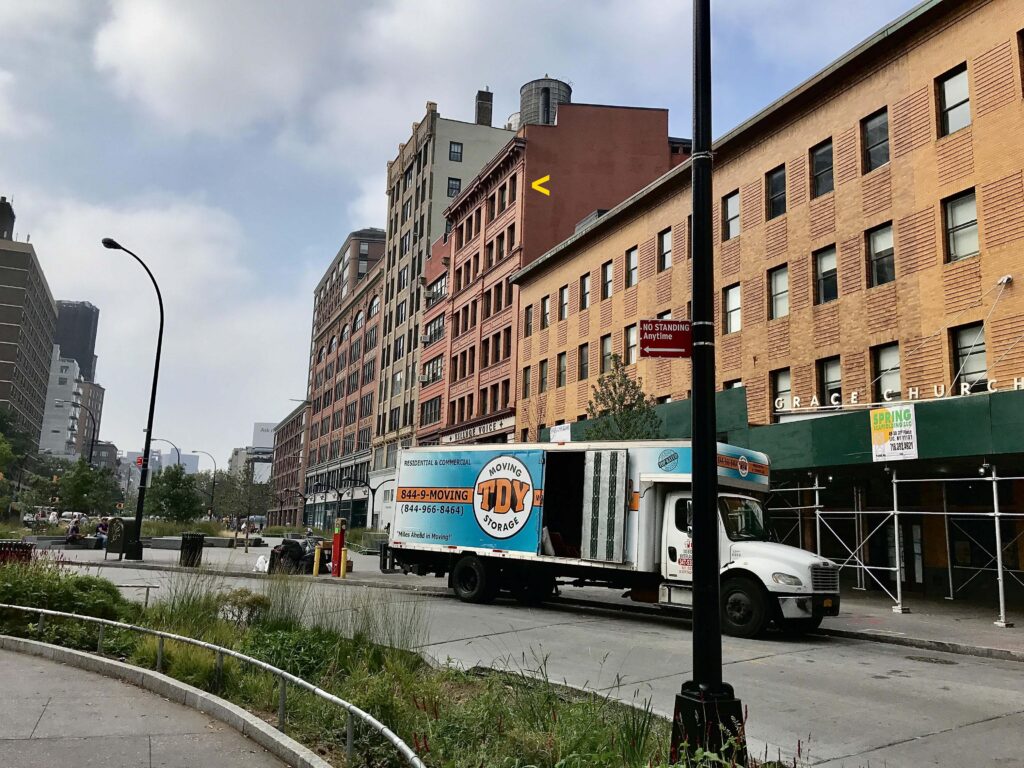
Leaving, September 2017. My home of 41 years, the 6 windows to the left of the yellow arrow, and extending back through half the floor, past the light pole.
Notes
1 The proposed Lower Manhattan Expressway would have run along Broome Street from the Holland Tunnel to the Williamsburg Bridge, demolishing much of SoHo and Little Italy. Robert Moses championed it from the 1940s; Jane Jacobs and a coalition of community organizations defeated it definitively in 1969. See Anthony Flint, Wrestling with Moses (Random House, 2009).
2 The Artist Tenants Association was founded in 1961 and organized the first significant political action by loft residents, including a march on City Hall in 1964. The SoHo Artists Association (SAA), formed in 1970, continued the legislative lobbying that eventually yielded the 1971 AIR zoning designation. See Sharon Zukin, Loft Living (Johns Hopkins University Press, 1982).
3 The AIR certification system required artists to demonstrate professional credentials—exhibition records, institutional affiliations—before their building could receive a residential use variance. The exclusionary character of this process was a persistent grievance and a driving force behind the push for broader statutory protection.
4 The 1971 SoHo rezoning as an “Artists In Residence” district was the first zoning designation of its kind in the United States. It acknowledged the existing community but provided no rent protections and left unresolved the fundamental questions of tenure and displacement that the Loft Law would later address.
5 Operation Move-In was organized in the summer of 1970 by a coalition including the Young Lords, the Black Panthers, and other community organizations. Over three hundred families were installed in vacant apartments on the Upper West Side. See Johanna Fernández, The Young Lords: A Radical History (University of North Carolina Press, 2020); Amy Starecheski, Ours to Lose (University of Chicago Press, 2016).
6 UHAB was co-founded in 1974. Its Tenant Interim Lease (TIL) program, developed in partnership with the New York City Department of Housing Preservation and Development, eventually converted over thirty thousand formerly abandoned units into tenant-owned limited-equity cooperatives. See UHAB organizational records and NYC HPD annual reports.
7 Author’s firsthand account. The author lived at 505 East 6th Street, Manhattan, from 1974 to 1975. The Nuyorican Poets Cafe opened in October 1974 in the ground-floor space of the former Sunshine Cafe. See also Miguel Algarin and Bob Holman, eds., Aloud: Voices from the Nuyorican Poets Cafe (Henry Holt, 1994).
8 The Odeon, at 145 West Broadway in Tribeca, opened in 1980. Chanterelle, opened by David and Karen Waltuck in SoHo in late 1979, was among the first fine dining establishments to locate in the neighborhood; it relocated to Tribeca in 1989. Together they mark the moment when downtown began its transformation into one of the most expensive urban neighborhoods on earth.
9 Author’s firsthand account. The author joined the Lower Manhattan Loft Tenants in 1979, the year of its formation, participated in the citywide rent strike, and contributed the concept behind Section 3 of Article 7-C during the legislative drafting process. His landlord at the time was Leonard Stern of Hartz Mountain Industries.
10 Lipkis v. Pikus, 99 Misc 2d 518 (Civil Court, New York County, 1979), affirmed 72 A.D.2d 697 (Appellate Division, First Department, 1980). The affirmance by the Appellate Division First Department gave the ruling statewide authority within its jurisdiction and made legislative action effectively inevitable.
11 Article 7-C of the Multiple Dwelling Law, enacted 1982, amended 1987, 1993, 2010, and 2019. Section 3, the conversion contribution exemption, was drafted to remove a cost that would have been passed through to tenants by landlords. The concept behind Section 3 was developed by myself; the statutory language was produced by attorneys working with the tenant coalition.
12 The TIL program’s conversion of over thirty thousand units is drawn from NYC HPD records and UHAB organizational reports. For a comprehensive account of the squatters’ movement that eventually converged with UHAB’s work, see Starecheski, Ours to Lose (2016).
13 Author’s firsthand account. Leonard Stern’s net worth at the time of the loft tenants’ organizing was approximately $400 million; it has since grown to an estimated $7 billion. Stern’s buyout of the author’s lease omitted fixture language. The New York City Loft Board has blocked Stern’s condominium conversion until the fixtures are separately purchased. The proceeding remains active as of this writing.
Selected Bibliography
Primary Sources
Multiple Dwelling Law, Article 7-C (“The Loft Law”), enacted 1982, amended 1987, 1993, 2010, 2019. McKinney’s Unconsolidated Laws of New York.
Lipkis v. Pikus, 99 Misc 2d 518 (Civil Court, New York County, 1979), affirmed 72 A.D.2d 697 (Appellate Division, First Department, 1980).
New York City Loft Board. Annual Reports, 1983–2000. NYC Department of Buildings.
Urban Homesteading Assistance Board (UHAB). Organizational Records and TIL Program Reports, 1974–2000.
NYC Department of Housing Preservation and Development. Tenant Interim Lease Program Records.
Secondary Sources
Algarin, Miguel, and Bob Holman, eds. Aloud: Voices from the Nuyorican Poets Cafe. New York: Henry Holt, 1994.
Charow, Joshua. Loft Law: The Last of New York City’s Original Artist Lofts. Bologna: Damiani Books, 2024.
Caro, Robert A. The Power Broker: Robert Moses and the Fall of New York. New York: Alfred A. Knopf, 1974
Fernández, Johanna. The Young Lords: A Radical History. Chapel Hill: University of North Carolina Press, 2020.
Flint, Anthony. Wrestling with Moses: How Jane Jacobs Took On New York’s Master Builder and Transformed the American City. New York: Random House, 2009.
Hartman, Chester. City for Sale: The Transformation of San Francisco. Berkeley: University of California Press, 1984.
Neuwirth, Robert. Shadow Cities: A Billion Squatters, A New Urban World. New York: Routledge, 2004.
Smith, Neil. The New Urban Frontier: Gentrification and the Revanchist City. New York: Routledge, 1996.
Starecheski, Amy. Ours to Lose: When Squatters Became Homeowners in New York City. Chicago: University of Chicago Press, 2016.
Zukin, Sharon. Loft Living: Culture and Capital in Urban Change. Baltimore: Johns Hopkins University Press, 1982.