How Progressive Reform Created the Conditions for Special Interest Capture in one American City
PART 1: ADMINISTERING COVER
Prologue
In May 2021, the Newburgh City Council faced an unusual demand. Todd Venning, their City Comptroller, wanted City Manager Joseph Donat’s job. He also wanted a $50,000 raise. And if the council said no, he would move on.
The council said yes.
Five years later, in November 2025, Venning’s contract was up. Four council members representing each ward opposed renewal. By any normal definition of democracy, they should have won. Because 4 is greater than 3.
Three months later, we are at the February 16, 2026 council meeting. Line item 16: Anticipated City Manager Vacancy. If the Vagueness Doctrine — a legal standard requiring that language not force citizens to guess at their meaning — were applied here, surely this line item would flunk.
The four ward members had asked for a search at the previous work session. They came expecting to vote on one this evening. Instead, Mayor Harvey began to offer a motion to appoint the deputy city manager to the city manager position … when a vacancy occurs.
Midway through his remarks, Harvey started to reference the Office of the State Comptroller. City Manager Todd Venning — who had sat through the meeting with an expression that could most charitably be described as restless disdain — snapped to attention, slammed his fist on the desk and firmly shook his head. The sound echoed through the room as he glared at the mayor. Councilmembers Shakur and McLymore, as well as Deputy City Manager Neppl looked askance with furtive apprehension. The mayor stopped mid-sentence. “Oh, I’m sorry,” Harvey said. “I won’t say that.”
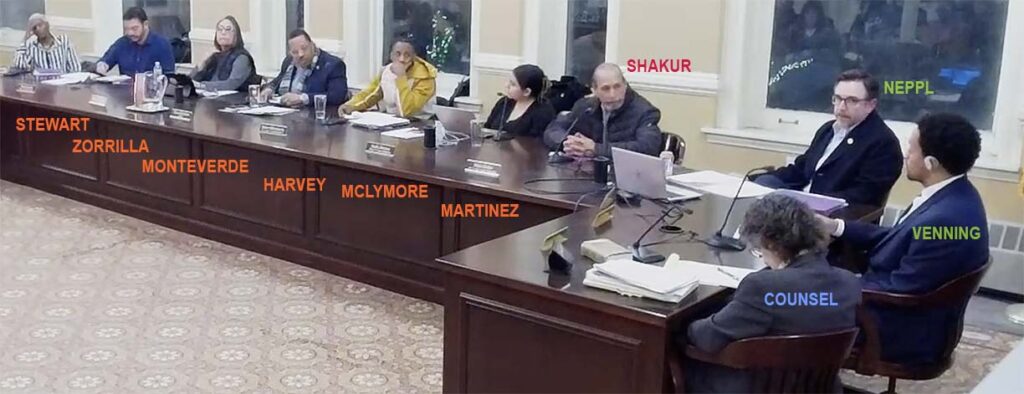
An appointed official had just silenced an elected one with one slam of his fist, in public, on camera — and the elected official apologized. This, from officials who spit out the word transparency with the frequency and velocity of Mariano Rivera’s cutter.
Todd turned to someone behind him with a look as if his bat had almost been shattered.

Councilmember Zorrilla, Ward 4, held up a letter. “Developers lobbying our government to give them a PILOT are the same people who are lobbying for how we do our staffing”. Anticipating a councilmember’s objection, Zorrilla states “This is public comment, it says public comment on the letter”.
At-large Councilmember Shakur took his turn at pounding the table. “4 Black men in the top 4 positions. Ya got rid of one and ya going for the other 3. That’s what this is about.”
Councilmember Stewart, Ward 3 — a Black woman who had voted with the three Latin ward members throughout — was unpersuaded. “This position holds more weight and has more power than the city council. Knowledge is power, and when you are the keeper and the holder of all the knowledge, you tend to have more power. We need to figure out if we are going to keep the position the way that it is.”
Jules Ridgeway, The Chair of the Newburgh City Democratic Committee, appeared to be trying to bark a message to a councilperson the way a baseball manager shouts from the dugout to get his outfielders to shift their positioning. The Clerk turned to her and said “I cannot hear, ma’am!”, before commencing a Roll Call on the motion to appoint.
What was actually being voted on requires close attention. Venning had announced his departure — by press release, not by resignation letter. Under the charter, a resignation is not effective until a letter is submitted to the city clerk. No letter had been submitted. There was no vacancy. The deputy city manager position Venning had created weeks earlier — a position that did not previously exist, filled within four days of its creation, with no meaningful public input — was the vehicle. Announce a departure without resigning. Create a new position. Install your successor in it. Then leave without formally vacating, so that — theoretically, at least, yet to be tested — the deputy becomes acting city manager without a search, without a vote, without the council ever choosing him. Harvey’s motion to “appoint the deputy when the vacancy occurs” would have ratified this sequence after the fact.
The roll call went as follows:
MARTINEZ – NO
MCLYMORE – YES
MONTEVERDE – NO
SHAKUR – YES
STEWART – NO
ZORRILLA – NO
HARVEY – YES
The motion failed, four to three. Four ward members — three Latino, one Black, against three citywide — all Black, seats.
The mayor then moved on to a motion to vote on a search, thinking he is placating Zorrilla, but Zorrilla objected with “Don’t put words in my mouth!” and moved to table any search until an actual vacancy exists. “In the work session the majority of us said we wanted a search. I expected to come to this meeting to vote on a search and decide on a framework for the search. I no longer feel comfortable with this administration deciding on a framework for a search and I’d rather wait until March 30 to decide”. He repeats: “In terms of the vacancy the current people seeking PILOTS are the same people who are lobbying for support for the current deputy. When there is a clear vacancy, then we decide. Follow the charter.”
A motion to table the search was made. The Clerk commenced another roll call:
MARTINEZ – YES
MCLYMORE – I’M CONFUSED
MONTEVERDE – YES
SHAKUR – I’M CONFUSED, I’M NEW TO THIS
STEWART – YES
ZORRILLA – YES
HARVEY – NO
The motion carried.
At that point, Venning, from the end of the table, challenged the clerk’s count. The city manager — who had silenced the mayor with his fist, who had arranged the succession the council just refused to ratify — was now contesting the parliamentary record on a vote about his own replacement. The city manager — who rose to his position from city comptroller on the strength of his budgeting expertise — now seemed challenged with basic 1st grade math.
But as this is Newburgh in 2026, maybe the city manager cannot be faulted for his apparent confusion. The ward members won each vote that night with their block of 4. Yet none of it changed the playing field. The supermajority requires more than four. In the City of Newburgh’s math textbooks, 3 is more than 4. Todd’s math is not so bad: he is still in the batter’s box, still trying to drive the next pitch out of the park.
Why the city manager seems so interested in going to such lengths to keep his job, or — at the minimum — micro-manage his successor, is a question that deserves attention, perhaps sooner rather than later.
I instead want to focus on why we are at a tipping point that is driving many Newburgh residents to seek an appointed commission to determine whether and how the city’s charter — that set the stage for this scenario — should be reformed.
…………
Andrew Jackson Downing lived and worked in Newburgh, New York. This Hudson Valley landscape aesthetician argued that well-designed public space accessible to all classes was the foundation of democratic civic life. Calvert Vaux, whom Downing had brought from England, based his practice there after Downing’s death in 1852. Vaux designed Central Park together with Frederick Law Olmsted. Their last collaboration was Downing Park — a memorial to Downing, completed in 1897 as a gift to the city, open to everyone.
The irony of what followed is almost too neat — and it compounds across generations. Olmsted Sr. was among the founding organizers of the National Municipal League at its 1894 Philadelphia conference, the very organization that would design the governance model Newburgh adopted. His son, Frederick Law Olmsted Jr., co-founded the American City Planning Institute in 1917 — the same year Newburgh’s charter was enacted into state law. The spatial and administrative projects of Progressive municipal reform were being institutionalized simultaneously, by the same families, through the same networks. The man who had spent his career arguing that democratic public space was the foundation of civic life helped launch a movement that would strip democratic accountability from the governments managing those spaces.
Fifteen years after Downing Park opened, Newburgh voted to give itself a Progressive Era governance structure that was at odds with the democratic gesture Olmsted and Vaux had made.
In November 1915, the citizens of Newburgh voted 1,400 to 1,000 to abolish their strong mayor government and replace it with something new: a city manager, appointed by a small council elected at-large, so voters couldn’t touch him.¹
The reformers who promoted the city manager model said they were fighting corruption.
They were not wrong to say so. But the structure they built to fight it put power in fewer hands and made it harder to hold anyone accountable — while removing the democratic pressure that, however imperfectly, had kept the old machine answerable to the people who voted for it. That mechanism has been running in Newburgh for 109 years.
The Corruption That Was Real
To take the reformers’ complaint seriously, you have to begin with the fact that the corruption they described was genuine.
The biggest example was New York City.² Boss Tweed and Tammany Hall extracted an estimated $25 million to $200 million from the city treasury between 1868 and 1871 alone — the range reflecting the difficulty of auditing systematic fraud rather than any scholarly uncertainty about its existence. The New York County Courthouse, begun in 1861, became the era’s defining symbol: a building whose construction costs were so grotesquely inflated that the graft paid to Tweed’s ring exceeded the actual cost of construction. Tweed died in jail in 1878. Most of his confederates retained their fortunes.
New York was not exceptional. In Philadelphia, the Republican machine of Matthew Quay and Boies Penrose operated a system of municipal graft so thorough that Lincoln Steffens, in his 1904 muckraking classic The Shame of the Cities, called it “the most corrupt and the most contented” city in America.³ In San Francisco, the Union Labor Party government of Mayor Eugene Schmitz and political boss Abe Ruef, exposed beginning in 1906, had sold franchises, extorted businesses, and corrupted the judiciary so systematically that a federal grand jury eventually indicted 65 city officials.⁴ In Cincinnati, St. Louis, and Minneapolis, similar patterns prevailed — ward bosses, padded contracts, patronage armies, elections manipulated through hired repeaters and bought inspectors.
The reformers who organized the National Municipal League in 1894 and spent the next two decades spreading the council-manager model to cities across the country were responding to something real.
What their indictment concealed was what the machine actually did for the people who depended on it — and what the structure they proposed to replace it would do instead.
What the Machine Actually Was
For working-class and immigrant communities in industrializing American cities, the ward machine was the institution through which they negotiated relationships with government.
The ward boss provided what the state did not: jobs for the unemployed, coal for families who couldn’t afford heat, intercession with a legal system conducted in a language many immigrants did not speak, protection from arbitrary police power, a path into the municipal economy that did not require educational credentials most immigrants could not obtain.⁵ The price was loyalty — votes, dependable turnout, support for the organization’s candidates. This was a transaction, frequently an exploitative one. It was also the only transaction available.
In Newburgh, this infrastructure was organized primarily through the volunteer fire companies. In the late 19th century, Newburgh’s volunteer fire companies — like the Brewster Hook & Ladder or the Chapman Steamer Company — were the centers of civic life.
This was not unique to Newburgh — it was the national pattern. As volunteer fire companies replaced bucket brigades in U.S. cities beginning in the 1820s, they drew young working-class men into organizations that functioned simultaneously as firefighting units, social clubs, and political levers. Boss Tweed himself got his start in politics as a member of the Americus Engine Company Number 6 in New York City.⁶ The firehouse-as-political-infrastructure was so well established that when the New York State legislature replaced New York City’s volunteer firemen with a paid professional force in 1865, the move was openly partisan: the volunteer fire companies were Democratic, the state legislature was Republican.⁷
In most American cities, the fire companies were Democratic — ward-level working-class organizations tied to the immigrant communities they served. Newburgh was different. Newburgh’s volunteer fire department was among the oldest in the state, chartered by act of the legislature in 1797.⁸ From the beginning, the village paid for equipment and its housing and maintenance while the firemen volunteered their labor — a public subsidy of what was, in practice, a civic and political organization as much as an emergency service.⁹ The companies expanded as neighborhoods grew, each rooted in a specific community — Italian on one block, Poles on the next, Germans in another — each company a node in a ward-level network.
But in Newburgh, city-level power was Republican. Benjamin B. Odell Sr. served twelve years as the city’s mayor; his son B.B. Odell Jr. turned Newburgh from a Democratic to a Republican city, then rose to chair the Republican State Committee and serve as the 34th Governor of New York. The Odell machine sat atop the ward structure, channeling patronage downward through the fire company networks while drawing political loyalty upward into the Republican Party apparatus. By 1915, the reformers who moved to abolish the fire companies and adopt the council-manager charter were Republicans attacking Democratic ward-level infrastructure from above — using the vocabulary of good government to break the political leverage of communities that were costing them money.
These communities were, as the local historian Mark Carnes has documented, “politically vulnerable”: remove those institutions and do not replace them with democratic representation, you leave those communities without leverage.¹⁰
The Reform Coalition and Its Interests
The reformers understood this, at least implicitly. The struggle over the fifteen years following Newburgh’s 1917 charter adoption was centrally about “dismantling the political opposition to the new system”¹¹ and eventually eliminating the volunteer fire companies altogether. The volunteer companies persisted as an independent civic organization through the first decades of the twentieth century, disbanding only in 1934 — nearly two decades after the charter revision, confirming the prolonged struggle required to dismantle them once the reformers had won the institutional battle.¹²
The commercial fire insurance industry was consolidating across the country.¹³ Insurance companies had begun tying premiums directly to ratings of local fire department effectiveness. Newburgh’s volunteer system received poor ratings. Business owners faced rising insurance costs on top of taxes they already considered excessive.
The mechanism that broke the political stalemate in 1915 was not so much moral outrage as it was cold cash.
The reform coalition was not composed of civic idealists. It was composed of people whose operating costs were going up and who had identified the ward machine as the source of the problem. On one side: immigrant working-class communities, voting Democratic, organized through the firehouses. On the other: the people with money and connections — property owners, business operators, professionals — voting Republican, organized through chambers of commerce, insurance boards, and a state party apparatus that ran from Newburgh straight to the governor’s office. They were a rival class using the vocabulary of good government to break the political leverage of communities that were costing them money.
The Russell Sage Foundation gave the project a veneer of expertise.¹⁴ The National Municipal League, founded in 1894, provided the playbook. The Model City Charter, published by the League in 1915, provided the design: a small council elected at-large, a professional manager serving at the council’s pleasure, no ward representation, no elected executive with independent authority.¹⁵
Richard Childs, the man most responsible for designing and spreading the council-manager form, made the ideological core explicit in a formulation that should be read with the care it deserves: “Democracy consists of controlling public offices — not necessarily in electing them.”¹⁶
He meant this as a defense of the council-manager form. He presented this as good government. He was also providing its most honest description.
© February 24, 2026 Michael Lebron
—————————————————————
This is a multi part series.
NEXT: PART 2 — REVOLUTION OR REFORM
—————————————————————
Notes:
¹ The City of Newburgh adopted its council-manager charter by referendum in November 1915. The charter was enacted into state law in 1917. See Mark Carnes, “What Happened to Newburgh’s Government?” (2024), prepared for the Newburgh Charter Review Initiative. The council-manager form of government provides for an appointed professional city manager who serves at the pleasure of the city council and is not directly elected by voters.
² The estimate of Tweed Ring theft ranges from $25 million to $200 million (approximately $600 million to $4.8 billion in 2024 dollars). See Kenneth D. Ackerman, Boss Tweed: The Rise and Fall of the Corrupt Pol Who Conceived the Soul of Modern New York (2005). The New York County Courthouse, begun in 1861, cost taxpayers an estimated $13 million — roughly four times the price of the Houses of Parliament — with much of the excess going directly to Tweed’s ring. Tweed was convicted in 1873 and died in the Ludlow Street Jail in 1878.
³ Lincoln Steffens, The Shame of the Cities (1904), Chapter 3: “Philadelphia: Corrupt and Contented.” Steffens documented the Quay-Penrose Republican machine’s systematic graft, including the sale of public franchises and the use of city contracts as patronage instruments.
⁴ The San Francisco graft prosecution (1906–1911) resulted in 65 indictments of city officials. Mayor Eugene Schmitz was convicted of extortion in 1907; political boss Abraham Ruef was convicted of bribery in 1908 and served four years in San Quentin. See Walton Bean, Boss Ruef’s San Francisco: The Story of the Union Labor Party, Big Business, and the Graft Prosecution (1952).
⁵ The ward boss as social service provider is documented extensively in the political science literature. See Robert K. Merton, “The Latent Functions of the Machine,” in Social Theory and Social Structure (1949), which analyzes how machine politics served the material needs of immigrant communities that were otherwise unserved by formal government institutions. See also Steven P. Erie, Rainbow’s End: Irish-Americans and the Dilemmas of Urban Machine Politics, 1840–1985 (1988).
⁶ William M. “Boss” Tweed joined Americus Engine Company No. 6 (“Big Six”) in 1848 and served as its foreman from 1849 to 1850. The company became his political base, launching his career as an alderman and eventually as the dominant figure in Tammany Hall. See Kenneth D. Ackerman, Boss Tweed (2005).
⁷ The New York State legislature created the Metropolitan Fire Department, replacing New York City’s volunteer fire companies with a paid professional force, by act of the legislature in 1865. The move was motivated in part by partisan politics: the volunteer companies were associated with the Democratic Party, while the Republican-dominated state legislature sought to reduce Democratic influence in the city’s governance. See Augustine E. Costello, Our Firemen: A History of the New York Fire Departments (1887); Lowell M. Limpus, History of the New York Fire Department (1940).
⁸ The Newburgh Fire Department was chartered by act of the New York State legislature in 1797, making it among the oldest organized fire departments in New York State. See Carnes (2024).
⁹ The village’s financial support of volunteer fire companies — purchasing equipment, providing and maintaining housing — while relying on volunteer labor created a hybrid public-private institution. See Carnes (2024), documenting the fire companies as simultaneously civic organizations and political infrastructure.
¹⁰ Carnes (2024). Carnes describes the immigrant communities organized through the fire companies as “politically vulnerable” and documents how the elimination of the volunteer companies removed their primary institutional connection to municipal governance.
¹¹ Carnes (2024). Carnes documents the post-charter struggle over the fire companies as central to the reform coalition’s consolidation of power, describing the process as “dismantling the political opposition to the new system.”
¹² The Newburgh volunteer fire companies were disbanded in 1934, replaced by a professional paid fire department. The nearly two-decade gap between the 1915 charter adoption and the final elimination of the volunteer companies reflects the depth of community resistance to the reform. See Carnes (2024).
¹³ The National Board of Fire Underwriters, established in 1866, developed standardized grading systems for municipal fire departments beginning in the late nineteenth century. Insurance premiums were tied directly to these ratings, creating financial pressure on cities with volunteer systems to professionalize. See Mark Tebeau, Eating Smoke: Fire in Urban America, 1800–1950 (2003).
¹⁴ The Russell Sage Foundation, established in 1907 by Margaret Olivia Sage, funded municipal research bureaus and provided technical assistance to cities adopting Progressive Era governance reforms, including the council-manager model. Its Department of Surveys and Exhibits conducted city surveys that frequently recommended structural reform. See David C. Hammack, “The Russell Sage Foundation and the Modernization of Social Policy in the United States, 1907–1972,” in The American Foundation: An Examination of a Great Philanthropic Institution (1998).
¹⁵ The National Municipal League was founded at a conference in Philadelphia in 1894. Its first Model City Charter was published in 1900; the 1915 edition incorporated the council-manager plan as the League’s recommended form of government. See Clinton Rogers Woodruff, “The National Municipal League,” Proceedings of the American Political Science Association 4 (1907): 133–146. Frederick Law Olmsted Sr. was among the founding organizers at the 1894 Philadelphia conference.
¹⁶ Richard S. Childs, Civic Victories: The Story of an Unfinished Revolution (1952). Childs (1882–1978) was the principal architect of the council-manager plan and a lifelong advocate of the short ballot movement. He served as president of the National Municipal League and is widely credited with designing the governance structure adopted by over 2,500 American cities. The quoted formulation — “Democracy consists of controlling public offices — not necessarily in electing them” — encapsulates the ideological core of the council-manager movement: that democratic accountability is achieved through structural oversight rather than direct popular election of executives.