How Progressive Reform Created the Conditions for Special Interest Capture in an American City
PART 4: WHAT THE STRUCTURE PRODUCED
The 1917 charter put in place a mayor and four at large council members, with a city manager. Since the mayor was largely ceremonial, this was basically five at large councilmembers. Every two years, either two or three council seats were up for election.
Though the stated reason of putting administration into the hands of a city manager was to insulate governance from corruption, it did not insulate the manager from political friction. When policies went awry, or controversies arose, fingers pointed at the city manager, who would then get replaced. Sometimes elections would change party control of the legislative side: that alone could be sufficient to bring change to the executive suite. The result was instability: over the decades, the average length of a city manager was little more than 18 months.
An 18-month average tenure means every manager walks in knowing the clock is running. He has to produce visible results before the next election cycle replaces allies on the council. That incentivizes him to pursue big, visible projects, such as large housing projects, over slow, invisible work like infrastructure maintenance. The manager who quietly maintains services gets replaced. The manager who wins redevelopment projects may also get replaced, but he gets to point to an initiative and then claim to be a victim of political dynamics.
It also creates a defensive posture. A manager who knows he can be replaced at the next party flip has an incentive to consolidate operational control — to build relationships with department heads that bypass the council, to control information flow, to make himself harder to remove by making himself harder to replace. That’s not corruption. That’s institutional self-preservation.
As we will see, the arrangement also did not insulate the position from the stated reason for its creation.
The 2011 charter amendment attempted to solve the instability question by requiring five of seven council votes to dismiss the manager. This replaced one structural failure with another: a manager who could not be held accountable even when services collapsed. Part 3 documented a consequence.
Let’s look at four other examples.
I. Joseph Mitchell and the War on Black Families (1960–1963)
In 1960, conservative councilman George McKneally arranged for Joseph Mitchell to be hired as Newburgh’s city manager.[1] Mitchell launched an immediate campaign against the city’s Black welfare recipients, announcing that they would be required to collect their checks at policeheadquarters. He proposed cutting all benefits after three months except for the aged, blind, and disabled. He claimed widespread fraud.[2]
A state investigation found not a shred of evidence to support his claims.[3]
Mitchell left Newburgh under bribery accusations.[4] He subsequently announced that he would become a director of the John Birch Society, changed his mind, then became field director of the Citizens’ Councils of America — also known as the White Citizens’ Councils — stating that he was answering George Wallace’s call to “stand up and be counted.”[5]
No voter in Newburgh’s Black community had any role in hiring Mitchell. No ward representative could block his appointment. The council-manager form permitted a single councilman’s political agenda to be executed as city policy through an appointed manager who answered to no electorate. The people targeted by Mitchell’s campaign had no structural mechanism to remove him.
II. Urban Renewal (1956–1973)
In 1956, Newburgh undertook what scholars Ann Pfau and Stacy Kinlock Sewell have called “an ambitious, arguably oversized, urban renewal program.”[6] The Newburgh Urban Renewal Agency approved the Water Street Urban Renewal Program in 1959 — a 26-acre clearance of the waterfront district encompassing Water, Smith, and Montgomery streets. Three hundred and twenty-three families would be displaced. A public housing project for those families was proposed but never built.[7]
In 1964, a second, larger plan — the East End Urban Renewal Project — was approved. It would level 102 acres at a cost of nearly $15 million, displacing more than 500 additional families.[8]
There was opposition. A group of preservationists sent letters to Jackie Kennedy, the New York Times, the Ford Foundation, and the local chamber of commerce. “Newburgh was sitting on a goldmine of a historically important American heritage, which we feel must be preserved,” the letter read. City historian Helen Gearn warned that “many of our beautiful houses have been ripped down without too much thought.”[9] In 1967, Barry Benepe was hired as city planner and fought to preserve the historic fabric, advocating for rehabilitation over demolition. He succeeded in saving the Alexander Jackson Davis Dutch Reformed Church from the wrecking ball, and in 1973 he and other preservationists secured the designation of the East Newburgh Historic District — one of the largest in New York State. That designation, combined with Nixon’s elimination of federal renewal funding in 1974, finally stopped the bulldozers.[10]
But by then the damage was done. Approximately 1,300 buildings were demolished. Roughly 120 acres were cleared.[11] Nine streets were plowed under, including Clinton Square, a triangular confluence of streets punctuated by a bronze statue of George Clinton.[12] Thousands of families were displaced — 89 percent of them nonwhite.[13] A community of homeowners was converted into a community of renters, destroying generational wealth that has never been recovered.
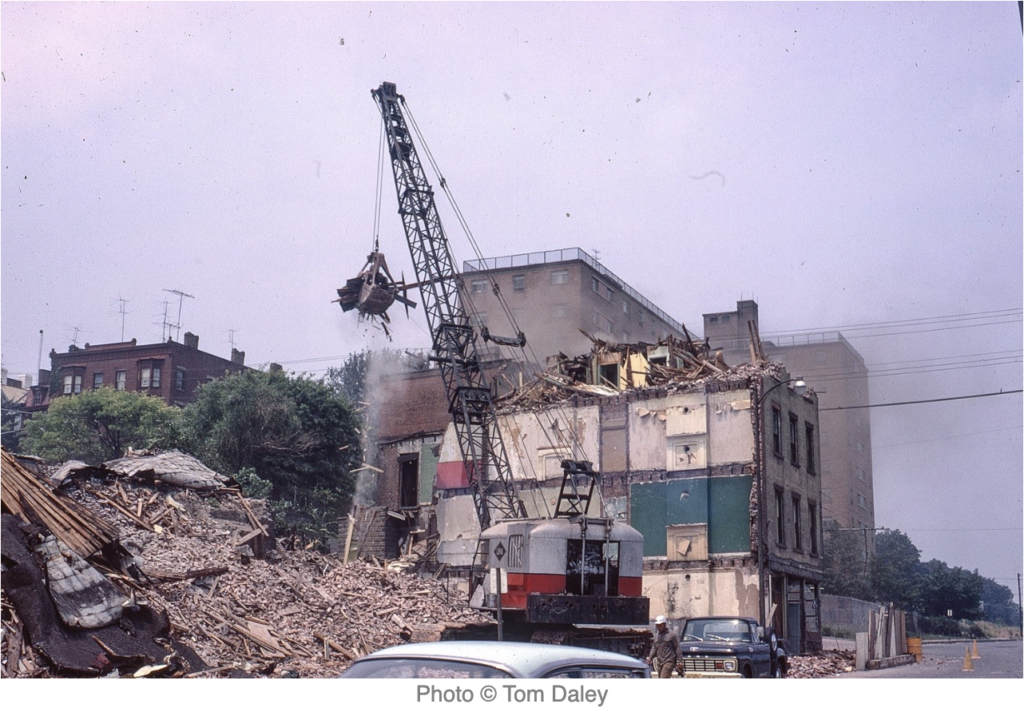
Photo from Newburgh Restoration
City historian Mary McTamaney described what she called “a fever for land clearance” taking hold of the city. “The thinking was that squaring off more and more parcels would attract larger investors,” she said. “And, we can’t underestimate the greed factor. Lots of money was made in salvage of building materials and in demolition contracts.”[14] A plaque in McTamaney’s office, dated November 14, 1974, from the New York State Association of Renewal and Housing Officials, salutes the City of Newburgh for “having successfully completed more urban renewal projects than any other New York State city in its population category.”[15]
The land is still largely vacant. The Department of Public Works mows it. Fifty-five years later.
Note what the opposition looked like and who mounted it. The preservationists who eventually stopped the demolition were well-connected white professionals with access to Jackie Kennedy, the Ford Foundation, and the New York Times. The displaced community — 89 percent nonwhite — had no equivalent channel. Under at-large elections, no council member represented their streets. The city manager and the Urban Renewal Agency director controlled planning, execution, and the flow of federal funding. No elected official was directly accountable to the neighborhoods being erased. Residents displaced from the waterfront could not vote the manager out. The demolition of an entire community was administered as a professional planning initiative — and the people whose homes were being demolished had no structural mechanism to stop it.
III. Harry Porr: The Party Chairman as City Manager (1990s)
During the administration of Audrey Carey — Newburgh’s first Black woman mayor — the city council selected Harry Porr as city manager. Porr was the chairman of the Orange County Republican Party.[16]
The council-manager form is sold as nonpartisan professional administration. Newburgh hired the county party chairman.
Animosity between Porr and Mayor Carey dominated city politics. Deputy sheriffs were stationed at polling places to challenge voters’ residency — an action widely understood as targeting minority neighborhoods.[17] Porr was fired, rehired, and fired again.
The form that was designed to separate politics from administration permitted the opposition party’s chairman to be installed as the chief executive of a city led by its first Black woman mayor. The “nonpartisan professional” turned out to be the most partisan appointment imaginable. The structure made it possible. The voters had no say.
IV. The Killing of the Leyland Waterfront Project (2007–2013)
The Leyland Development Group proposed a $600 million mixed-use project for Newburgh’s vacant waterfront: 1,170 residential units, 140,000 square feet of retail, a 150-room hotel, 1,740 jobs, and $13.5 million in annual revenue to the city. Every city department confirmed capacity. The developer invested more than $1 million.[18]
City Manager McGrane concealed an unfavorable federal report on the city’s mishandling of two HUD grants while the council was considering a $6 million bond, the 2009 budget, and CDBG allocations.[19] A $700,000 sewer study needed to unlock $120 million in public financing was never funded.
McGrane was fired in January 2009.
Two acting managers quit in succession — one after a confrontation with a councilwoman, the other to take a comptroller job in Peekskill. The replacement, Herbek, wanted to kill Leyland entirely and bring in his own development team. He finished what McGrane started.
Developer principal Lou Marquet — now deceased — told this writer directly: the city’s misuse of allocated funds that were re-directed towards an “emergency” killed the project.[20] The waterfront remains dozens of acres of empty grass, fifty years after urban renewal cleared it.
Two managers. One mechanism. One dead project. No one accountable.
Each of these incidents is specific to Newburgh. Each involves different people, different decades, different circumstances. And each was made possible by the same structural feature: an unelected executive with operational control, insulated from the voters affected by his decisions, operating within a form of government that distances decision-making from accountability to residents.
The question is whether this pattern is unique to Newburgh — whether these are local, anecdotal failures attributable to individual decisions that happened to occur under a council-manager charter.
They are not.
———————————————————
© March 17, 2026 Michael Lebron
NEXT: PART 5 — NEWBURGH IS AMERICA
Notes
[1] Lisa Levenstein, “Reconsidering the Local Politics of Welfare: The Example of the Newburgh Controversy (1961–1962),” Revue française d’études américaines 161, no. 3 (2019): 129–148. See also Joseph Ritz, The Despised Poor: Newburgh’s War on Welfare (Boston: Beacon Press, 1966).
[2] NBC White Paper, The Battle of Newburgh (1962). See also Wikipedia, “Joseph Mitchell (city manager).” Moreland Commission on Welfare, Correspondence and Subject Files, 1961–1963, New York State Archive.
[3] State Board of Social Welfare v. City of Newburgh, Orange County Supreme Court (August 18, 1961; permanent injunction December 19, 1961). Twelve of Mitchell’s thirteen points were struck down.
[4] Wikipedia, “Joseph Mitchell (city manager).” Mitchell was accused of accepting a $20,000 bribe over a zoning issue in December 1962. He was acquitted in April 1963 but resigned in September 1963.
[5] Wikipedia, “Citizens’ Councils.” Mitchell was named field director of the Maryland and Virginia Citizens’ Councils in 1964. See also New York Almanack, “The Battle of Newburgh, White Citizens Councils & New York State” (July 2025). Mitchell later disavowed the Councils (Jet magazine, 1966) and returned to municipal administration.
[6] Ann Pfau and Stacy Kinlock Sewell, “Newburgh’s ‘Last Chance’: The Elusive Promise of Urban Renewal in a Small and Divided City,” Journal of Planning History 19, no. 3 (2020): 144–163.
[7] Lynn D. Woods, “Lost Newburgh: The Tragedy of Urban Renewal,” Newburgh Restoration (January 17, 2018). The Water Street program encompassed 26 acres. The proposed public housing project “became such a political hot potato that it was never built.”
[8] Woods, “Lost Newburgh.” The East End Urban Renewal Project: 102 acres, nearly $15 million, more than 500 families displaced.
[9] Woods, “Lost Newburgh,” citing Newburgh Evening News, November 21, 1964. The preservationists’ letter was sent to the Chamber of Commerce, Jackie Kennedy, the New York Times, and the Ford Foundation.
[10] Woods, “Lost Newburgh.” See also “Renewal’s Toll on Newburgh,” Architect Magazine (April 1, 2019). Benepe was hired in 1967 as city planner. The East Newburgh Historic District was designated in 1973. Federal urban renewal funding was eliminated in 1974.
[11] Pfau and Sewell, 144–163. Between 1962 and 1974, “city officials successfully cleared roughly 120 acres of prime waterfront real estate for redevelopment, displacing a largely black population.” Woods reports approximately 1,300 buildings demolished.
[12] Woods, “Lost Newburgh.” Nine streets plowed under including Clinton Square.
[13] University of Richmond Digital Scholarship Lab, “Renewing Inequality: Family Displacements through Urban Renewal, 1950–1966.” Federal data shows 323 families displaced through 1966: 35 white, 288 nonwhite (89%). Demolition continued through 1973; actual displacement totals exceed the federal figure.
[14] “Battle of Newburgh,” My Hudson Valley / Times Herald-Record (December 11, 2018), quoting Mary McTamaney.
[15] “Renewal’s Toll on Newburgh,” Architect Magazine (April 1, 2019). The plaque is dated November 14, 1974, from the New York State Association of Renewal and Housing Officials.
[16] Familypedia, “Newburgh (city), New York.” “These tensions were only aggravated when the council selected the county’s Republican chairman at the time, Harry Porr, as the new city manager.” See also Long Beach Herald, March 21, 2002: Porr was “twice forced from office by Democrat-led councils.”
[17] Familypedia, “Newburgh (city), New York”: “Deputy sheriffs were stationed at polling places and challenged voters to provide proof of residency and identity.” Carey’s supporters alleged minority voters were singled out.
[18] Account based on this writer’s reporting and direct conversations with developer principal Lou Marquet (now deceased).
[19] This writer’s reporting. McGrane was terminated in January 2009.
[20] Conversation with Lou Marquet, reported by this writer.